Rahimlou Mehran, Nematollahi Shima, Husain Durdana, Banaei-Jahromi Nasrin, Majdinasab Nastaran, Hosseini Seyed Ahmad
Department of Nutrition, School of Allied Medical Sciences, Ahvaz Jundishapur University of Medical Sciences, Ahvaz, Iran.
Department of Nutrition, Faculty of Medicine, Zanjan University of Medical Sciences, Zanjan, Iran.
Front Neurosci. 2022 Sep 20;16:901846. doi: 10.3389/fnins.2022.901846. eCollection 2022.
Multiple sclerosis (MS) is a complex inflammatory disease in which demyelination occurs in the central nervous system affecting approximately 2.5 million people worldwide. Intestinal microbiome changes play an important role in the etiology of chronic diseases.
This study aimed to investigate the effect of probiotic supplementation on systemic inflammation in patients with MS.
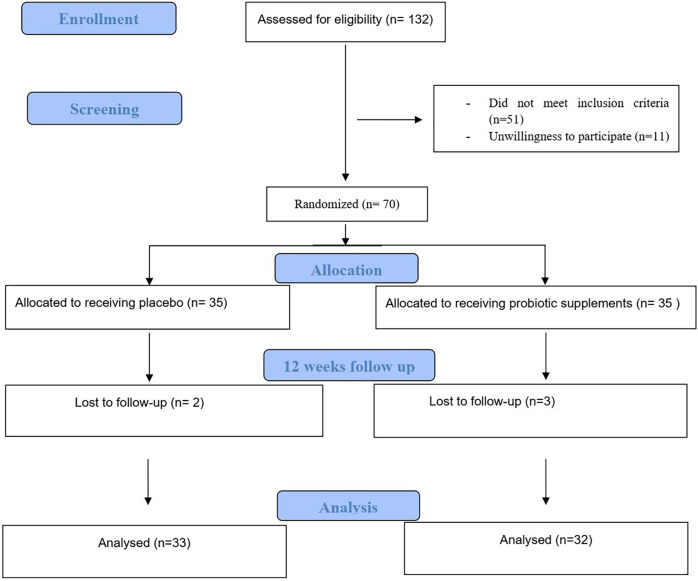
A 12-week double-blind clinical trial study was designed and seventy patients with MS were randomly divided into two groups receiving probiotics and placebo. Patients in the intervention group received two capsules containing multi-strain probiotics daily and patients in the control group received the same amount of placebo. Factors associated with systemic inflammation were assessed at the beginning and end of the study.
Sixty-five patients were included in the final analysis. There was no significant difference between the two groups in terms of baseline variables except for the duration of the disease ( > 0.05). At the end of the study, probiotic supplementation compared to the placebo caused a significant reduction in the serum levels of CRP (-0.93 ± 1.62 vs. 0.05 ± 1.74, = 0.03), TNF-α (-2.09 ± 1.88 vs. 0.48 ± 2.53, = 0.015) and IFN-γ (-13.18 ± 7.33 vs. -1.93 ± 5.99, < 0.001). Also, we found a significant increase in the FOXP3 and TGF-β levels in the intervention group ( < 0.05).
The results of our study showed that supplementation with probiotics can have beneficial effects on serum levels of some factors associated with systemic inflammation.
[http://www.irct.ir], identifier [IRCT20181210041 918N1].
多发性硬化症(MS)是一种复杂的炎症性疾病,中枢神经系统会发生脱髓鞘,全球约有250万人受其影响。肠道微生物群的变化在慢性病的病因中起着重要作用。
本研究旨在调查补充益生菌对MS患者全身炎症的影响。
设计了一项为期12周的双盲临床试验研究,70例MS患者被随机分为两组,分别接受益生菌和安慰剂。干预组患者每天服用两粒含多种菌株益生菌的胶囊,对照组患者服用等量安慰剂。在研究开始和结束时评估与全身炎症相关的因素。
65例患者纳入最终分析。除疾病持续时间外,两组基线变量无显著差异(>0.05)。研究结束时,与安慰剂相比,补充益生菌导致血清CRP水平显著降低(-0.93±1.62 vs. 0.05±1.74,P=0.03)、TNF-α水平显著降低(-2.09±1.88 vs. 0.48±2.53,P=0.015)和IFN-γ水平显著降低(-13.18±7.33 vs. -1.93±5.99,P<0.001)。此外,我们发现干预组中FOXP3和TGF-β水平显著升高(P<0.05)。
我们的研究结果表明,补充益生菌可对一些与全身炎症相关的血清因子水平产生有益影响。