Kim Su-Kyoung, Song Jaeho, Rajeev Meora, Kim Su Kyoung, Kang Ilnam, Jang In-Kwon, Cho Jang-Cheon
West Sea Mariculture Research Center, National Institute of Fisheries Science, Taean, South Korea.
Division of Microbiology, Honam National Institute of Biological Resources, Mokpo, South Korea.
Front Microbiol. 2022 Sep 20;13:995699. doi: 10.3389/fmicb.2022.995699. eCollection 2022.
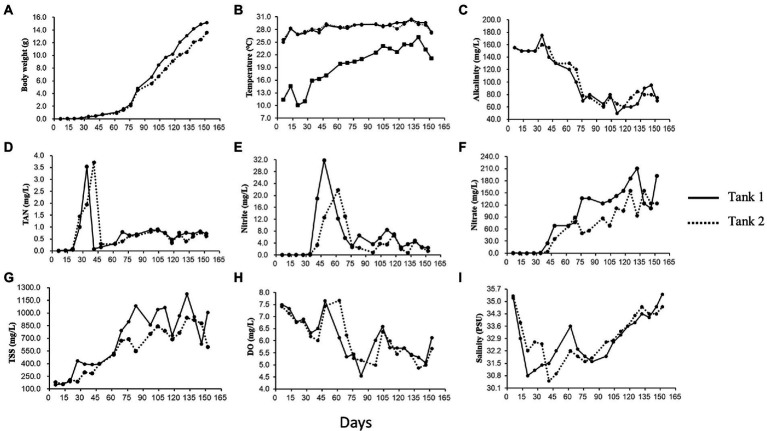
Biofloc technology (BFT) has recently gained considerable attention as a sustainable method in shrimp aquaculture. In a successful BFT system, microbial communities are considered a crucial component in their ability to both improve water quality and control microbial pathogens. Yet, bacterioplankton diversity in rearing water and how bacterioplankton community composition changes with shrimp growth are rarely documented. In this study, the Pacific white shrimp, was cultivated in a greenhouse-enclosed BFT system. Rearing water samples were collected on a weekly basis for 5 months (152 days) and water quality variables such as physicochemical parameters and inorganic nutrients were monitored. In parallel, 16S rRNA gene pyrosequencing was employed to investigate the temporal patterns of rearing-water microbiota. The productivity, survival rate, and feed conversion ratio were 3.2-4.4 kg/m, 74%-89%, and 1.2-1.3, respectively, representing successful super-intensive cultures. The metataxonomic results indicated a highly dynamic bacterioplankton community, with two major shifts over the culture. Members of the phylum dominated in rearing water during the early stages, while dominated during the middle stages, and and dominated during the late stages of culture. The bacterioplankton community fluctuated more in the beginning but stabilized as the culture progressed. Intriguingly, we observed that certain bacterioplankton groups dominated in a culture-stage-specific manner; these groups include , , and , which either contribute to water quality regulation or possess probiotic potential. Altogether, our results indicate that an operationally successful BFT-based aquaculture system favors the growth and dynamics of specific microbial communities in rearing water. Our study expands the scientific understanding of the practical utilization of microbes in sustainable aquaculture. A thorough understanding of rearing-water microbiota and factors influencing their dynamics will help to establish effective management strategies.
生物絮团技术(BFT)作为一种可持续的对虾养殖方法,最近受到了广泛关注。在一个成功的BFT系统中,微生物群落被认为是改善水质和控制微生物病原体能力的关键组成部分。然而,养殖水中浮游细菌的多样性以及浮游细菌群落组成如何随对虾生长而变化却鲜有记录。在本研究中,太平洋白对虾在温室封闭的BFT系统中养殖。每周采集养殖水样,持续5个月(152天),并监测水质变量,如理化参数和无机养分。同时,采用16S rRNA基因焦磷酸测序技术研究养殖水微生物群的时间模式。生产力、存活率和饲料转化率分别为3.2 - 4.4 kg/m、74% - 89%和1.2 - 1.3,代表了成功的超集约化养殖。宏分类学结果表明,浮游细菌群落具有高度动态性,在养殖过程中有两次主要转变。在养殖早期,养殖水中以 门的成员为主,中期以 为主,后期以 和 为主。浮游细菌群落在开始时波动较大,但随着养殖的进行而趋于稳定。有趣的是,我们观察到某些浮游细菌群以特定养殖阶段为主导;这些菌群包括 、 、 和 ,它们要么有助于水质调节,要么具有益生菌潜力。总之,我们的结果表明,一个在操作上成功的基于BFT的水产养殖系统有利于养殖水中特定微生物群落的生长和动态变化。我们的研究扩展了对可持续水产养殖中微生物实际利用的科学理解。深入了解养殖水微生物群及其动态变化的影响因素将有助于制定有效的管理策略。