• 文献检索
  • 文档翻译
  • 深度研究
  • 学术资讯
  • Suppr Zotero 插件Zotero 插件
  • 邀请有礼
  • 套餐&价格
  • 历史记录
应用&插件
Suppr Zotero 插件Zotero 插件浏览器插件Mac 客户端Windows 客户端微信小程序
定价
高级版会员购买积分包购买API积分包
服务
文献检索文档翻译深度研究API 文档MCP 服务
关于我们
关于 Suppr公司介绍联系我们用户协议隐私条款
关注我们

Suppr 超能文献

核心技术专利:CN118964589B侵权必究
粤ICP备2023148730 号-1Suppr @ 2026

文献检索

告别复杂PubMed语法,用中文像聊天一样搜索,搜遍4000万医学文献。AI智能推荐,让科研检索更轻松。

立即免费搜索

文件翻译

保留排版,准确专业,支持PDF/Word/PPT等文件格式,支持 12+语言互译。

免费翻译文档

深度研究

AI帮你快速写综述,25分钟生成高质量综述,智能提取关键信息,辅助科研写作。

立即免费体验

不同放养密度对虾养殖系统池塘水中细菌丰度和群落组成的影响

Bacterial Abundance and Community Composition in Pond Water From Shrimp Aquaculture Systems With Different Stocking Densities.

作者信息

Alfiansah Yustian Rovi, Hassenrück Christiane, Kunzmann Andreas, Taslihan Arief, Harder Jens, Gärdes Astrid

机构信息

Leibniz Centre for Tropical Marine Research (ZMT), Bremen, Germany.

Laboratory of Marine Microbiology, Research Center for Oceanography, Indonesian Institute of Sciences, Jakarta, Indonesia.

出版信息

Front Microbiol. 2018 Oct 18;9:2457. doi: 10.3389/fmicb.2018.02457. eCollection 2018.

DOI:10.3389/fmicb.2018.02457
PMID:30405548
原文链接:https://pmc.ncbi.nlm.nih.gov/articles/PMC6200860/
Abstract

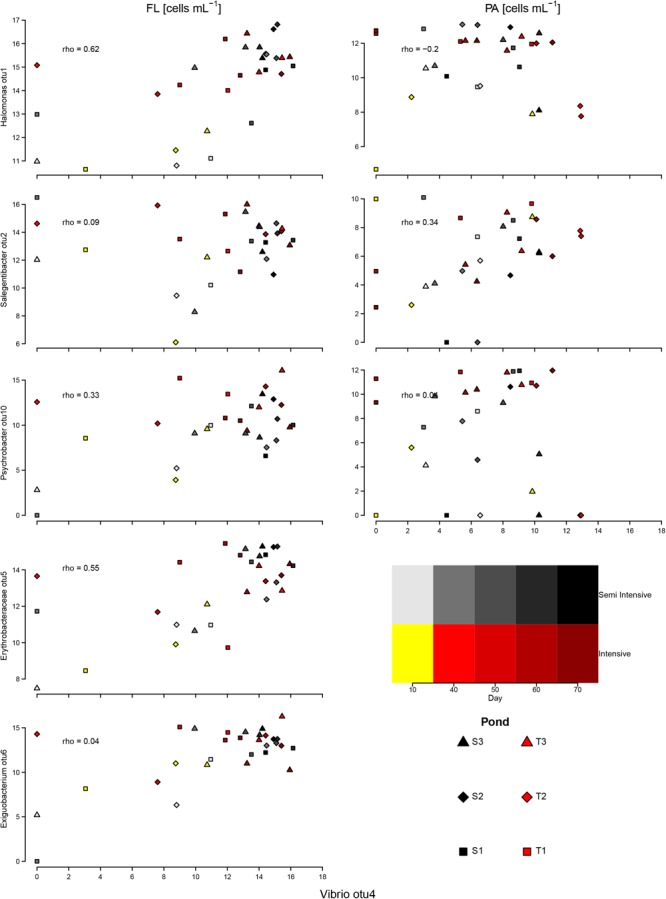
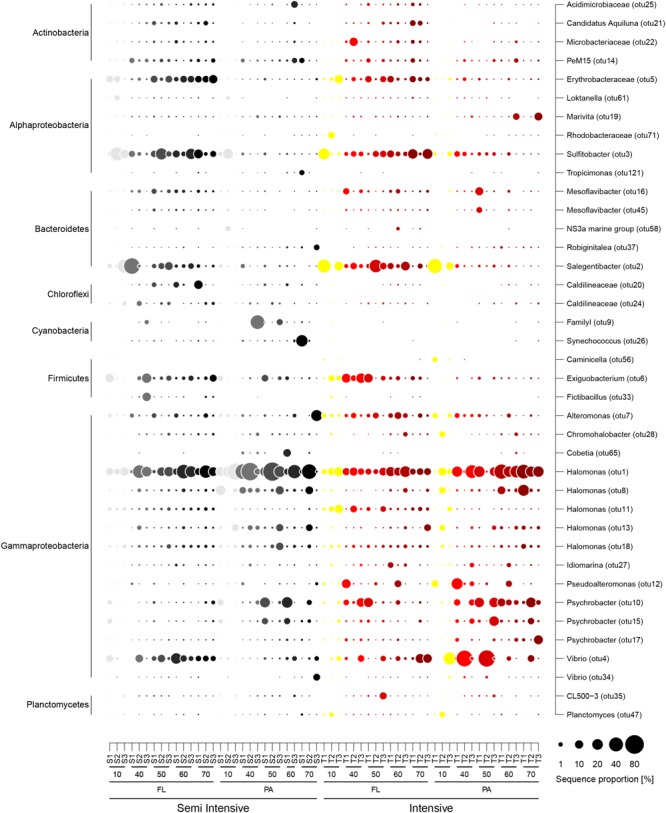
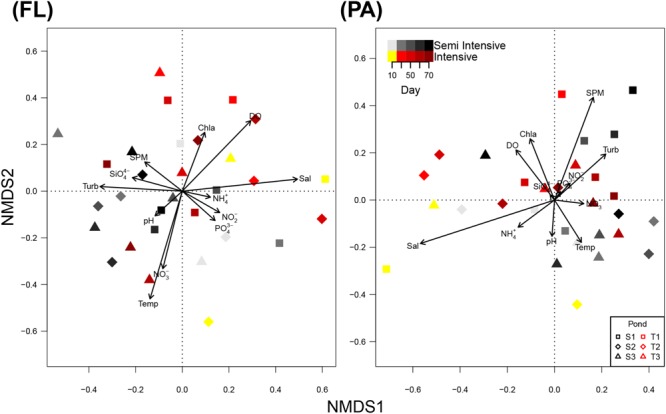
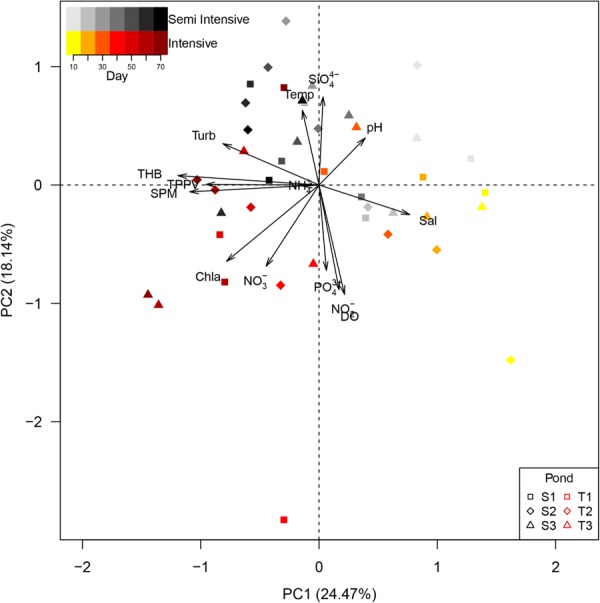
In shrimp aquaculture, farming systems are carefully managed to avoid rearing failure due to stress, disease, or mass mortality, and to achieve optimum shrimp production. However, little is known about how shrimp farming systems affect biogeochemical parameters and bacterial communities in rearing water, whether high stocking densities (intensive system) will increase the abundance of pathogenic bacteria. In this study, we characterized bacterial communities in shrimp ponds with different population densities. Water quality, such as physical parameters, inorganic nutrient concentrations, and cultivable heterotrophic bacterial abundances, including potential pathogenic , were determined in moderate density/semi-intensive (40 post-larvae m) and high density/intensive shrimp ponds (90 post-larvae m), over the shrimp cultivation time. Free-living and particle-attached bacterial communities were characterized by amplicon sequencing of the 16S rRNA gene. Suspended particulate matter (SPM), salinity, chlorophyll a, pH, and dissolved oxygen differed significantly between semi-intensive and intensive systems. These variations contrasted with the equal abundance of cultivable heterotrophic bacteria and inorganic nutrient concentrations. Bacterial communities were dominated by , and . and were the most dominant genera in the particle-attached fractions, while , and were found in the free-living fractions of both systems. Redundancy analysis indicated that among the observed environmental parameters, salinity was best suited to explain patterns in the composition of both free-living and particle-attached bacterial communities ( : 15.32 and 12.81%, respectively), although a large fraction remained unexplained. Based on 16S rRNA gene sequences, aggregated particles from intensive ponds loaded a higher proportion of than particles from semi-intensive ponds. In individual ponds, sequence proportions of and displayed an inverse relationship that coincided with changes in pH. Our observations suggest that high pH-values may suppress populations and eventually pathogenic . Our study showed that high-density shrimp ponds had a higher prevalence of , increased amounts of SPM, and higher phytoplankton abundances. To avoid rearing failure, these parameters have to be managed carefully, for example by providing adequate feed, maintaining pH level, and removing organic matter deposits regularly.

摘要

在对虾养殖中,养殖系统会得到精心管理,以避免因应激、疾病或大规模死亡导致养殖失败,并实现对虾的最佳产量。然而,对于对虾养殖系统如何影响养殖水体中的生物地球化学参数和细菌群落,以及高放养密度(集约化系统)是否会增加病原菌的丰度,人们了解甚少。在本研究中,我们对不同种群密度的对虾池塘中的细菌群落进行了特征描述。在对虾养殖期间,测定了中等密度/半集约化(40尾仔虾/立方米)和高密度/集约化对虾池塘(90尾仔虾/立方米)中的水质,如物理参数、无机养分浓度以及可培养的异养细菌丰度,包括潜在病原菌的丰度。通过对16S rRNA基因进行扩增子测序,对自由生活和附着于颗粒上的细菌群落进行了特征描述。半集约化和集约化系统之间的悬浮颗粒物(SPM)、盐度、叶绿素a、pH值和溶解氧存在显著差异。这些变化与可培养异养细菌的丰度和无机养分浓度的相等情况形成对比。细菌群落主要由[具体菌属1]、[具体菌属2]和[具体菌属3]主导。[具体菌属4]和[具体菌属5]是附着于颗粒部分中最主要的菌属,而[具体菌属6]、[具体菌属7]和[具体菌属8]则在两个系统的自由生活部分中被发现。冗余分析表明,在所观察到的环境参数中,盐度最适合解释自由生活和附着于颗粒上的细菌群落组成模式(分别为:15.32%和12.81%),尽管仍有很大一部分无法解释。基于16S rRNA基因序列,集约化池塘中的聚集颗粒比半集约化池塘中的颗粒负载了更高比例的[某种菌]。在各个池塘中,[具体菌属9]和[具体菌属10]的序列比例呈现出与pH值变化一致的反比关系。我们的观察结果表明,高pH值可能会抑制[某种菌]种群,最终抑制病原菌[具体菌名]。我们的研究表明,高密度对虾池塘中[某种菌]的患病率更高,SPM含量增加,浮游植物丰度也更高。为避免养殖失败,必须谨慎管理这些参数,例如提供充足的饲料、维持pH水平以及定期清除有机物质沉积物。
https://cdn.ncbi.nlm.nih.gov/pmc/blobs/de3e/6200860/55a8bfa11eba/fmicb-09-02457-g004.jpg
https://cdn.ncbi.nlm.nih.gov/pmc/blobs/de3e/6200860/b12ae4b886e5/fmicb-09-02457-g001.jpg
https://cdn.ncbi.nlm.nih.gov/pmc/blobs/de3e/6200860/317e0882f39c/fmicb-09-02457-g002.jpg
https://cdn.ncbi.nlm.nih.gov/pmc/blobs/de3e/6200860/ecbfd3395013/fmicb-09-02457-g003.jpg
https://cdn.ncbi.nlm.nih.gov/pmc/blobs/de3e/6200860/55a8bfa11eba/fmicb-09-02457-g004.jpg
https://cdn.ncbi.nlm.nih.gov/pmc/blobs/de3e/6200860/b12ae4b886e5/fmicb-09-02457-g001.jpg
https://cdn.ncbi.nlm.nih.gov/pmc/blobs/de3e/6200860/317e0882f39c/fmicb-09-02457-g002.jpg
https://cdn.ncbi.nlm.nih.gov/pmc/blobs/de3e/6200860/ecbfd3395013/fmicb-09-02457-g003.jpg
https://cdn.ncbi.nlm.nih.gov/pmc/blobs/de3e/6200860/55a8bfa11eba/fmicb-09-02457-g004.jpg

相似文献

1
Bacterial Abundance and Community Composition in Pond Water From Shrimp Aquaculture Systems With Different Stocking Densities.不同放养密度对虾养殖系统池塘水中细菌丰度和群落组成的影响
Front Microbiol. 2018 Oct 18;9:2457. doi: 10.3389/fmicb.2018.02457. eCollection 2018.
2
Integrating short- and full-length 16S rRNA gene sequencing to elucidate microbiome profiles in Pacific white shrimp () ponds.整合短序列和全长 16S rRNA 基因测序以阐明太平洋白对虾()池塘中的微生物组图谱。
Microbiol Spectr. 2024 Nov 5;12(11):e0096524. doi: 10.1128/spectrum.00965-24. Epub 2024 Sep 27.
3
Addition of Molasses Ameliorates Water and Bio-Floc Quality in Shrimp Pond Water.添加糖蜜可改善对虾塘水质和生物絮团质量。
Trop Life Sci Res. 2022 Mar;33(1):121-141. doi: 10.21315/tlsr2022.33.1.8. Epub 2022 Mar 31.
4
Influence of stocking density on the growth, immune and physiological responses, and cultivation environment of white-leg shrimp (Litopenaeus vannamei) in biofloc systems.养殖密度对生物絮团系统中凡纳滨对虾(Litopenaeus vannamei)生长、免疫和生理反应及养殖环境的影响。
Sci Rep. 2024 May 15;14(1):11147. doi: 10.1038/s41598-024-61328-4.
5
Assessment of Performance, Microbial Community, Bacterial Food Quality, and Gene Expression of Whiteleg Shrimp () Reared under Different Density Biofloc Systems.不同密度生物絮团系统养殖凡纳滨对虾(Litopenaeus vannamei)的生长性能、微生物群落、细菌食物质量及基因表达评估
Aquac Nutr. 2022 Sep 21;2022:3499061. doi: 10.1155/2022/3499061. eCollection 2022.
6
Diversity, community structure, and abundance of nirS-type denitrifying bacteria on suspended particulate matter in coastal high-altitude aquaculture pond water.沿海高海拔水产养殖池塘水中悬浮颗粒物上nirS 型反硝化细菌的多样性、群落结构和丰度。
Sci Rep. 2024 Mar 7;14(1):5594. doi: 10.1038/s41598-024-56196-x.
7
Effect of orally administered vibrio bacterin on immunity, survival and growth in tiger shrimp (Penaeus monodon) grow-out culture ponds.口服弧菌菌苗对斑节对虾养成池免疫力、存活率及生长的影响
Lett Appl Microbiol. 2017 Dec;65(6):475-481. doi: 10.1111/lam.12802. Epub 2017 Nov 7.
8
Microbiota assemblages of water, sediment, and intestine and their associations with environmental factors and shrimp physiological health.水体、沉积物和虾肠道微生物群落及其与环境因子和虾生理健康的关系。
Appl Microbiol Biotechnol. 2018 Oct;102(19):8585-8598. doi: 10.1007/s00253-018-9229-5. Epub 2018 Jul 23.
9
Effects of stocking density of the white shrimp Litopenaeus vannamei (Boone) on immunities, antioxidant status, and resistance against Vibrio harveyi in a biofloc system.凡纳滨对虾(Litopenaeus vannamei,Boone)养殖密度对生物絮团系统中免疫、抗氧化状态及对哈维氏弧菌抗性的影响
Fish Shellfish Immunol. 2017 Aug;67:19-26. doi: 10.1016/j.fsi.2017.05.038. Epub 2017 May 15.
10
Abundance and removal of antibiotic resistance genes (ARGs) in the rearing environments of intensive shrimp aquaculture in South China.中国南方集约化对虾养殖环境中抗生素抗性基因(ARGs)的丰度与去除
J Environ Sci Health B. 2019;54(3):211-218. doi: 10.1080/03601234.2018.1550310. Epub 2019 Feb 12.

引用本文的文献

1
A study of bacterial community structure of shrimp farms along the Ratnagiri coast, Maharashtra.马哈拉施特拉邦拉特纳吉里海岸虾养殖场细菌群落结构研究。
Heliyon. 2025 Jan 5;11(1):e41712. doi: 10.1016/j.heliyon.2025.e41712. eCollection 2025 Jan 15.
2
Impact of tidal fluctuations on bacterial community structure in Wuyuan Bay: A comparative analysis of waters inside and outside the tidal barrage.潮流波动对五里湖细菌群落结构的影响:潮汐坝内外水域的对比分析。
PLoS One. 2024 Oct 25;19(10):e0312283. doi: 10.1371/journal.pone.0312283. eCollection 2024.
3
Effects of Fishery Utilization on the Physicochemical Index and Microbial Community Composition in Saline-Alkaline Water.

本文引用的文献

1
Environmental Factors Shape Water Microbial Community Structure and Function in Shrimp Cultural Enclosure Ecosystems.环境因素塑造对虾养殖围隔生态系统中的水体微生物群落结构与功能。
Front Microbiol. 2017 Nov 29;8:2359. doi: 10.3389/fmicb.2017.02359. eCollection 2017.
2
Isolation and Characterization of Bacteria That Degrade Phosphonates in Marine Dissolved Organic Matter.海洋溶解有机物中降解膦酸盐细菌的分离与鉴定
Front Microbiol. 2017 Sep 26;8:1786. doi: 10.3389/fmicb.2017.01786. eCollection 2017.
3
Estimating Population Turnover Rates by Relative Quantification Methods Reveals Microbial Dynamics in Marine Sediment.
渔业利用对盐碱水理化指标和微生物群落组成的影响
ACS Omega. 2024 Apr 19;9(17):18872-18881. doi: 10.1021/acsomega.3c08437. eCollection 2024 Apr 30.
4
Bacteria of Zoonotic Interest Identified on Edible Freshwater Fish Imported to Australia.在进口到澳大利亚的可食用淡水鱼上发现的具有人畜共患病意义的细菌。
Foods. 2023 Mar 17;12(6):1288. doi: 10.3390/foods12061288.
5
Exploring bacterioplankton communities and their temporal dynamics in the rearing water of a biofloc-based shrimp () aquaculture system.探索基于生物絮团的对虾养殖系统养殖水体中的浮游细菌群落及其时间动态。
Front Microbiol. 2022 Sep 20;13:995699. doi: 10.3389/fmicb.2022.995699. eCollection 2022.
6
Functional and Seasonal Changes in the Structure of Microbiome Inhabiting Bottom Sediments of a Pond Intended for Ecological King Carp Farming.用于生态鲤鱼养殖的池塘底部沉积物中微生物群落结构的功能和季节性变化。
Biology (Basel). 2022 Jun 14;11(6):913. doi: 10.3390/biology11060913.
7
Bacterial community structure and bacterial isolates having antimicrobial potential in shrimp pond aquaculture.对虾池塘养殖中具有抗菌潜力的细菌群落结构及细菌分离株
AMB Express. 2022 Jun 23;12(1):82. doi: 10.1186/s13568-022-01423-9.
8
Addition of Molasses Ameliorates Water and Bio-Floc Quality in Shrimp Pond Water.添加糖蜜可改善对虾塘水质和生物絮团质量。
Trop Life Sci Res. 2022 Mar;33(1):121-141. doi: 10.21315/tlsr2022.33.1.8. Epub 2022 Mar 31.
9
Sustainability of the rice-crayfish co-culture aquaculture model: microbiome profiles based on multi-kingdom analyses.稻虾共作养殖模式的可持续性:基于多界分析的微生物群落概况
Environ Microbiome. 2022 May 22;17(1):27. doi: 10.1186/s40793-022-00422-4.
10
Development of top-dressing automation technology for sustainable shrimp aquaculture in India.印度可持续对虾养殖追肥自动化技术的发展
Discov Sustain. 2021;2(1):26. doi: 10.1007/s43621-021-00036-9. Epub 2021 May 24.
通过相对定量方法估算种群周转率揭示了海洋沉积物中的微生物动态。
Appl Environ Microbiol. 2017 Dec 15;84(1). doi: 10.1128/AEM.01443-17. Print 2018 Jan 1.
4
Indigenous Halomonas spp., the Potential Nitrifying Bacteria for Saline Ammonium Waste Water Treatment.本土嗜盐单胞菌属,用于含盐铵废水处理的潜在硝化细菌。
Pak J Biol Sci. 2017;20(1):52-58. doi: 10.3923/pjbs.2017.52.58.
5
Differences in free-living and particle-associated bacterial communities and their spatial variation in Kongsfjorden, Arctic.在北极的孔斯峡湾,自由生活和颗粒相关的细菌群落及其空间变化的差异。
J Basic Microbiol. 2017 Oct;57(10):827-838. doi: 10.1002/jobm.201700216. Epub 2017 Jul 28.
6
Distinct Network Interactions in Particle-Associated and Free-Living Bacterial Communities during a Bloom in a Plateau Lake.高原湖泊水华期间颗粒相关细菌群落和自由生活细菌群落中不同的网络相互作用
Front Microbiol. 2017 Jun 30;8:1202. doi: 10.3389/fmicb.2017.01202. eCollection 2017.
7
Isolation of Bdellovibrio and like organisms and potential to reduce acute hepatopancreatic necrosis disease caused by Vibrio parahaemolyticus.蛭弧菌类生物的分离及其降低副溶血性弧菌引起的急性肝胰腺坏死病的潜力。
Dis Aquat Organ. 2017 May 11;124(3):223-232. doi: 10.3354/dao03120.
8
Shrimp AHPND-causing plasmids encoding the PirAB toxins as mediated by pirAB-Tn903 are prevalent in various Vibrio species.携带 pirAB-Tn903 介导的 PirAB 毒素的导致虾类急性肝胰腺坏死病的质粒在各种弧菌属中普遍存在。
Sci Rep. 2017 Feb 7;7:42177. doi: 10.1038/srep42177.
9
Bacterial abundance and diversity in pond water supplied with different feeds.池塘水中不同饲料供应的细菌丰度和多样性。
Sci Rep. 2016 Oct 19;6:35232. doi: 10.1038/srep35232.
10
Advances, challenges, and directions in shrimp disease control: the guidelines from an ecological perspective.对虾疾病控制的进展、挑战与方向:生态学视角的指南
Appl Microbiol Biotechnol. 2016 Aug;100(16):6947-54. doi: 10.1007/s00253-016-7679-1. Epub 2016 Jun 23.