Luchetti Francesca, Carloni Silvia, Nasoni Maria G, Reiter Russel J, Balduini Walter
Department of Biomolecular Sciences, University of Urbino Carlo Bo, Urbino, Italy.
Department of Cell Systems and Anatomy, Long School of Medicine, UT Health, San Antonio, TX, USA.
Neural Regen Res. 2023 Apr;18(4):760-762. doi: 10.4103/1673-5374.353480.
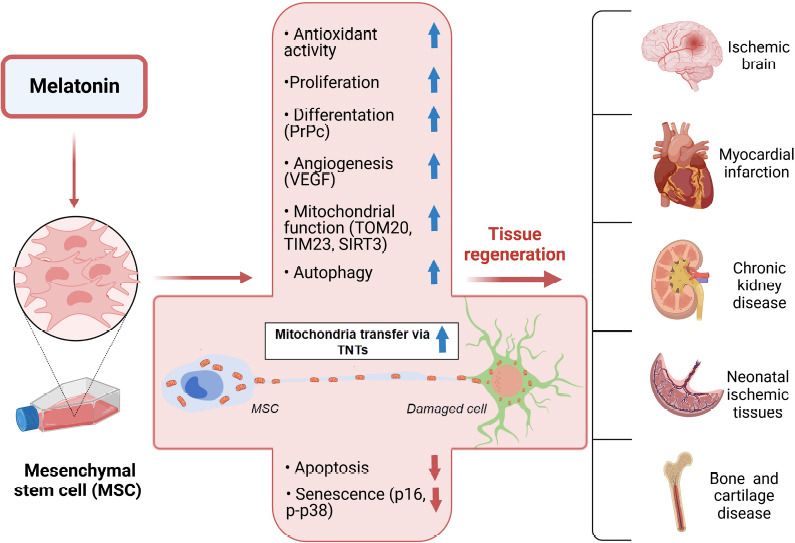
Mesenchymal stem cells are multipotent stem cells that reside in many human tissues and organs. Mesenchymal stem cells are widely used in experimental and clinical regenerative medicine due to their capability to transdifferentiate into various lineages. However, when transplanted, they lose part of their multipotency and immunomodulatory properties, and most of them die after injection into the damaged tissue. In this review, we discuss the potential utility of melatonin in preserving mesenchymal stem cells' survival and function after transplantation. Melatonin is a pleiotropic molecule regulating critical cell functions including apoptosis, endoplasmic reticulum stress, and autophagy. Melatonin is also synthesized in the mitochondria where it reduces oxidative stress, the opening of the mitochondrial permeability transition pore and the downstream caspase activation, activates uncoupling proteins, and curtails the proinflammatory response. In addition, recent findings showed that melatonin also promotes the formation of tunneling nanotubes and the transfer of mitochondria between cells through the connecting tubules. As mitochondrial dysfunction is a primary cause of mesenchymal stem cells death and senescence and a critical issue for survival after transplantation, we propose that melatonin by favoring mitochondria functionality and their transfer through tunneling nanotubes from healthy to suffering cells could improve mesenchymal stem cell-based therapy in a large number of diseases for which basic and clinical trials are underway.
间充质干细胞是存在于许多人体组织和器官中的多能干细胞。由于间充质干细胞能够转分化为各种谱系细胞,因此在实验性和临床再生医学中得到广泛应用。然而,在移植时,它们会丧失部分多能性和免疫调节特性,并且大多数在注射到受损组织后死亡。在本综述中,我们探讨了褪黑素在移植后维持间充质干细胞存活和功能方面的潜在效用。褪黑素是一种多效性分子,可调节包括细胞凋亡、内质网应激和自噬在内的关键细胞功能。褪黑素也在线粒体中合成,在那里它可降低氧化应激、线粒体通透性转换孔的开放及下游半胱天冬酶激活,激活解偶联蛋白,并抑制促炎反应。此外,最近的研究结果表明,褪黑素还可促进隧道纳米管的形成以及线粒体通过连接小管在细胞间的转移。由于线粒体功能障碍是间充质干细胞死亡和衰老的主要原因,也是移植后存活的关键问题,我们提出,褪黑素通过促进线粒体功能以及它们通过隧道纳米管从健康细胞向受损细胞的转移,可改善大量正在进行基础和临床试验的疾病的间充质干细胞治疗。