Adeyemo Rasheed Omotayo, Famuyide Ibukun Michael, Dzoyem Jean Paul, Lyndy Joy McGaw
Phytomedicine Programme, Department of Paraclinical Sciences, Faculty of Veterinary Science, University of Pretoria, Private Bag X04, Onderstepoort, Pretoria 0110, South Africa.
Department of Microbiology/Immunology, Faculty of Basic Medical Science, Kampala International University, Kampala, Uganda.
Evid Based Complement Alternat Med. 2022 Sep 28;2022:1307801. doi: 10.1155/2022/1307801. eCollection 2022.
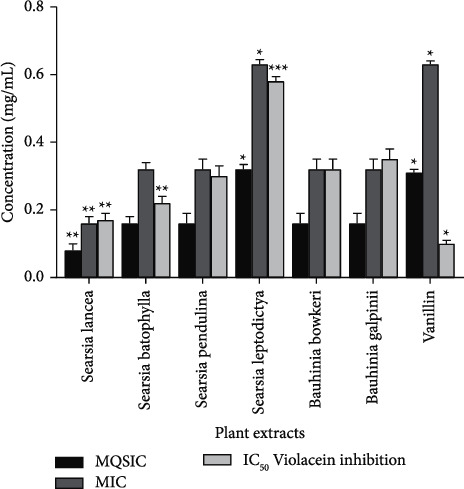
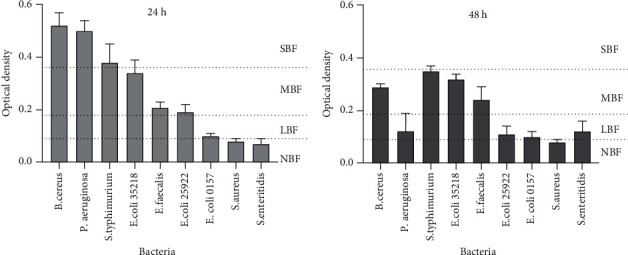
The development of resistance of microorganisms to conventional antibiotics is a major global health concern; hence, there is an increasing interest in medicinal plants as a therapeutic option. This study aimed to evaluate the antibacterial, anti-biofilm, and anti-quorum activities of crude extracts prepared using various solvents of nine indigenous South African plants used locally for the treatment of diarrhoea. The minimum inhibitory concentration (MIC) was determined using the broth microdilution method and the crystal violet assay was used to test the anti-biofilm activity of the extracts against a panel of bacteria. Anti-quorum sensing activity of the extracts was assessed via inhibition of violacein production in ATCC 12472. Preliminary screening of extracts against ATCC 25922 revealed that the acetone extracts had significant activity, with MIC values ranging from 0.04 to 0.63 mg/mL. Further screening against a panel of bacterial pathogens showed that the acetone extract of was the most active with MIC of 0.01 mg/mL against , followed by with MIC of 0.03 mg/mL against . All the plant extracts prevented the attachment of biofilms by more than 50% against at least one of the tested bacteria. However, only the mature biofilm of . was susceptible to the extracts, with 98.22% eradication by extract. The minimum quorum sensing inhibitory concentration of the extracts ranged from 0.08 to 0.32 mg/mL with . having the most significant activity. The extract of . had the best violacein production inhibitory activity with IC value of 0.17 mg/mL. Overall, the results obtained indicate that acetone extracts of . , . , . , . , . , and . possess antibacterial and anti-biofilm activities and can modulate quorum sensing through the inhibition of violacein production. Therefore, these results signify the potential of the selected plant extracts in treating diarrhoea through inhibition of bacterial growth, biofilm formation inhibition, and quorum sensing antagonism, supporting their medicinal use.
微生物对传统抗生素产生耐药性是一个重大的全球健康问题;因此,作为一种治疗选择,药用植物越来越受到关注。本研究旨在评估用九种南非本土用于治疗腹泻的植物的各种溶剂制备的粗提物的抗菌、抗生物膜和抗群体感应活性。采用肉汤微量稀释法测定最低抑菌浓度(MIC),并使用结晶紫测定法测试提取物对一组细菌的抗生物膜活性。通过抑制ATCC 12472中紫色杆菌素的产生来评估提取物的抗群体感应活性。对ATCC 25922的提取物进行初步筛选发现,丙酮提取物具有显著活性,MIC值范围为0.04至0.63mg/mL。对一组细菌病原体的进一步筛选表明,[植物名称1]的丙酮提取物活性最高,对[细菌名称1]的MIC为0.01mg/mL,其次是[植物名称2],对[细菌名称2]的MIC为0.03mg/mL。所有植物提取物对至少一种受试细菌的生物膜附着抑制率均超过50%。然而,只有[植物名称3]的成熟生物膜对提取物敏感,[提取物名称]提取物的根除率为98.22%。提取物的最低群体感应抑制浓度范围为0.08至0.32mg/mL,其中[植物名称4]的活性最显著。[植物名称5]的提取物具有最佳的紫色杆菌素产生抑制活性,IC值为0.17mg/mL。总体而言,所得结果表明,[植物名称1]、[植物名称2]、[植物名称3]、[植物名称4]、[植物名称5]和[植物名称6]的丙酮提取物具有抗菌和抗生物膜活性,并可通过抑制紫色杆菌素的产生来调节群体感应。因此,这些结果表明所选植物提取物通过抑制细菌生长、抑制生物膜形成和群体感应拮抗作用来治疗腹泻的潜力,支持它们的药用价值。