Gudmundsson G Haukur, Mészáros Judit, Björnsdóttir Ágústa E, Ámundadóttir María L, Thorvardardottir Gudrun E, Magnusdottir Erna, Helgadottir Halla, Oddsson Saemundur
Medical and Research Department, Sidekick Health, Kopavogur, Iceland.
Medical and Research Department, Sidekick Health, Berlin, Germany.
JMIR Form Res. 2022 Oct 13;6(10):e39764. doi: 10.2196/39764.
Increasing evidence shows that lifestyle interventions can improve the symptoms, quality of life (QoL), and even overall survival of patients with cancer. Digital therapeutics (DTx) can help implement behavioral modifications and empower patients through education, lifestyle support, and remote symptom monitoring.
We aimed to test the feasibility of a DTx program for patients with cancer, as measured by engagement, retention, and acceptability. In addition, we explored the effects of the program on cancer-related QoL.
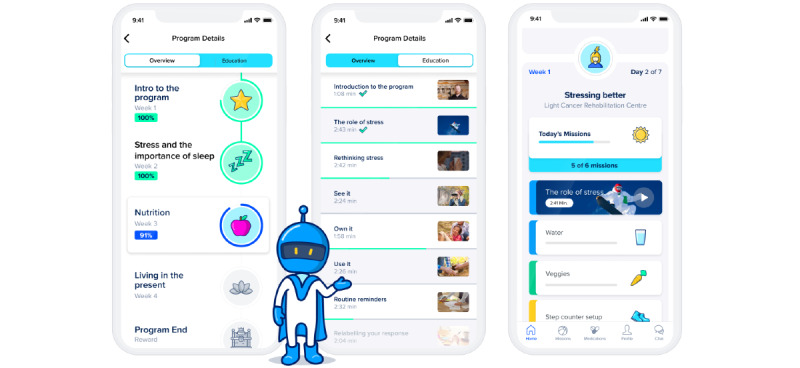
We conducted a 4-week single-arm trial in Iceland, where DTx was delivered through a smartphone app. The intervention consisted of patient education about mindfulness, sleep, stress, and nutrition; lifestyle coaching; and the completion of daily missions for tracking physical activity and exercise, reporting patient-reported outcomes (PROs), practicing mindfulness, and logging healthy food intake. Information on program engagement and retention, step goal attainment, as well as PROs were collected throughout the study. QoL was measured using the European Organization for Research and Treatment of Cancer Quality of Life Questionnaire C30 at baseline and follow-up.
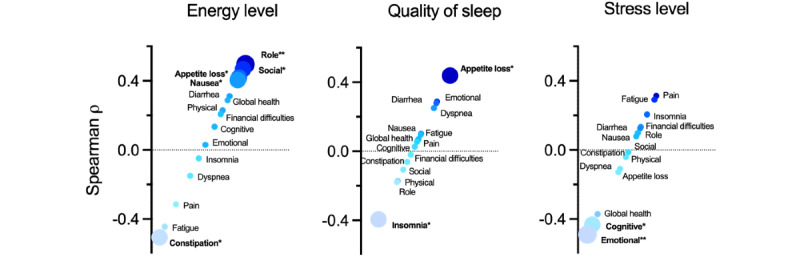
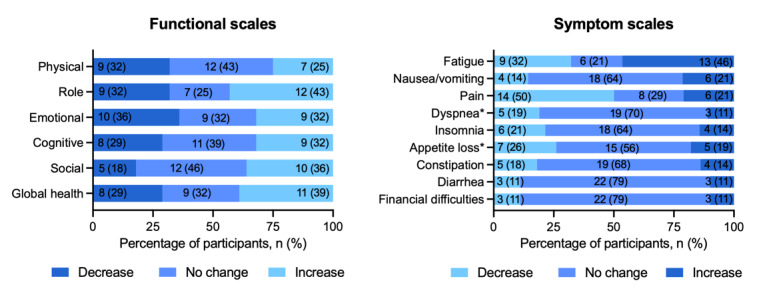
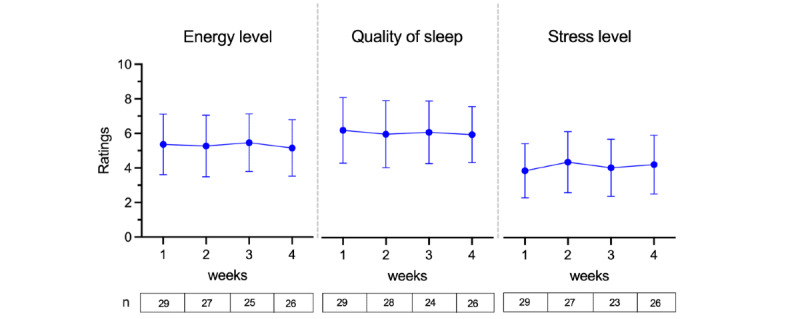
In total, 30 patients with cancer undergoing active therapy were enrolled, and 29 registered in the app (23 female, 18 with breast cancer; mean age 52.6, SD 11.5 years). Overall, 97% (28/29) of participants were active in 3 of the 4 weeks and completed the pre- and postprogram questionnaires. The weekly active days (median) were 6.8 (IQR 5.8-6.8), and 72% (21/29) of participants were active at least 5 days a week. Users interacted with the app on average 7.7 (SD 1.9) times per day. On week 1, all 29 participants used the step counter and logged an average of 20,306 steps; 21 (72%) participants reached their step goals of at least 3000 steps per day. On week 4, of the 28 active users, 27 (96%) were still logging their steps, with 19 (68%) reaching their step goals. Of the 28 participants who completed the satisfaction questionnaire, 25 (89%) were likely to recommend the program, 23 (82%) said the program helped them deal with the disease, and 24 (86%) said it helped them remember their medication. QoL assessment showed that the average global health status, functioning, and symptom burden remained stable from baseline to follow-up. In all, 50% (14/28) of participants reported less pain, and the average pain score decreased from 31 (SD 20.1) to 22.6 (SD 23.2; P=.16). There was no significant change in PROs on the quality of sleep, energy, and stress levels from the first to the last week.
The high retention, engagement, and acceptability found in this study demonstrate that multidisciplinary DTx is feasible for patients with cancer. A longer, full-scale randomized controlled trial is currently being planned to evaluate the efficacy of the intervention.
越来越多的证据表明,生活方式干预可以改善癌症患者的症状、生活质量(QoL),甚至提高其总生存率。数字疗法(DTx)可以通过教育、生活方式支持和远程症状监测来帮助实施行为改变并增强患者能力。
我们旨在通过参与度、留存率和可接受性来测试针对癌症患者的DTx计划的可行性。此外,我们还探讨了该计划对癌症相关生活质量的影响。
我们在冰岛进行了一项为期4周的单臂试验,通过一款智能手机应用程序提供DTx。干预措施包括对患者进行正念、睡眠、压力和营养方面的教育;生活方式指导;以及完成每日任务,以跟踪身体活动和锻炼情况、报告患者报告结局(PROs)、进行正念练习以及记录健康食品摄入量。在整个研究过程中收集了有关计划参与度和留存率、步数目标达成情况以及PROs的信息。在基线和随访时使用欧洲癌症研究与治疗组织生活质量问卷C30来测量生活质量。
总共招募了30名正在接受积极治疗的癌症患者,其中29人在应用程序中注册(23名女性,18名乳腺癌患者;平均年龄52.6岁,标准差11.5岁)。总体而言,97%(28/29)的参与者在4周中的3周内保持活跃,并完成了计划前后的问卷调查。每周的活跃天数(中位数)为6.8(四分位距5.8 - 6.8),72%(21/29)的参与者每周至少活跃5天。用户平均每天与应用程序交互7.7(标准差1.9)次。在第1周,所有29名参与者都使用了步数计数器,平均记录了20306步;21名(72%)参与者达到了他们每天至少3000步 的步数目标。在第4周,28名活跃用户中,27名(96%)仍在记录步数,19名(68%)达到了步数目标。在完成满意度问卷的28名参与者中,25名(89%)可能会推荐该计划,23名(82%)表示该计划帮助他们应对疾病,24名(86%)表示该计划帮助他们记住服药。生活质量评估显示,从基线到随访,平均总体健康状况、功能和症状负担保持稳定。总共有50%(14/28)的参与者报告疼痛减轻,平均疼痛评分从31(标准差20.1)降至22.6(标准差23.2;P = 0.16)。从第一周到最后一周,睡眠质量、能量和压力水平方面的PROs没有显著变化。
本研究中发现的高留存率、参与度和可接受性表明,多学科数字疗法对癌症患者是可行的。目前正在计划进行一项更长时间的、全面的随机对照试验,以评估该干预措施的疗效。