Primi Caterina, Sanson Francesco, Vecchiato Marta, Serra Emilia, Donati Maria Anna
NEUROFARBA Department, University of Florence, Florence, Italy.
Addictions Department, Azienda ULSS n. 4 Veneto Orientale, Venice, Italy.
Front Psychol. 2022 Sep 27;13:1009129. doi: 10.3389/fpsyg.2022.1009129. eCollection 2022.
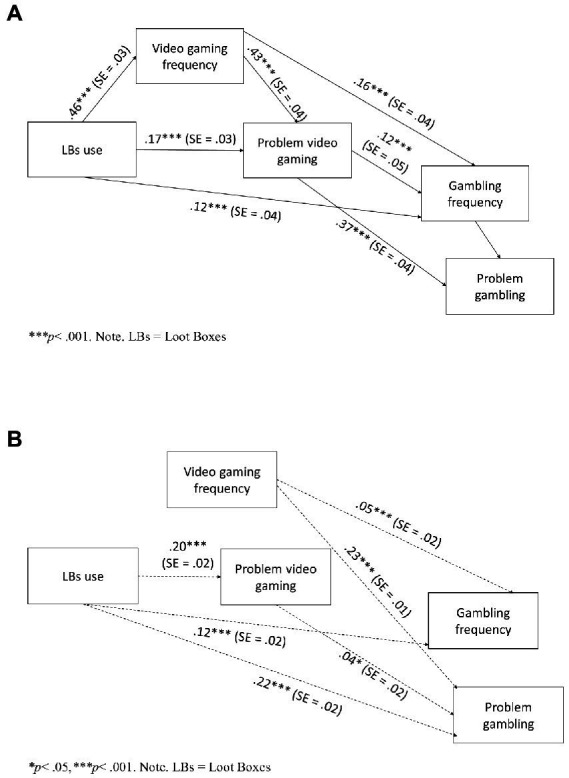
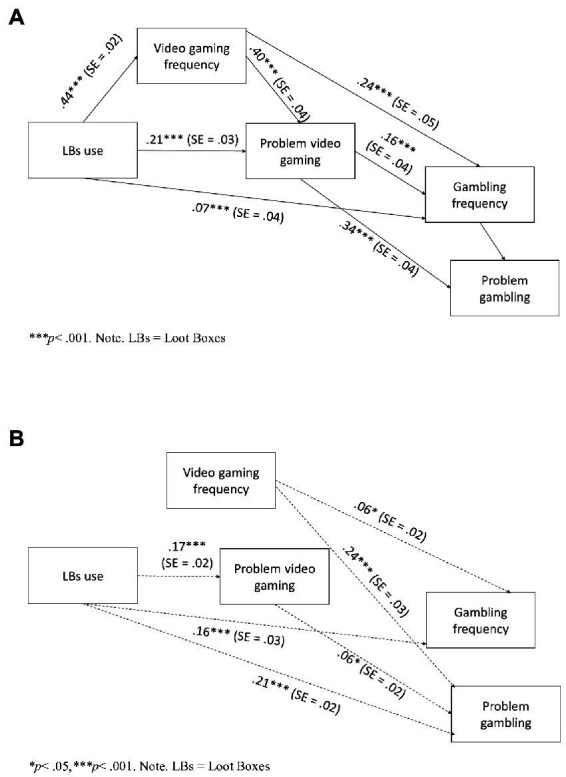
Loot Boxes (LBs), i.e., virtual items embedded within video games with numerous features reminiscent of gambling, are increasingly widespread among adolescents. LB use is associated with problem gambling in youth, but few studies have been conducted on the association between LB use and gambling behavior considering adolescents. Thus, the mechanisms underlying this relationship are not clear. As LB use is a significant and positive risk factor for video gaming severity, and video gaming is associated with problem gambling, we hypothesized that LB use would be related to gambling frequency and problem gambling through the intermediary role of video gaming frequency and problem video gaming. We tested our hypothesis before COVID-19-pandemic-related lockdown and during COVID-19-pandemic-related lockdown, in Italy. Study 1 was conducted with 1,078 high school students (39% boys, mean age = 16.46, = 1.28) before COVID-19-pandemic-related lockdown, and Study 2 was conducted with 1,204 high school students (57% boys, mean age = 15.62, = 0.64) during COVID-19-pandemic-related lockdown. A path analysis was carried out to analyze the significance of indirect effects from LB use to gambling behavior and problem gambling through video gaming and problem video gaming. In both the studies, results showed that LB use exerted significant and positive direct effects on video gaming frequency, problem video gaming, and gambling frequency. Moreover, LB use had indirect significant and positive effects on problem gambling through video gaming frequency, problem video gaming, and gambling frequency. Findings attest that LB use can be related to problem gambling through a greater involvement in videogames. Thus, a specific subtype of young gamblers can develop Gambling Disorder symptoms from the use of LBs and through an intense use of video games. Practical implications for prevention and treatment are discussed.
开箱(Loot Boxes,简称LB),即在电子游戏中嵌入的虚拟物品,具有许多类似赌博的特征,在青少年中越来越普遍。使用开箱与青少年的问题赌博有关,但考虑到青少年群体,关于开箱使用与赌博行为之间关联的研究较少。因此,这种关系背后的机制尚不清楚。由于开箱使用是电子游戏严重程度的一个重要且积极的风险因素,而电子游戏又与问题赌博相关,我们假设开箱使用会通过电子游戏频率和问题电子游戏的中介作用与赌博频率和问题赌博相关。我们在意大利新冠疫情相关封锁之前和期间对我们的假设进行了测试。研究1是在新冠疫情相关封锁之前对1078名高中生(39%为男生,平均年龄 = 16.46,标准差 = 1.28)进行的,研究2是在新冠疫情相关封锁期间对1204名高中生(57%为男生,平均年龄 = 15.62,标准差 = 0.64)进行的。进行了路径分析,以分析从开箱使用通过电子游戏和问题电子游戏到赌博行为和问题赌博的间接效应的显著性。在两项研究中,结果都表明开箱使用对电子游戏频率、问题电子游戏和赌博频率产生了显著且积极的直接影响。此外,开箱使用通过电子游戏频率、问题电子游戏和赌博频率对问题赌博产生了间接的显著且积极的影响。研究结果证明,开箱使用可能通过更多地参与电子游戏而与问题赌博相关。因此,一类特定的年轻赌徒可能会因使用开箱以及大量玩电子游戏而出现赌博障碍症状。文中讨论了预防和治疗的实际意义。