Nanchang Branch of National Center of Oil crops Improvement, Jiangxi Province Key Laboratory of Oil crops Biology, Crops Research Institute of Jiangxi Academy of Agricultural Sciences, Nanchang, China.
The National Key Facility for Crop Gene Resources and Genetic Improvement (NFCRI) and MOA KeyLab of Soybean Biology (Beijing), Institute of Crop Science, Chinese Academy of Agricultural Sciences, Beijing, China.
Theor Appl Genet. 2022 Nov;135(11):4095-4121. doi: 10.1007/s00122-022-04222-9. Epub 2022 Oct 14.
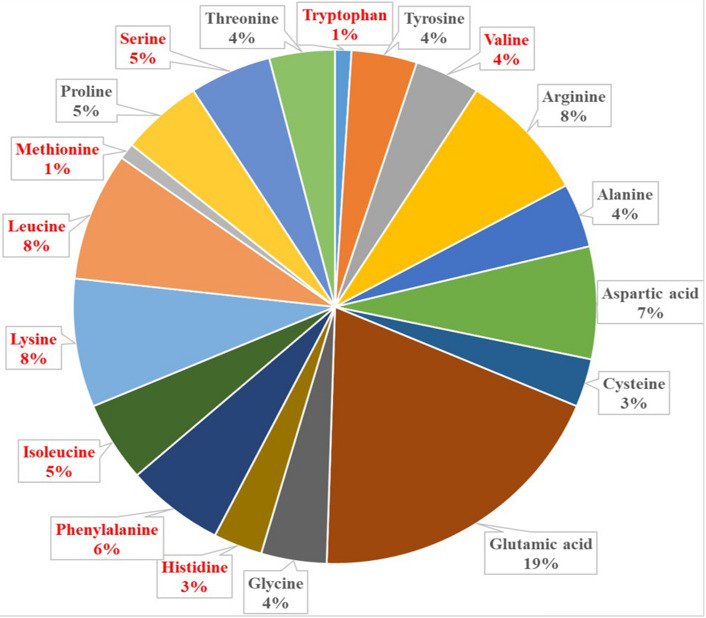
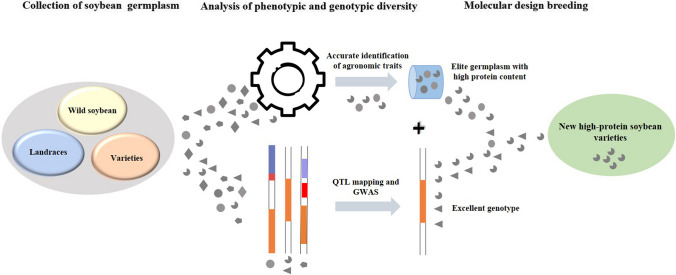
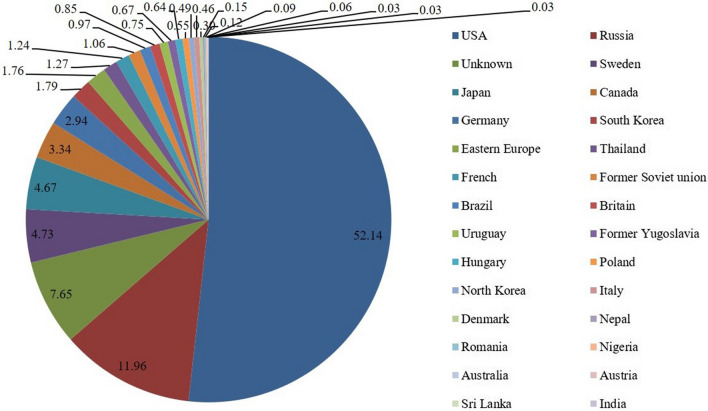
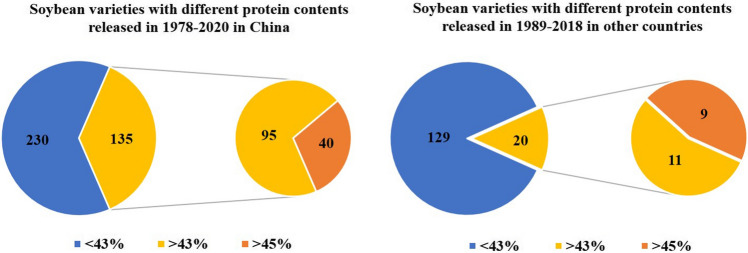
Genetic resources contributes to the sustainable protein production in soybean. Soybean is an important crop for food, oil, and forage and is the main source of edible vegetable oil and vegetable protein. It plays an important role in maintaining balanced dietary nutrients for human health. The soybean protein content is a quantitative trait mainly controlled by gene additive effects and is usually negatively correlated with agronomic traits such as the oil content and yield. The selection of soybean varieties with high protein content and high yield to secure sustainable protein production is one of the difficulties in soybean breeding. The abundant genetic variation of soybean germplasm resources is the basis for overcoming the obstacles in breeding for soybean varieties with high yield and high protein content. Soybean has been cultivated for more than 5000 years and has spread from China to other parts of the world. The rich genetic resources play an important role in promoting the sustainable production of soybean protein worldwide. In this paper, the origin and spread of soybean and the current status of soybean production are reviewed; the genetic characteristics of soybean protein and the distribution of resources are expounded based on phenotypes; the discovery of soybean seed protein-related genes as well as transcriptomic, metabolomic, and proteomic studies in soybean are elaborated; the creation and utilization of high-protein germplasm resources are introduced; and the prospect of high-protein soybean breeding is described.
遗传资源有助于大豆的可持续蛋白质生产。大豆是一种重要的粮食、油料和饲料作物,是食用植物油和植物蛋白的主要来源。它在维持人类健康饮食营养平衡方面发挥着重要作用。大豆蛋白含量是一个主要受基因加性效应控制的数量性状,通常与含油量和产量等农艺性状呈负相关。选择高蛋白含量和高产量的大豆品种以确保可持续的蛋白质生产是大豆育种的难点之一。大豆种质资源丰富的遗传变异是克服高产量和高蛋白含量大豆品种选育障碍的基础。大豆已经种植了 5000 多年,从中国传播到了世界其他地区。丰富的遗传资源在促进全球大豆蛋白质的可持续生产方面发挥着重要作用。本文综述了大豆的起源和传播以及大豆生产的现状;基于表型阐述了大豆蛋白的遗传特性和资源分布;阐述了大豆种子蛋白相关基因的发现以及大豆的转录组学、代谢组学和蛋白质组学研究;介绍了高蛋白种质资源的创造和利用;并描述了高蛋白大豆育种的前景。