Medicine, Uniformed Services University of the Health Sciences, Bethesda, Maryland, USA.
Center for Health Professions Education, Henry M. Jackson Foundation, Bethesda, Maryland, USA.
Med Educ. 2023 Mar;57(3):280-289. doi: 10.1111/medu.14959. Epub 2022 Nov 8.
The voices of authors who publish medical education literature have a powerful impact on the field's discourses. Researchers have identified a lack of author diversity, which suggests potential epistemic injustice. This study investigates author characteristics to provide an evidence-based starting point for communal discussion with the intent to move medical education towards a future that holds space for, and values, diverse ways of knowing.
The authors conducted a bibliometric analysis of all articles published in 24 medical education journals published between 2000 and 2020 to identify author characteristics, with an emphasis on author gender and geographic location and their intersection. Article metadata was downloaded from Web of Science. Genderize.io was used to predict author gender.
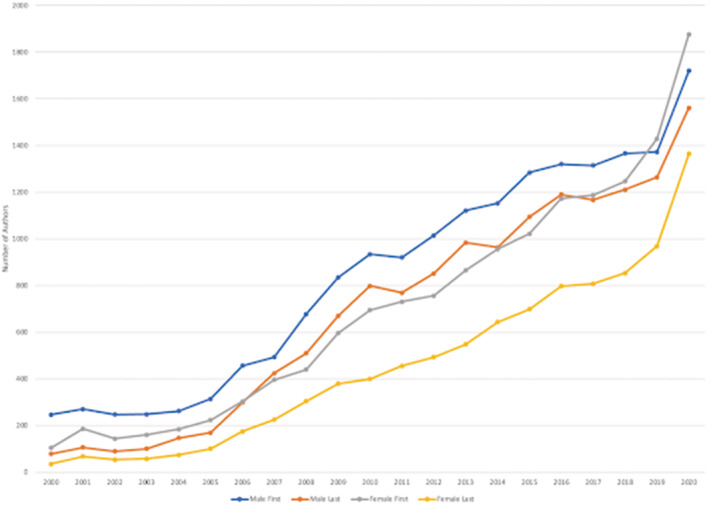
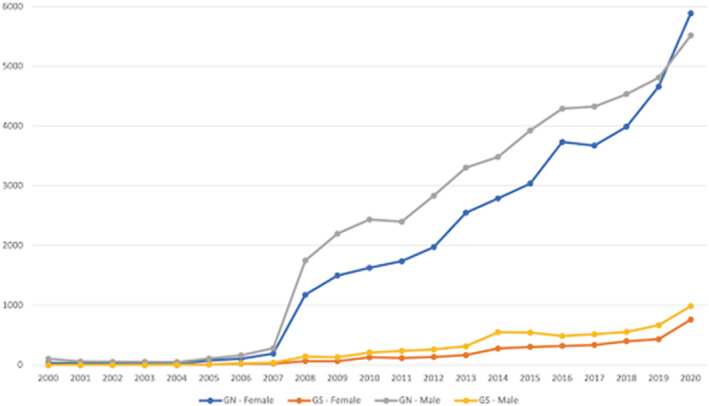
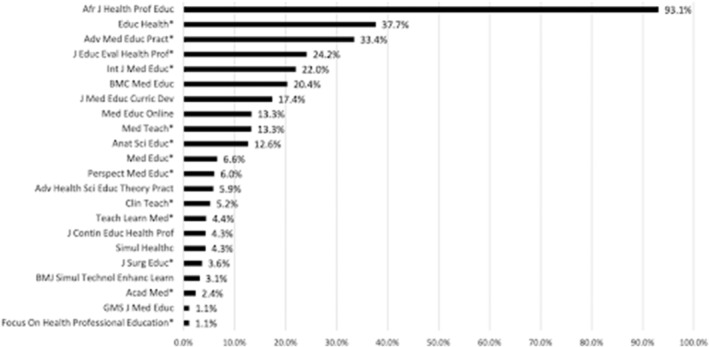
The journals published 37 263 articles authored by 62 708 unique authors. Males were more prevalent across all authorship positions (n = 62 828; 55.7%) than females (n = 49 975; 44.3%). Authors listed affiliations in 146 countries of which 95 were classified as Global South. Few articles were written by multinational teams (n = 3765; 16.2%). Global South authors accounted for 12 007 (11.4%) author positions of which 3594 (3.8%) were female.
This study provides an evidence-based starting point to discuss the imbalance of author voices in medical education, especially when considering the intersection of gender and geographical location, which further suggests epistemic injustice in medical education. If the field values a diversity of perspectives, there is considerable opportunity for improvement by engaging the community in discussions about what knowledge matters in medical education, the role of journals in promoting diversity, how to best use this baseline data and how to continue studying epistemic injustice in medical education.
发表医学教育文献的作者的声音对该领域的论述具有强大的影响力。研究人员发现作者群体缺乏多样性,这表明可能存在认识论上的不公正。本研究调查了作者的特征,为社区讨论提供了一个基于证据的起点,旨在推动医学教育走向一个为多样化的认知方式留出空间并重视其价值的未来。
作者对 2000 年至 2020 年间出版的 24 种医学教育期刊发表的所有文章进行了文献计量分析,以确定作者特征,重点关注作者的性别和地理位置及其交叉情况。文章元数据从 Web of Science 下载。使用 Genderize.io 预测作者的性别。
该期刊发表了 37263 篇文章,由 62708 位不同的作者撰写。在所有作者职位中,男性的比例(n=62828;55.7%)均高于女性(n=49975;44.3%)。作者列出了在 146 个国家/地区的隶属关系,其中 95 个被归类为全球南方国家。很少有文章是由跨国团队撰写的(n=3765;16.2%)。全球南方国家的作者占 12007 个(11.4%)作者职位,其中 3594 个(3.8%)为女性。
本研究为讨论医学教育中作者声音的不平衡提供了一个基于证据的起点,特别是考虑到性别和地理位置的交叉,这进一步表明医学教育中的认识论不公正。如果该领域重视多样性的观点,那么通过让社区参与讨论医学教育中哪些知识是重要的、期刊在促进多样性方面的作用、如何最好地利用这些基准数据以及如何继续研究医学教育中的认识论不公正等问题,就有很大的改进机会。