Nat Commun. 2022 Oct 25;13(1):6160. doi: 10.1038/s41467-022-33627-9.
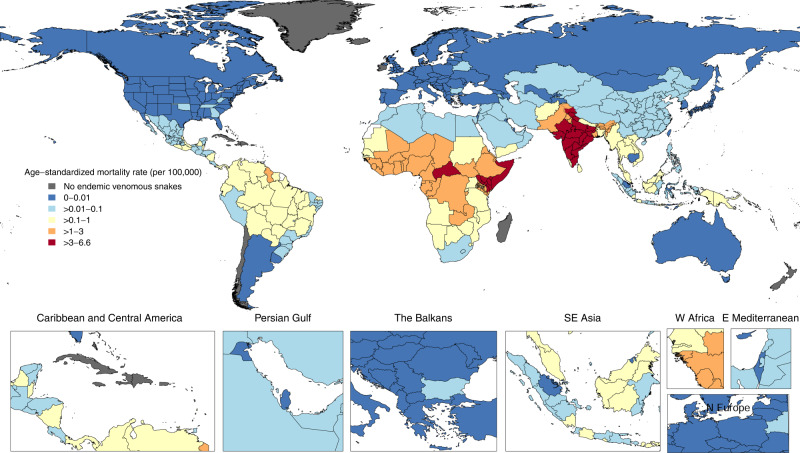
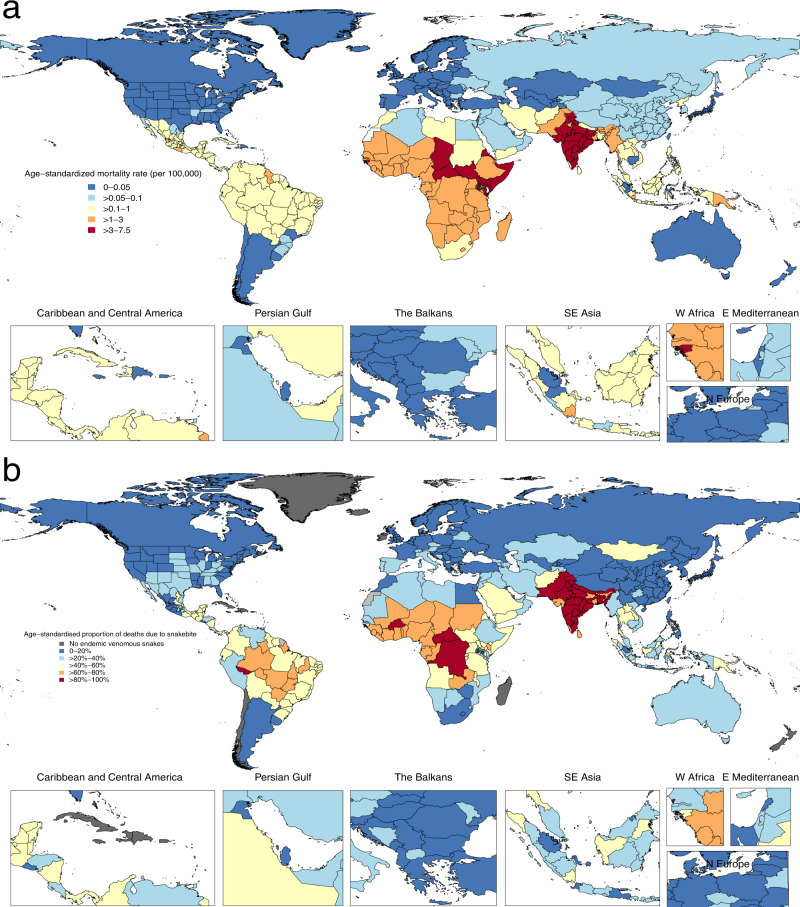
Snakebite envenoming is an important cause of preventable death. The World Health Organization (WHO) set a goal to halve snakebite mortality by 2030. We used verbal autopsy and vital registration data to model the proportion of venomous animal deaths due to snakes by location, age, year, and sex, and applied these proportions to venomous animal contact mortality estimates from the Global Burden of Disease 2019 study. In 2019, 63,400 people (95% uncertainty interval 38,900-78,600) died globally from snakebites, which was equal to an age-standardized mortality rate (ASMR) of 0.8 deaths (0.5-1.0) per 100,000 and represents a 36% (2-49) decrease in ASMR since 1990. India had the greatest number of deaths in 2019, equal to an ASMR of 4.0 per 100,000 (2.3-5.0). We forecast mortality will continue to decline, but not sufficiently to meet WHO's goals. Improved data collection should be prioritized to help target interventions, improve burden estimation, and monitor progress.
蛇伤中毒是可预防死亡的一个重要原因。世界卫生组织(世卫组织)设定了一个目标,即在 2030 年将蛇伤死亡率降低一半。我们使用死因推断调查和生命登记数据,按地点、年龄、年份和性别建模因蛇类而死亡的有毒动物的比例,并将这些比例应用于 2019 年全球疾病负担研究中有毒动物接触死亡估计数。2019 年,全球有 63400 人(95%不确定区间 38900-78600)死于蛇伤,其标准化死亡率(ASMR)为每 10 万人中有 0.8 人(0.5-1.0)死亡,自 1990 年以来 ASMR 下降了 36%(2-49)。印度在 2019 年的死亡人数最多,ASMR 为每 10 万人中有 4.0 人(2.3-5.0)死亡。我们预测死亡率将继续下降,但不足以实现世卫组织的目标。应优先重视改善数据收集,以帮助确定干预措施的目标、改进负担估计,并监测进展情况。