Sakaguchi Katsuhisa, Akimoto Kei, Takaira Masanori, Tanaka Ryu-Ichiro, Shimizu Tatsuya, Umezu Shinjiro
Department of Integrative Bioscience and Biomedical Engineering, Graduate School of Advanced Science and Engineering, TWIns, Waseda University, 2-2 Wakamatsu-Cho, Shinju-Ku, Tokyo 162-8480, Japan.
Department of Modern Mechanical Engineering, Graduate School of Creative Science and Engineering, Waseda University, 1-104 Totsuka-Cho, Shinju-Ku, Tokyo 169-8555, Japan.
Cyborg Bionic Syst. 2022 Jan 27;2022:9758187. doi: 10.34133/2022/9758187. eCollection 2022.
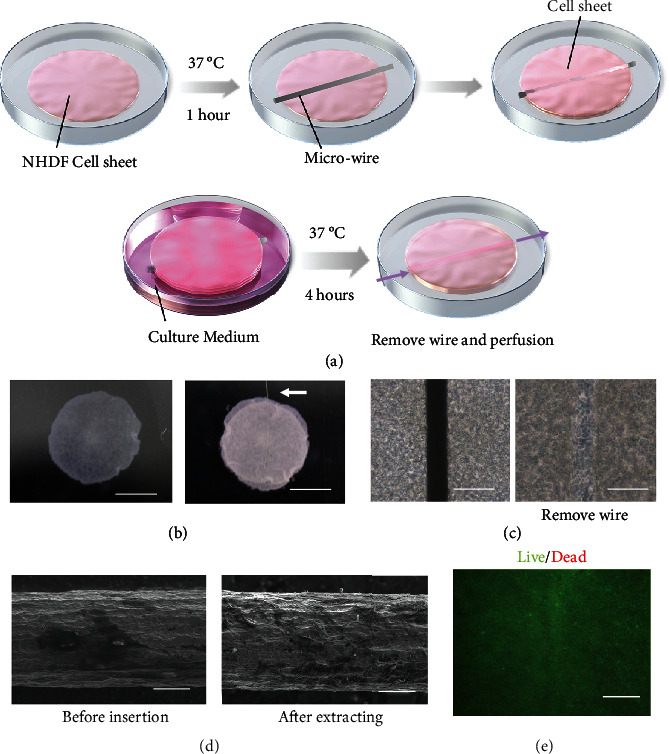
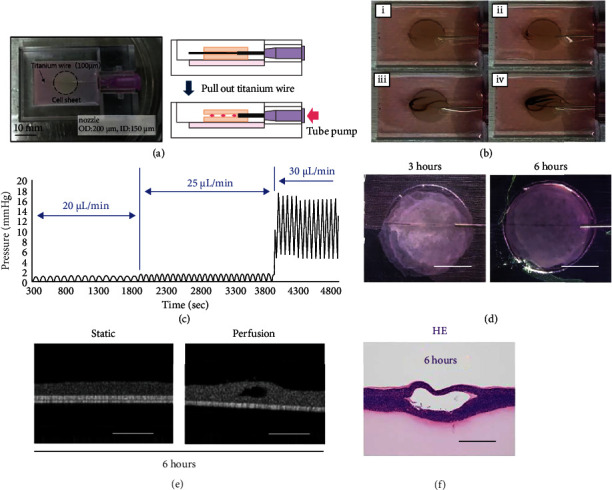
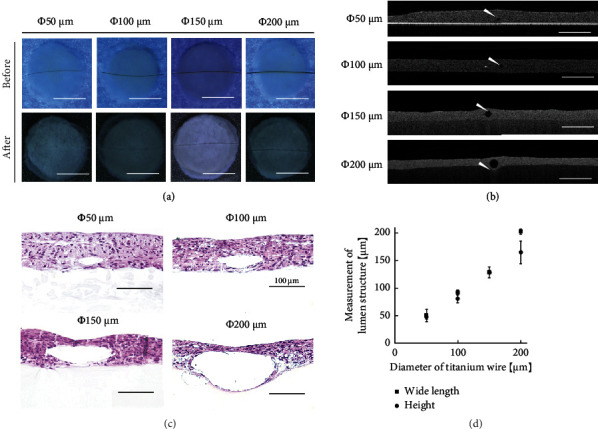
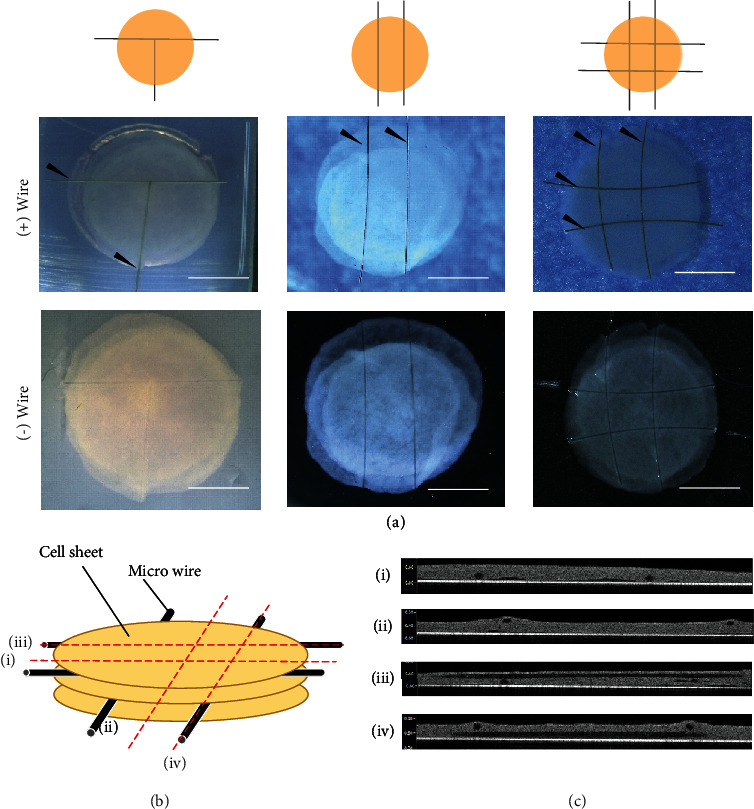
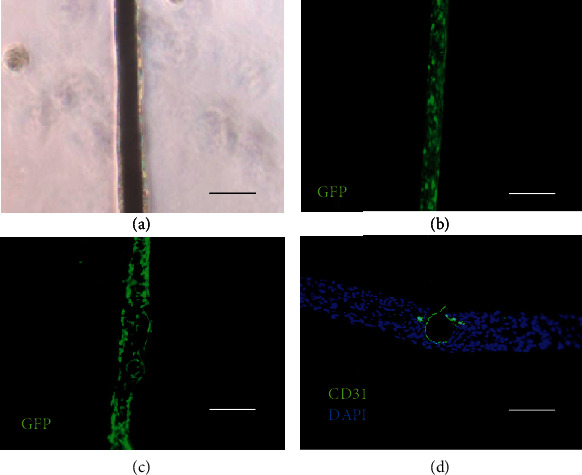
The development of microelectromechanical systems has resulted in the rapid development of polydimethylpolysiloxane (PDMS) microfluidic devices for drug screening models. Various cell functions, such as the response of endothelial cells to fluids, have been elucidated using microfluidic devices. Additionally, organ-on-a-chip systems that include organs that are important for biological circulation, such as the heart, liver, pancreas, kidneys, and brain, have been developed. These organs realize the biological circulation system in a manner that cannot be reproduced by artificial organs; however, the flow channels between the organs are often artificially created by PDMS. In this study, we developed a microfluidic device consisting only of cells, by combining cell sheet technology with microtitanium wires. Microwires were placed between stacked fibroblast cell sheets, and the cell sheets adhered to each other, after which the microwires were removed leaving a luminal structure with a size approximately equal to the arteriolar size. The lumen structure was constructed using wires with diameters of 50, 100, 150, and 200 m, which were approximations of the arteriole diameters. Furthermore, using a perfusion device, we successfully perfused the luminal structure created inside the cell sheets. The results revealed that a culture solution can be supplied to a cell sheet with a very high cell density. The biofabrication technology proposed in this study can contribute to the development of organ-on-a-chip systems.
微机电系统的发展推动了用于药物筛选模型的聚二甲基硅氧烷(PDMS)微流控装置的快速发展。利用微流控装置已经阐明了各种细胞功能,如内皮细胞对流体的反应。此外,还开发了包含对生物循环至关重要的器官(如心脏、肝脏、胰腺、肾脏和大脑)的芯片器官系统。这些器官以人工器官无法复制的方式实现生物循环系统;然而,器官之间的流动通道通常是由PDMS人工创建的。在本研究中,我们通过将细胞片技术与微钛丝相结合,开发了一种仅由细胞组成的微流控装置。将微丝放置在堆叠的成纤维细胞片之间,细胞片相互粘附,然后去除微丝,留下尺寸近似于小动脉大小的腔结构。使用直径为50、100、150和200μm的金属丝构建腔结构,这些直径近似于小动脉直径。此外,我们使用灌注装置成功地对细胞片内部形成的腔结构进行了灌注。结果表明,可以向细胞密度非常高的细胞片供应培养液。本研究中提出的生物制造技术有助于芯片器官系统的发展。