Oslan Siti Nur Hazwani, Shapawi Rossita, Mokhtar Ruzaidi Azli Mohd, Noordin Wan Norhana Md, Huda Nurul
Faculty of Food Science and Nutrition, Universiti Malaysia Sabah, Jalan UMS, Kota Kinabalu 88400, Malaysia.
Borneo Marine Research Institute, Universiti Malaysia Sabah, Jalan UMS, Kota Kinabalu 88400, Malaysia.
Gels. 2022 Oct 17;8(10):665. doi: 10.3390/gels8100665.
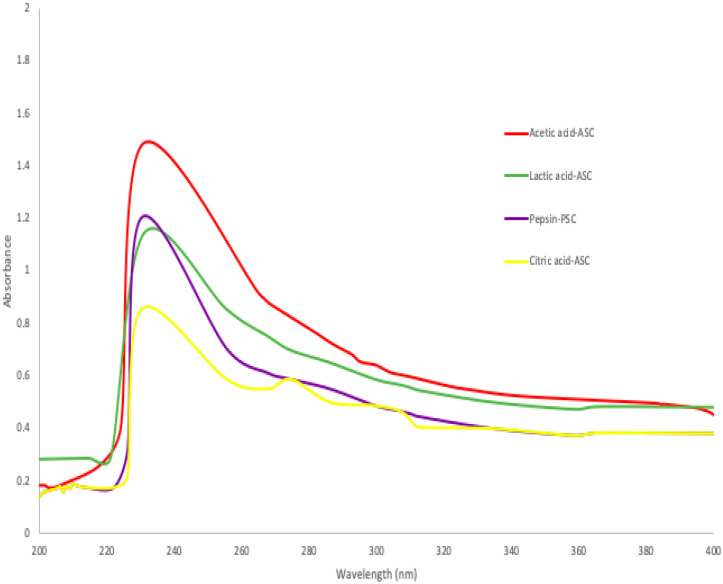
Fish processing waste is a prospective source of collagen and a cost-effective environmental pollutant. The skin of the purple-spotted bigeye snapper (Priacanthus tayenus) was extracted utilising various acid soluble collagens (ASC) including acetic acid (AAC), lactic acid (LAC), citric acid (CAC) and pepsin soluble collagens (PSC). In this study, PSC (6.65%) had the highest collagen yield, followed by AAC (5.79%), CAC (4.15%), and LAC (3.19%). The maximum temperatures (Tmax) denaturation of AAC, LAC, CAC, and PSC were 31.4, 31.7, 31.5, and 33.2 °C, respectively. UV-VIS absorption spectra showed all extracted collagens had a range of absorbance at 230 nm, due to the presence of glycine, proline, hydroxyproline, and triple-helical collagen. Additionally, they exhibited amide A, B, amide I, II, and III peaks. SDS−PAGE identified all extracted collagens as type I. The PSC had a significantly higher (p < 0.05) hydroxyproline content than acidic extraction 66.3 ± 1.03 (mg/g sample). Furthermore, all samples were extremely soluble in acetic conditions at pH 5, and all collagen was soluble in NaCl up to 3% (w/v). Therefore, PSC was the best treatment since it did not impact collagen triple helical and acetic acid yielded the most collagen in ASC extraction. Overall, the analysis revealed that fish skin waste might be used as an alternate source of collagen in diverse applications, particularly in food applications.
鱼类加工废弃物是胶原蛋白的潜在来源,也是一种具有成本效益的环境污染物。利用各种酸溶性胶原蛋白(ASC),包括乙酸(AAC)、乳酸(LAC)、柠檬酸(CAC)和胃蛋白酶溶性胶原蛋白(PSC),对紫斑大眼鲷(Priacanthus tayenus)的鱼皮进行了提取。在本研究中,PSC的胶原蛋白产量最高(6.65%),其次是AAC(5.79%)、CAC(4.15%)和LAC(3.19%)。AAC、LAC、CAC和PSC的最大变性温度(Tmax)分别为31.4、31.7、31.5和33.2℃。紫外可见吸收光谱显示,由于甘氨酸、脯氨酸、羟脯氨酸和三螺旋胶原蛋白的存在,所有提取的胶原蛋白在230nm处都有一定的吸光度范围。此外,它们还表现出酰胺A、B、酰胺I、II和III峰。SDS-PAGE鉴定所有提取的胶原蛋白均为I型。PSC的羟脯氨酸含量显著高于酸性提取物,为66.3±1.03(mg/g样品)。此外,所有样品在pH 5的醋酸条件下极易溶解,所有胶原蛋白在高达3%(w/v)的NaCl中均可溶解。因此,PSC是最佳处理方法,因为它不会影响胶原蛋白三螺旋结构,并且在ASC提取中乙酸产生的胶原蛋白最多。总体而言,分析表明鱼皮废弃物可作为胶原蛋白的替代来源,用于各种应用,特别是食品应用。