Department of Cardiology, Aerospace Center Hospital, Beijing, China.
Department of Geriatric Medicine, Aerospace Center Hospital, Beijing, China.
Front Endocrinol (Lausanne). 2022 Oct 10;13:975209. doi: 10.3389/fendo.2022.975209. eCollection 2022.
The relationship between body mass index (BMI) and mortality in older adults diminished. It is necessary to examine other factors that may accurately predict mortality in older adults. The visceral adiposity index (VAI) is an uncomplicated marker specific to the gender that incorporates anthropometric data and lipid profiles. VAI has been proposed as a marker of visceral adipose tissue dysfunction and of the related cardiometabolic risk. The aim of this study was to evaluate the link of VAI with all-cause mortality among the elderly.
The present prospective cohort study included data from 1999 to 2014 provided by the National Health and Nutrition Examination Survey (NHANES) in the United States. NHANES participants at or above the age of 65 were included. Data collection was carried out by taking face-to-face interviews, mobile-physical examinations, and lab tests. From the start of the survey to the end of December 2015, mortality-related follow-up statistics are available. The shape of the link between VAI and all-cause mortality was investigated using a restricted cubic spline model. Univariate- and multivariate-adjusted Cox proportional hazard models were estimated for VAI, and the results were presented as regression coefficients and 95% confidence intervals (CI).
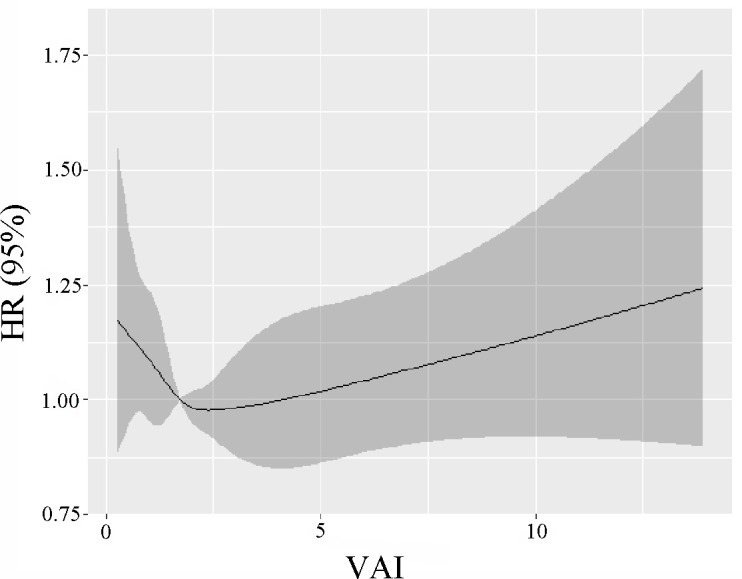
The 82,091 NHANES participants represented 442.2 million non-institutionalized residents of the United States. A total of 11,173 older individuals (representing 23.3 million; aged 73.4 ± 5.8 years; 56.3% women, 82.7% non-Hispanic Whites, 6.8% non-Hispanic Blacks, and 3.3% Mexican Americans) were included in the study. During the 80-month follow-up period, 4466 fatalities were reported, including 825 deaths from cancer, 867 from heart disease, and 211 from cerebrovascular disease. The restricted cubic spline model demonstrated a robust J-shaped link between VAI and all-cause mortality, revealing a significant decrease in risk within the lower range of VAI, which attained the lowest risk close to 1.7. With VAI greater than 1.7, the risk of mortality increased with the increase of VAI (P for non-linearity = 0.025). In the multivariate-adjusted model, the risk of all-cause mortality was 0.73 (0.56-0.97) and 1.05 (1.01-1.09) in participants with VAI less than 1.7 and VAI greater than or equal to 1.7, respectively.
This investigation is a population-based cohort study with high sample sizes and a long-term in older individuals follow-up that showed a J-shaped link between VAI levels and all-cause mortality. Understanding the independent roles of VAI in the relationship between BMI and mortality is crucial to understanding the obesity paradox phenomenon.
体质指数(BMI)与老年人死亡率之间的关系减弱。有必要研究其他可能准确预测老年人死亡率的因素。内脏脂肪指数(VAI)是一种特定于性别的简单标志物,它包含人体测量数据和血脂谱。VAI 被提议作为内脏脂肪组织功能障碍和相关心血管代谢风险的标志物。本研究的目的是评估 VAI 与老年人全因死亡率之间的关系。
本前瞻性队列研究纳入了美国国家健康与营养调查(NHANES)提供的 1999 年至 2014 年的数据。纳入年龄在 65 岁及以上的 NHANES 参与者。通过面对面访谈、移动体检和实验室测试进行数据收集。从调查开始到 2015 年 12 月 31 日,可获得与死亡率相关的随访统计数据。使用限制性立方样条模型研究 VAI 与全因死亡率之间的关联形状。使用单变量和多变量调整的 Cox 比例风险模型估计 VAI,并以回归系数和 95%置信区间(CI)表示结果。
82091 名 NHANES 参与者代表美国 4.422 亿非机构化居民。共有 11173 名老年人(代表 2330 万人;年龄 73.4±5.8 岁;56.3%为女性,82.7%为非西班牙裔白人,6.8%为非西班牙裔黑人,3.3%为墨西哥裔美国人)被纳入研究。在 80 个月的随访期间,报告了 4466 例死亡,其中 825 例死于癌症,867 例死于心脏病,211 例死于脑血管病。限制性立方样条模型显示 VAI 与全因死亡率之间存在稳健的 J 形关联,表明 VAI 较低范围内的风险显著降低,接近 1.7 时风险最低。VAI 大于 1.7 时,死亡率随 VAI 的增加而增加(P 非线性=0.025)。在多变量调整模型中,VAI 小于 1.7 和 VAI 大于或等于 1.7 的参与者全因死亡率的风险分别为 0.73(0.56-0.97)和 1.05(1.01-1.09)。
本研究是一项基于人群的队列研究,样本量较大,对老年人进行了长期随访,结果显示 VAI 水平与全因死亡率之间呈 J 形关联。了解 VAI 在 BMI 和死亡率之间关系中的独立作用对于理解肥胖悖论现象至关重要。