1Division of Endocrinology Metabolism and Diabetes, Department of Internal Medicine, Dr. Cipto Mangunkusumo National Referral Hospital, Faculty of Medicine, Universitas Indonesia, Jakarta, Indonesia.
3Department of Internal Medicine, Dr. Cipto Mangunkusumo National Referral Hospital, Faculty of Medicine, Universitas Indonesia, Jakarta, Indonesia.
Rev Diabet Stud. 2022 Sep 28;18(3):157-165. doi: 10.1900/RDS.2022.18.157.
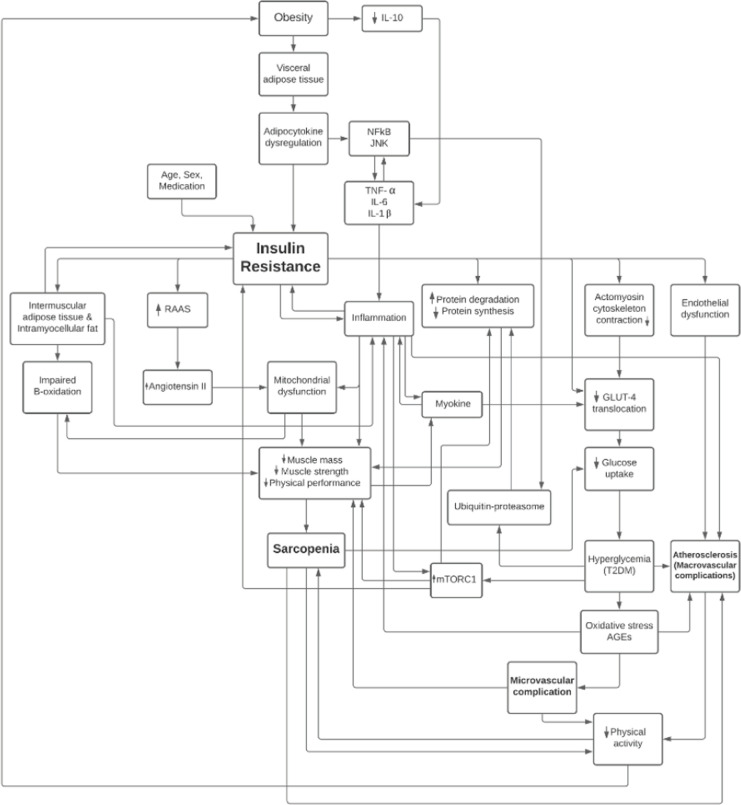
Sarcopenia, defined as the loss of skeletal muscle mass and strength and/or a decrease in physical performance, is classically related to aging. However, chronic disease, including type 2 diabetes mellitus (T2DM), may accelerate the development of sarcopenia. Previous studies found strong association between T2DM and sarcopenia. Insulin resistance that exists in T2DM is thought to be the key mediator for impaired physical function and mobility which may lead to sarcopenia. T2DM may cause sarcopenia through the mediation of insulin resistance, inflammation, accumulation of advanced glycation end-products, and oxidative stress that may affect muscle mass and strength, protein metabolism, and vascular and mitochondrial dysfunction. On the other hand, loss of muscle in sarcopenia may play a role in the development of T2DM through the decreased production of myokines that play a role in glucose and fat metabolism. This review highlights the findings of existing literature on the relationship between T2DM and sarcopenia which emphasize the pathophysiology, chronic vascular complications, and the course of macrovascular and microvascular complications in T2DM.
肌肉减少症是一种以骨骼肌质量和力量下降和/或身体机能下降为特征的疾病,与衰老密切相关。然而,慢性疾病,包括 2 型糖尿病(T2DM),可能会加速肌肉减少症的发展。先前的研究发现 T2DM 与肌肉减少症之间存在很强的关联。T2DM 中存在的胰岛素抵抗被认为是导致身体功能和活动能力受损的关键介质,这可能导致肌肉减少症。T2DM 可能通过胰岛素抵抗、炎症、晚期糖基化终产物的积累以及氧化应激的介导导致肌肉减少症,这些因素可能会影响肌肉质量和力量、蛋白质代谢以及血管和线粒体功能障碍。另一方面,肌肉减少症中肌肉的丧失可能通过减少肌因子的产生在 T2DM 的发展中发挥作用,肌因子在葡萄糖和脂肪代谢中发挥作用。本综述强调了现有文献中关于 T2DM 和肌肉减少症之间关系的研究结果,这些结果强调了 T2DM 的病理生理学、慢性血管并发症以及大血管和微血管并发症的病程。