Liu Liu, Shen Fujin, Liang Hua, Yang Zhe, Yang Jing, Chen Jiao
Department of Obstetrics and Gynecology, Renmin Hospital, Wuhan University, Wuhan 430072, China.
Reproductive Medicine Center, Renmin Hospital, Wuhan University, Wuhan 430072, China.
Diagnostics (Basel). 2022 Feb 14;12(2):492. doi: 10.3390/diagnostics12020492.
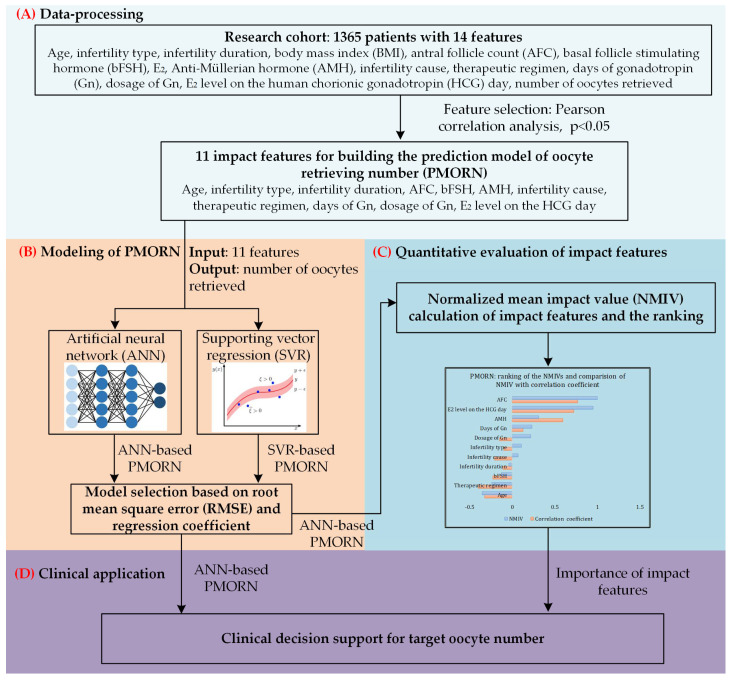
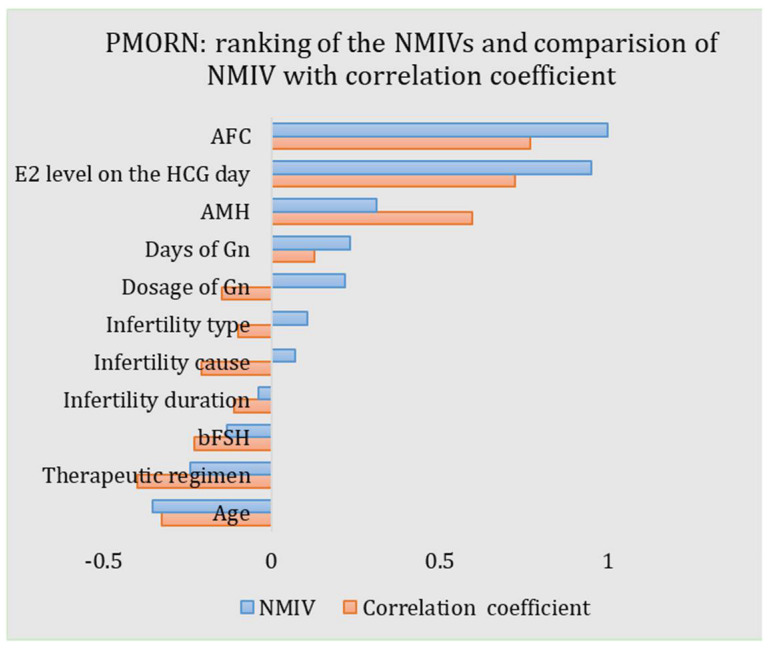
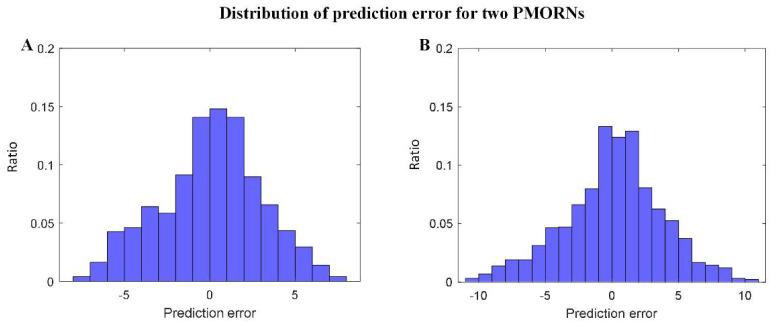
Appropriate ovarian responses to the controlled ovarian stimulation strategy is the premise for a good outcome of the in vitro fertilization cycle. With the booming of artificial intelligence, machine learning is becoming a popular and promising approach for tailoring a controlled ovarian stimulation strategy. Nowadays, most machine learning-based tailoring strategies aim to generally classify the controlled ovarian stimulation outcome, lacking the capacity to precisely predict the outcome and evaluate the impact features. Based on a clinical cohort composed of 1365 women and two machine learning methods of artificial neural network and supporting vector regression, a regression prediction model of the number of oocytes retrieved is trained, validated, and selected. Given the proposed model, an index called the normalized mean impact value is defined and calculated to reflect the importance of each impact feature. The proposed models can estimate the number of oocytes retrieved with high precision, with the regression coefficient being 0.882% and 89.84% of the instances having the prediction number ≤ 5. Among the impact features, the antral follicle count has the highest importance, followed by the E level on the human chorionic gonadotropin day, the age, and the Anti-Müllerian hormone, with their normalized mean impact value > 0.3. Based on the proposed model, the prognostic results for ovarian response can be predicted, which enables scientific clinical decision support for the customized controlled ovarian stimulation strategies for women, and eventually helps yield better in vitro fertilization outcomes.
对控制性卵巢刺激方案产生适当的卵巢反应是体外受精周期获得良好结果的前提。随着人工智能的蓬勃发展,机器学习正成为一种流行且有前景的方法来制定控制性卵巢刺激方案。如今,大多数基于机器学习的定制策略旨在对控制性卵巢刺激结果进行一般分类,缺乏精确预测结果和评估影响特征的能力。基于由1365名女性组成的临床队列以及人工神经网络和支持向量回归这两种机器学习方法,训练、验证并选择了一个关于获卵数的回归预测模型。基于所提出的模型,定义并计算了一个名为归一化平均影响值的指标,以反映每个影响特征的重要性。所提出的模型能够高精度地估计获卵数,回归系数为0.882%,且89.84%的实例预测数≤5。在影响特征中,窦卵泡计数的重要性最高,其次是绒毛膜促性腺激素日的E水平、年龄和抗苗勒管激素,它们的归一化平均影响值>0.3。基于所提出的模型,可以预测卵巢反应的预后结果,这为针对女性的定制控制性卵巢刺激方案提供科学的临床决策支持,并最终有助于获得更好的体外受精结果。