School of Life Sciences, Gwangju Institute of Science and Technology, Gwangju, Korea.
School of Electrical Engineering and Computer Science, Gwangju Institute of Science and Technology, Gwangju, Korea.
Cancer Med. 2023 Mar;12(6):7603-7615. doi: 10.1002/cam4.5420. Epub 2022 Nov 7.
Predicting the survival of cancer patients provides prognostic information and therapeutic guidance. However, improved prediction models are needed for use in diagnosis and treatment.
This study aimed to identify genomic prognostic biomarkers related to colon cancer (CC) based on computational data and to develop survival prediction models.
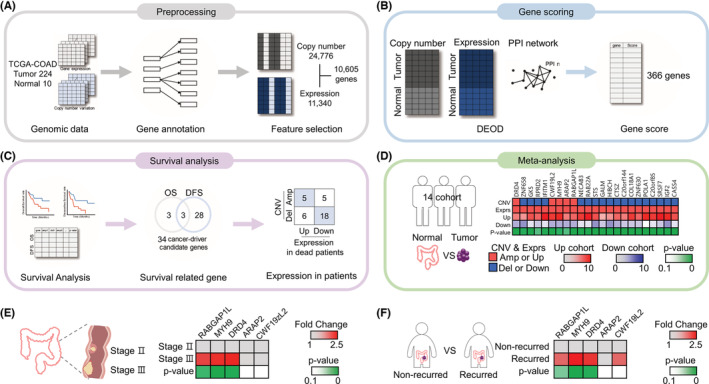
We performed machine-learning (ML) analysis to screen pathogenic survival-related driver genes related to patient prognosis by integrating copy number variation and gene expression data. Moreover, in silico system analysis was performed to clinically assess data from ML analysis, and we identified RABGAP1L, MYH9, and DRD4 as candidate genes. These three genes and tumor stages were used to generate survival prediction models. Moreover, the genes were validated by experimental and clinical analyses, and the theranostic application of the survival prediction models was assessed.
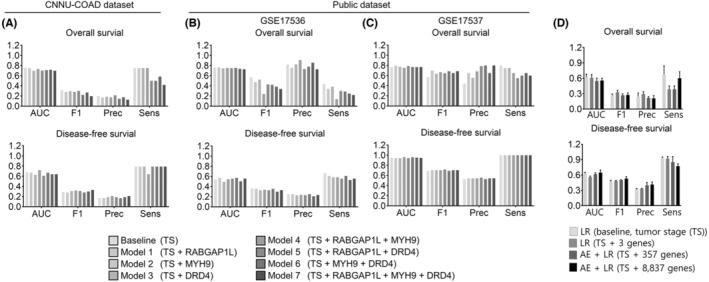
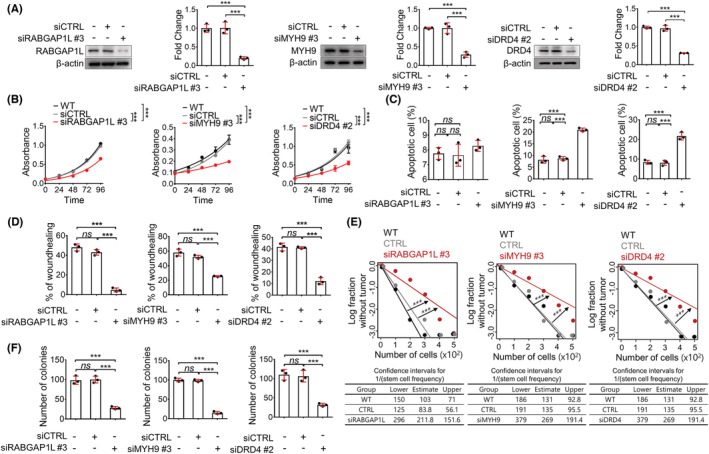
RABGAP1L, MYH9, and DRD4 were identified as survival-related candidate genes by ML and in silico system analysis. The survival prediction model using the expression of the three genes showed higher predictive performance when applied to predict the prognosis of CC patients. A series of functional analyses revealed that each knockdown of three genes reduced the protumor activity of CC cells. In particular, validation with an independent cohort of CC patients confirmed that the coexpression of MYH9 and DRD4 gene expression reflected poorer clinical outcomes in terms of overall survival and disease-free survival.
Our survival prediction approach will contribute to providing information on patients and developing a therapeutic strategy for CC patients.
预测癌症患者的生存率可以提供预后信息和治疗指导。然而,在诊断和治疗中需要更好的预测模型。
本研究旨在基于计算数据识别与结肠癌(CC)相关的基因组预后生物标志物,并开发生存预测模型。
我们通过整合拷贝数变异和基因表达数据,进行机器学习(ML)分析,筛选与患者预后相关的致病性生存相关驱动基因。此外,我们还进行了计算机系统分析,对 ML 分析中的数据进行临床评估,并确定 RABGAP1L、MYH9 和 DRD4 为候选基因。这三个基因和肿瘤分期用于生成生存预测模型。此外,通过实验和临床分析验证了这些基因,并评估了生存预测模型的治疗应用。
RABGAP1L、MYH9 和 DRD4 是通过 ML 和计算机系统分析鉴定的与生存相关的候选基因。使用这三个基因的表达生成的生存预测模型在应用于预测 CC 患者的预后时表现出更高的预测性能。一系列功能分析表明,三个基因中的每个敲低都降低了 CC 细胞的促肿瘤活性。特别是,对 CC 患者的独立队列进行验证证实,MYH9 和 DRD4 基因表达的共表达反映了总生存率和无病生存率较差的临床结局。
我们的生存预测方法将有助于为患者提供信息并为 CC 患者制定治疗策略。