The University of Queensland, Brisbane, QLD, Australia.
The Royal Brisbane and Women's Hospital, Brisbane, QLD, Australia.
Support Care Cancer. 2022 Dec;30(12):10391-10405. doi: 10.1007/s00520-022-07409-4. Epub 2022 Nov 9.
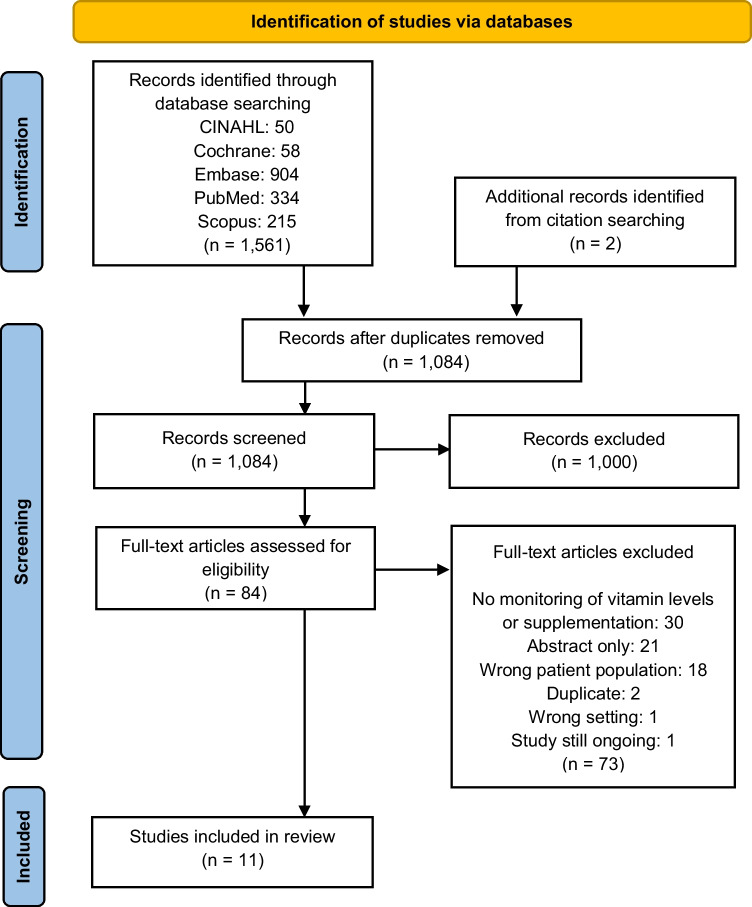
Patients undergoing stem cell transplantation (SCT) are at high risk of malnutrition during the acute post-transplantation period. This systematic review aimed to collate and analyse the evidence for vitamin requirements post-SCT. A systematic search of five databases was conducted to include studies published until March 2021. The review utilised the Preferred Reporting Items for Systematic Reviews and Meta-analyses (PRISMA) framework. Inclusion criteria consisted of adults undergoing SCT who received vitamin supplementation or had their vitamin levels monitored up to 100 days post-SCT. Studies with paediatric patients or those that looked at vitamin derivates such as folinic acid were excluded. Main outcomes included vitamin deficiency and relevant clinical outcomes. Eleven studies (n = 11) were eligible for inclusion with five rated as neutral quality and six as positive quality. Five studies focused on allogenic SCT, two on autologous SCT and the remaining included a mix of both. Eight studies monitored vitamins levels post-SCT, and seven studies provided vitamin supplementation. Three studies (one provided supplementation) found a high prevalence of vitamin D deficiency (23-60%) prior to SCT. Findings indicate an unclear association between vitamin deficiency and post-SCT complications including acute graft-versus-host-disease, oral mucositis, and mortality. The GRADE certainty of evidence across these outcomes was low or very low. It is unclear if supplementation is needed during SCT, though assessing vitamin D levels prior to transplant should be considered. Further large observational studies or randomised control trials are required to establish vitamin requirements and guide supplementation protocols during SCT.
接受干细胞移植 (SCT) 的患者在移植后急性期存在营养风险。本系统评价旨在整理和分析 SCT 后维生素需求的证据。对五个数据库进行了系统搜索,以纳入截至 2021 年 3 月发表的研究。本综述采用系统评价和荟萃分析的首选报告项目 (PRISMA) 框架。纳入标准包括接受维生素补充或监测维生素水平至 SCT 后 100 天的成人 SCT 患者。排除儿科患者或研究维生素衍生物(如叶酸)的研究。主要结局包括维生素缺乏和相关临床结局。有 11 项研究(n=11)符合纳入标准,其中 5 项研究质量为中性,6 项研究质量为阳性。五项研究专注于同种异体 SCT,两项研究专注于自体 SCT,其余研究包括两者的混合。八项研究监测 SCT 后维生素水平,七项研究提供维生素补充。三项研究(一项提供补充)发现 SCT 前维生素 D 缺乏症的患病率较高(23-60%)。结果表明,维生素缺乏与 SCT 后并发症(包括急性移植物抗宿主病、口腔黏膜炎和死亡率)之间的关联尚不清楚。这些结局的 GRADE 证据确定性为低或极低。目前尚不清楚 SCT 期间是否需要补充维生素,但应考虑在移植前评估维生素 D 水平。需要进一步进行大型观察性研究或随机对照试验,以确定 SCT 期间的维生素需求并指导补充方案。