Cancer Initiation and Tumor Cell Identity Department, Cancer Research Centre of Lyon (CRCL) INSERM 1052, CNRS UMR5286, Centre Léon Bérard, Université Claude Bernard Lyon 1, 69008, Lyon, Villeurbanne, France.
Univ Lyon, CNRS, Institut Lumière Matière, Univ Claude Bernard Lyon 1, 69622, Villeurbanne, France.
Sci Rep. 2022 Nov 9;12(1):19066. doi: 10.1038/s41598-022-21822-z.
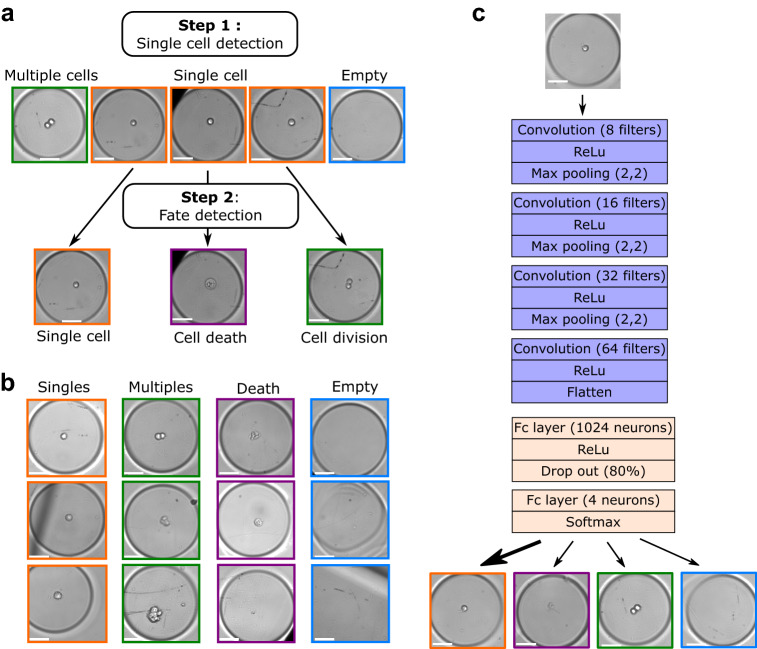
The detection of cancer stem-like cells (CSCs) is mainly based on molecular markers or functional tests giving a posteriori results. Therefore label-free and real-time detection of single CSCs remains a difficult challenge. The recent development of microfluidics has made it possible to perform high-throughput single cell imaging under controlled conditions and geometries. Such a throughput requires adapted image analysis pipelines while providing the necessary amount of data for the development of machine-learning algorithms. In this paper, we provide a data-driven study to assess the complexity of brightfield time-lapses to monitor the fate of isolated cancer stem-like cells in non-adherent conditions. We combined for the first time individual cell fate and cell state temporality analysis in a unique algorithm. We show that with our experimental system and on two different primary cell lines our optimized deep learning based algorithm outperforms classical computer vision and shallow learning-based algorithms in terms of accuracy while being faster than cutting-edge convolutional neural network (CNNs). With this study, we show that tailoring our deep learning-based algorithm to the image analysis problem yields better results than pre-trained models. As a result, such a rapid and accurate CNN is compatible with the rise of high-throughput data generation and opens the door to on-the-fly CSC fate analysis.
癌症干细胞样细胞(CSC)的检测主要基于分子标记或功能测试,给出后验结果。因此,对单个 CSC 的无标记和实时检测仍然是一个具有挑战性的难题。微流控技术的最新发展使得在受控条件和几何形状下进行高通量单细胞成像成为可能。这种高通量需要适应的图像分析管道,同时为机器学习算法的开发提供必要的数据量。在本文中,我们提供了一项数据驱动的研究,以评估在非贴壁条件下监测分离的癌症干细胞样细胞命运的明场延时监测的复杂性。我们首次将单个细胞命运和细胞状态时间分析结合在一个独特的算法中。我们表明,在我们的实验系统和两种不同的原代细胞系上,我们优化的基于深度学习的算法在准确性方面优于经典计算机视觉和基于浅层学习的算法,而速度比最先进的卷积神经网络(CNN)更快。通过这项研究,我们表明,针对图像分析问题定制基于深度学习的算法比预训练模型产生更好的结果。因此,这种快速准确的 CNN 与高通量数据生成的兴起兼容,并为实时 CSC 命运分析开辟了道路。