Department of Pediatrics, Division of Neonatology, University of Texas Health San Antonio, San Antonio, TX, USA.
Department of Pediatrics, Division of Neonatology, University Health System, San Antonio, TX, USA.
Pediatr Res. 2023 Jun;93(7):2028-2035. doi: 10.1038/s41390-022-02364-6. Epub 2022 Nov 10.
To compare body composition and growth in very low birthweight infants according to their source of human milk: maternal expressed breast milk (MEBM) versus donor breast milk (DBM). We hypothesized that infants fed predominately MEBM would exhibit reduced body fat percentage compared to those fed predominately DBM.
Premature infants weighing ≤1500 g on an exclusive human milk diet were enrolled in a single-center study between 2017 and 2021. Demographic data and anthropometric measurements were collected. All infants underwent body composition analysis via dual energy x-ray absorptiometry at 36 weeks corrected post menstrual age.
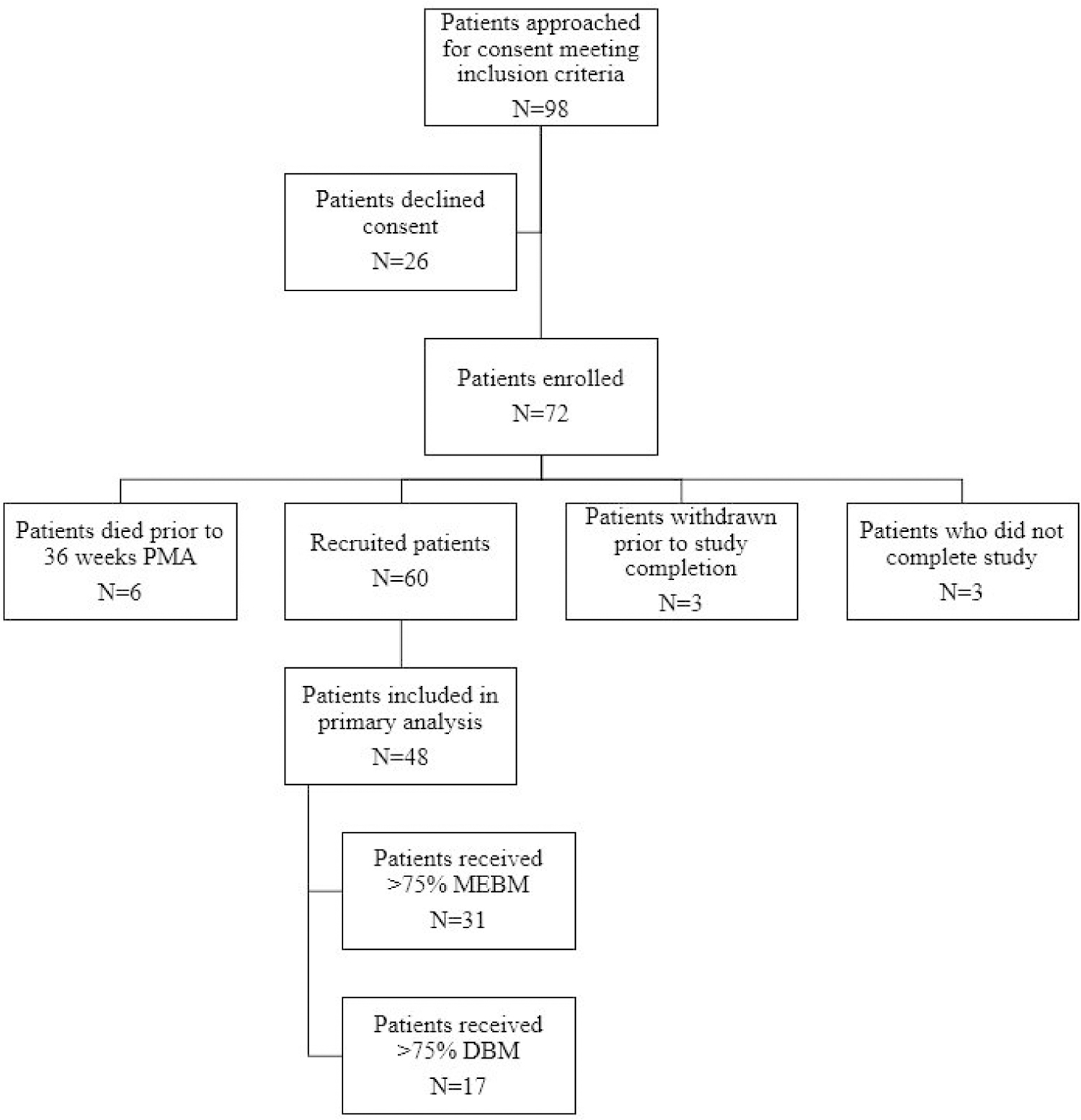
A total of 60 infants were enrolled and 48 were included in the primary analysis. No differences were detected in percent body fat (14 vs. 12%, p = 0.7) or fat-free mass (2050 vs. 2130 g, p = 0.7). Both groups displayed similar growth and anthropometric measurements. Caloric and macronutrient intake between groups was similar.
In the cohort of patients studied, no differences were observed in percent body fat based on primary human milk type intake in the first 28 postnatal days. Further investigation is required in a larger population of exclusive human milk fed preterm infants to determine if body composition differences exist based on an infant's primary human milk source.
Premature infants are at risk for altered body composition at term corrected age, specifically increased body fat percentage, which may have implications for the future. To our knowledge this is the first study exploring body composition outcomes based on an infant's primary human milk source. Infants fed exclusive human milk (e.g., donor vs. maternal) displayed similar percent body fat and growth outcomes.
比较极低出生体重儿根据人乳来源的体成分和生长情况:母乳(MEBM)与捐赠母乳(DBM)。我们假设,与主要喂养 DBM 的婴儿相比,主要喂养 MEBM 的婴儿体脂百分比会降低。
2017 年至 2021 年,在一家单中心进行了一项研究,纳入了单纯人乳喂养且出生体重≤1500g 的早产儿。收集人口统计学数据和人体测量学数据。所有婴儿在 36 周校正胎龄时均通过双能 X 射线吸收法进行体成分分析。
共纳入 60 例婴儿,48 例婴儿纳入主要分析。两组婴儿的体脂百分比(14%比 12%,p=0.7)或去脂体重(2050g 比 2130g,p=0.7)均无差异。两组的生长和人体测量数据相似。两组间的热量和宏量营养素摄入相似。
在本研究队列中,在出生后 28 天内,根据主要人乳类型摄入,婴儿体脂百分比无差异。需要在更大的单纯人乳喂养早产儿人群中进一步研究,以确定婴儿的主要人乳来源是否存在体成分差异。
早产儿在校正胎龄时存在体成分改变的风险,特别是体脂百分比增加,这可能对未来有影响。据我们所知,这是第一项基于婴儿主要人乳来源探索体成分结果的研究。单纯人乳喂养(如捐赠人乳与母亲人乳)的婴儿体脂百分比和生长结果相似。