Ferrer-Quintero Marta, Fernández Daniel, López-Carrilero Raquel, Díaz-Cutraro Luciana, Verdaguer-Rodríguez Marina, García-Mieres Helena, Huerta-Ramos Elena, Gómez-Benito Juana, Peláez Trini, Birulés Irene, Barajas Ana, Pousa Esther, Barrigón Marisa, Gutiérrez-Zotes Alfonso, Grasa Eva, Ruiz-Delgado Isabel, Lorente-Rovira Esther, Cid Jordi, Ochoa Susana
Parc Sanitari Sant Joan de Déu, Sant Boi de Llobregat, 08830 Barcelona, Spain.
Department of Social and Quantitative Psychology, Faculty of Psychology, University of Barcelona, 08035 Barcelona, Spain.
Healthcare (Basel). 2022 Oct 28;10(11):2155. doi: 10.3390/healthcare10112155.
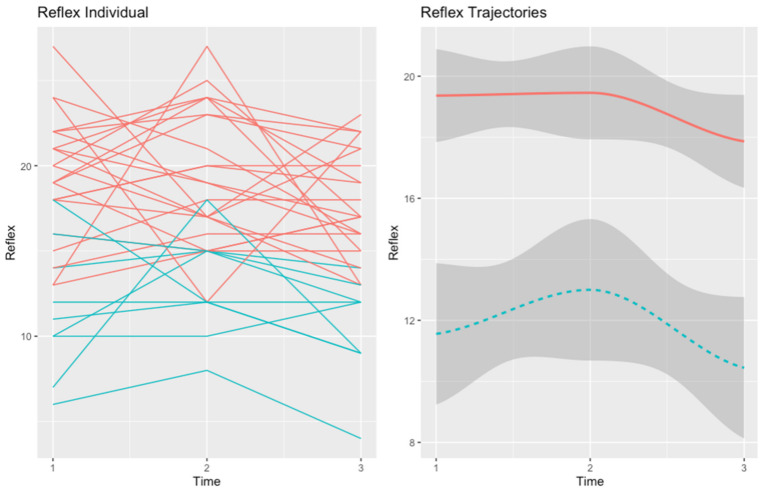
Metacognitive training (MCT) is an effective treatment for psychosis. Longitudinal trajectories of treatment response are unknown but could point to strategies to maximize treatment efficacy during the first episodes. This work aims to explore the possible benefit of using latent class mixed models (LCMMs) to understand how treatment response differs between metacognitive training and psychoeducation. We conducted LCMMs in 28 patients that received MCT and 34 patients that received psychoeducation. We found that MCT is effective in improving cognitive insight in all patients but that these effects wane at follow-up. In contrast, psychoeducation does not improve cognitive insight, and may increase self-certainty in a group of patients. These results suggest that LCMMs are valuable tools that can aid in treatment prescription and in predicting response to specific treatments.
元认知训练(MCT)是一种治疗精神病的有效方法。治疗反应的纵向轨迹尚不清楚,但可能会为首次发作期间最大化治疗效果的策略指明方向。这项工作旨在探索使用潜在类别混合模型(LCMMs)来理解元认知训练和心理教育之间治疗反应差异的潜在益处。我们对28名接受MCT的患者和34名接受心理教育的患者进行了LCMMs分析。我们发现,MCT对改善所有患者的认知洞察力有效,但这些效果在随访时会减弱。相比之下,心理教育并不能改善认知洞察力,且可能会增加一组患者的自我确定性。这些结果表明,LCMMs是有价值的工具,有助于治疗方案的制定以及预测对特定治疗的反应。