Department of Nutrition, School of Public Health, Anhui Medical University, Hefei 230032, China.
School of Public Health, Wannan Medical College, Wuhu 241002, China.
Nutrients. 2022 Oct 24;14(21):4462. doi: 10.3390/nu14214462.
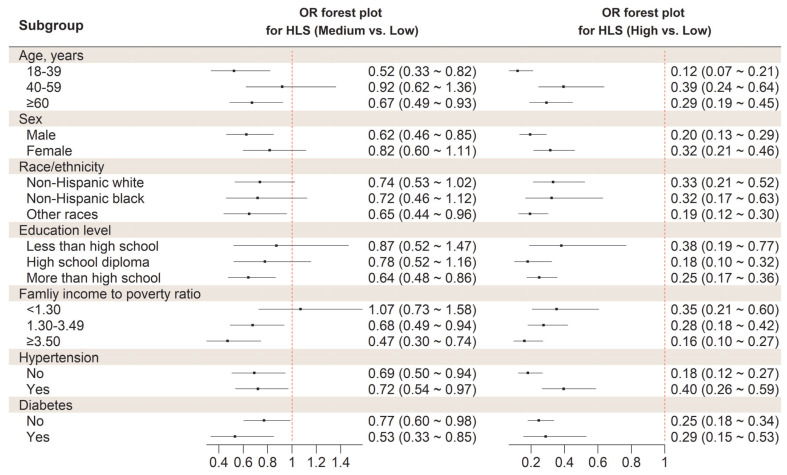
Growing evidence supports that individual lifestyle factors contribute to the development of non-alcoholic fatty liver disease (NAFLD) without considering the coexistence and synergistic effect of lifestyle factors. Our aim is to derive a healthy lifestyle score (HLS) and estimate its association with NAFLD. In this nationwide cross-sectional study, we derived a five-item HLS including dietary pattern, body mass index, physical activity, cigarette smoking, and sleep duration. NAFLD and clinically significant fibrosis (CSF) were assessed based on vibration-controlled transient elastography (VCTE). Liver function parameters were also tested. Multivariable logistic and linear regressions were applied to investigate the association between HLS and liver diseases. Of the 3893 participants with VCTE examination, approximately 14.1% of participants possessed zero or one healthy lifestyle, 62.5% possessed two or three healthy lifestyles, and 23.4% possessed four or five healthy lifestyles. Compared with participants with a low HLS (0−1 score), the adjusted odds ratios and 95% confidence intervals for those with a high HLS (4−5 score) were 0.25 (0.190.33, Ptrend < 0.001) for NAFLD and 0.30 (0.180.50, Ptrend < 0.001) for CSF. HLS was positively associated with albumin, total protein, and total bilirubin (all Ptrend ≤ 0.001), and was inversely associated with globulin, alanine aminotransferase, and gamma-glutamyl transaminase (all Ptrend ≤ 0.003). Higher adherence to HLS is associated with lower odds of NAFLD and CSF and may improve liver function. Strategies for the promotion of a healthy lifestyle should be considered as part of NAFLD prevention.
越来越多的证据表明,个体生活方式因素在非酒精性脂肪性肝病(NAFLD)的发生发展中起作用,而不考虑生活方式因素的共存和协同作用。我们的目的是制定一个健康生活方式评分(HLS),并评估其与 NAFLD 的相关性。在这项全国性的横断面研究中,我们制定了一个包含饮食模式、体重指数、身体活动、吸烟和睡眠时间的五项 HLS。NAFLD 和临床显著纤维化(CSF)根据振动控制瞬态弹性成像(VCTE)进行评估。还测试了肝功能参数。应用多变量逻辑和线性回归来研究 HLS 与肝脏疾病之间的关系。在接受 VCTE 检查的 3893 名参与者中,大约 14.1%的参与者具有零或一种健康生活方式,62.5%的参与者具有两种或三种健康生活方式,23.4%的参与者具有四种或五种健康生活方式。与 HLS 低(0-1 分)的参与者相比,HLS 高(4-5 分)的参与者患 NAFLD 的调整比值比和 95%置信区间为 0.25(0.190.33,Ptrend<0.001),患 CSF 的比值比和 95%置信区间为 0.30(0.180.50,Ptrend<0.001)。HLS 与白蛋白、总蛋白和总胆红素呈正相关(所有 Ptrend≤0.001),与球蛋白、丙氨酸氨基转移酶和γ-谷氨酰转移酶呈负相关(所有 Ptrend≤0.003)。更高的 HLS 依从性与较低的 NAFLD 和 CSF 几率相关,并可能改善肝功能。应考虑促进健康生活方式的策略作为 NAFLD 预防的一部分。