Medical Science, Kawasaki Medical School, 577 Matsushima, Kurashiki, Okayama 701-0192, Japan.
Cardiovascular, Renal, and Metabolism, Medical Affairs, AstraZeneca K.K., Tower B Grand Front Osaka, 3-1 Ofukacho, Kita-ku, Osaka 530-0011, Japan.
Nutrients. 2022 Nov 3;14(21):4614. doi: 10.3390/nu14214614.
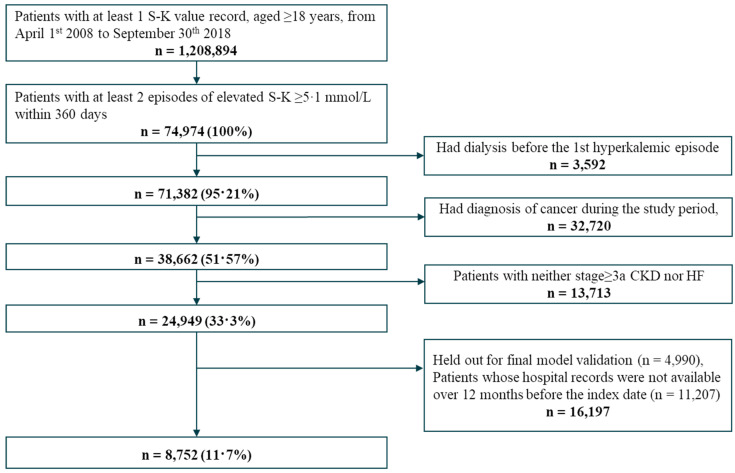
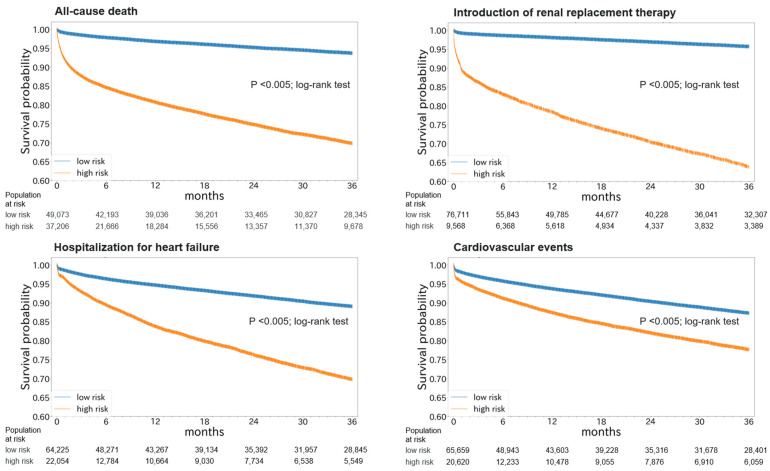
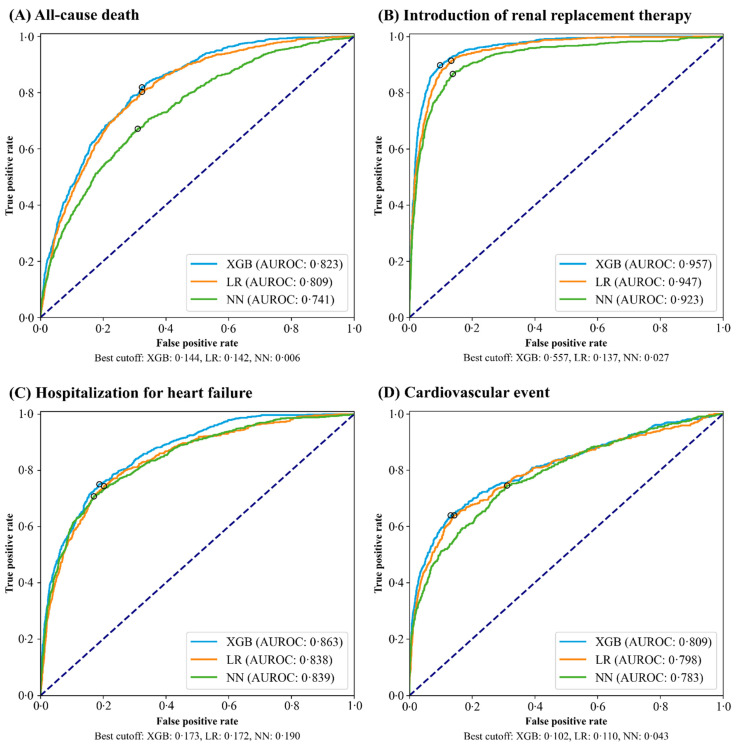
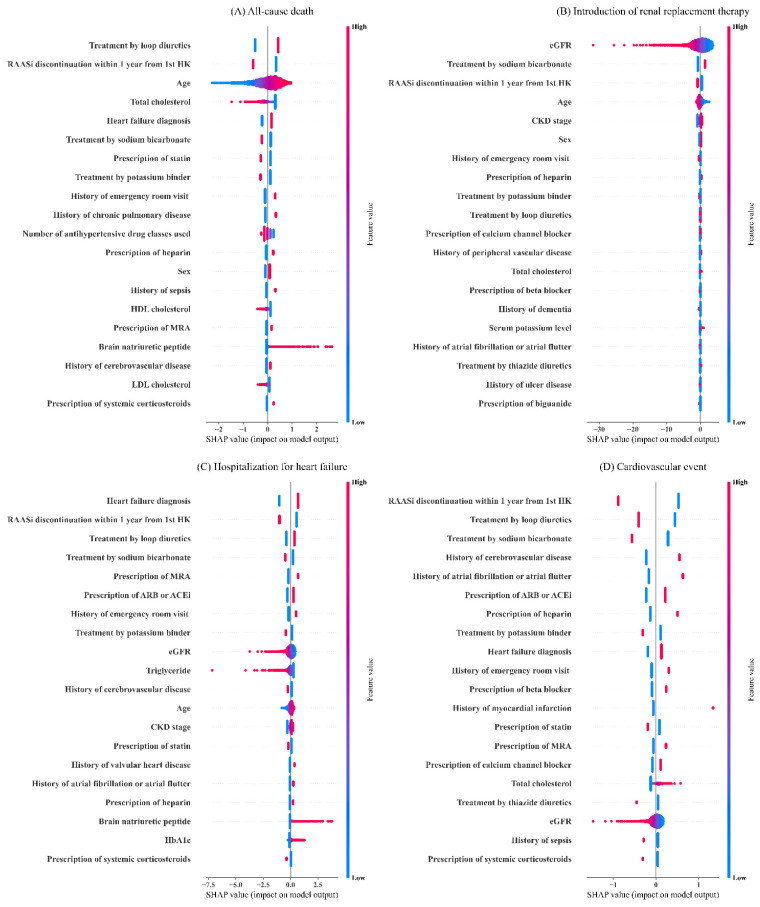
Hyperkalemia is associated with increased risks of mortality and adverse clinical outcomes. The treatment of hyperkalemia often leads to the discontinuation or restriction of beneficial but potassium-increasing therapy such as renin-angiotensin-aldosterone inhibitors (RAASi) and high-potassium diet including fruits and vegetables. To date, limited evidence is available for personalized risk evaluation in this heterogeneous and multifactorial pathophysiological condition. We developed risk prediction models using extreme gradient boosting (XGB), multiple logistic regression (LR), and deep neural network. Models were derived from a retrospective cohort of hyperkalemic patients with either heart failure or chronic kidney disease stage ≥3a from a Japanese nationwide database (1 April 2008−30 September 2018). Studied outcomes included all-cause death, renal replacement therapy introduction (RRT), hospitalization for heart failure (HHF), and cardiovascular events within three years after hyperkalemic episodes. The best performing model was further validated using an external cohort. A total of 24,949 adult hyperkalemic patients were selected for model derivation and internal validation. A total of 1452 deaths (16.6%), 887 RRT (10.1%), 1,345 HHF (15.4%), and 621 cardiovascular events (7.1%) were observed. XGB outperformed other models. The area under receiver operator characteristic curves (AUROCs) of XGB vs. LR (95% CIs) for death, RRT, HHF, and cardiovascular events were 0.823 (0.805−0.841) vs. 0.809 (0.791−0.828), 0.957 (0.947−0.967) vs. 0.947 (0.936−0.959), 0.863 (0.846−0.880) vs. 0.838 (0.820−0.856), and 0.809 (0.784−0.834) vs. 0.798 (0.772−0.823), respectively. In the external dataset including 86,279 patients, AUROCs (95% CIs) for XGB were: death, 0.747 (0.742−0.753); RRT, 0.888 (0.882−0.894); HHF, 0.673 (0.666−0.679); and cardiovascular events, 0.585 (0.578−0.591). Kaplan−Meier curves of the high-risk predicted group showed a statistically significant difference from that of the low-risk predicted groups for all outcomes (p < 0.005; log-rank test). These findings suggest possible use of machine learning models for real-world risk assessment as a guide for observation and/or treatment decision making that may potentially lead to improved outcomes in hyperkalemic patients while retaining the benefit of life-saving therapies.
高钾血症与死亡率和不良临床结局风险增加相关。高钾血症的治疗常导致终止或限制有益但增加血钾的治疗,如肾素-血管紧张素-醛固酮抑制剂(RAASi)和包括水果和蔬菜在内的高钾饮食。迄今为止,对于这种异质和多因素病理生理状况的个性化风险评估,可用的证据有限。我们使用极端梯度增强(XGB)、多变量逻辑回归(LR)和深度神经网络开发了风险预测模型。模型来自于日本全国数据库中(2008 年 4 月 1 日至 2018 年 9 月 30 日)患有心力衰竭或慢性肾脏病 3a 期以上的高钾血症患者的回顾性队列。研究结果包括所有原因死亡、肾脏替代治疗(RRT)、心力衰竭住院(HHF)和高钾血症发作后三年内的心血管事件。表现最好的模型使用外部队列进一步验证。共选择了 24949 名成年高钾血症患者用于模型推导和内部验证。共观察到 1452 例死亡(16.6%)、887 例 RRT(10.1%)、1345 例 HHF(15.4%)和 621 例心血管事件(7.1%)。XGB 优于其他模型。XGB 与 LR(95%CI)在死亡、RRT、HHF 和心血管事件方面的接收器操作特征曲线(AUROCs)面积分别为 0.823(0.805-0.841)与 0.809(0.791-0.828)、0.957(0.947-0.967)与 0.947(0.936-0.959)、0.863(0.846-0.880)与 0.838(0.820-0.856)和 0.809(0.784-0.834)与 0.798(0.772-0.823)。在包括 86279 名患者的外部数据集,XGB 的 AUROCs(95%CI)为:死亡,0.747(0.742-0.753);RRT,0.888(0.882-0.894);HHF,0.673(0.666-0.679);心血管事件,0.585(0.578-0.591)。高风险预测组的 Kaplan-Meier 曲线与低风险预测组在所有结局上均有统计学显著差异(p < 0.005;对数秩检验)。这些发现表明,机器学习模型可能可用于真实世界的风险评估,作为观察和/或治疗决策的指南,这可能会改善高钾血症患者的预后,同时保留挽救生命治疗的益处。