Argabright Stirling T, Tran Kate T, Visoki Elina, DiDomenico Grace E, Moore Tyler M, Barzilay Ran
Department of Child and Adolescent Psychiatry and Behavioral Sciences, Children's Hospital of Philadelphia (CHOP), Philadelphia, PA, USA.
Lifespan Brain Institute of CHOP and Penn Medicine, Philadelphia, PA, USA.
Lancet Reg Health Am. 2022 Dec;16:100391. doi: 10.1016/j.lana.2022.100391. Epub 2022 Nov 15.
The COVID-19 pandemic and associated responses have induced a host of crises worldwide, including an economic recession and a global mental health crisis. The specific effects of recession on youth mental health are understudied. We aimed to examine the mechanisms by which pandemic-related financial strain may affect mental health in a diverse sample of American adolescents.
We analyzed data from the Adolescent Brain Cognitive Development Study (ABCD Study®), a large, longitudinal study of diverse US adolescents which collected data before and during the pandemic (N = 9,720, mean age 12.9 years, 18.2% Black). Linear mixed-effects models tested associations of financial strain (parent-reported household wage loss and youth-reported financial stress) with depressive symptomatology over time, covarying for multiple confounders including pre-pandemic socioeconomic status and psychopathology, and pandemic-related environmental factors. Longitudinal mediation analyses examined potential mechanisms leading from wage loss to youth mental health.
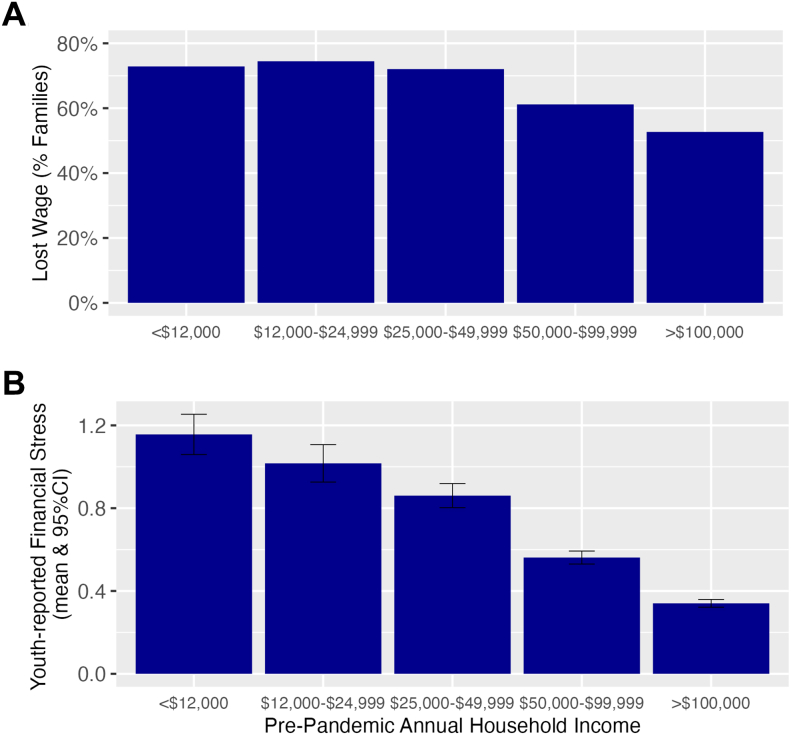
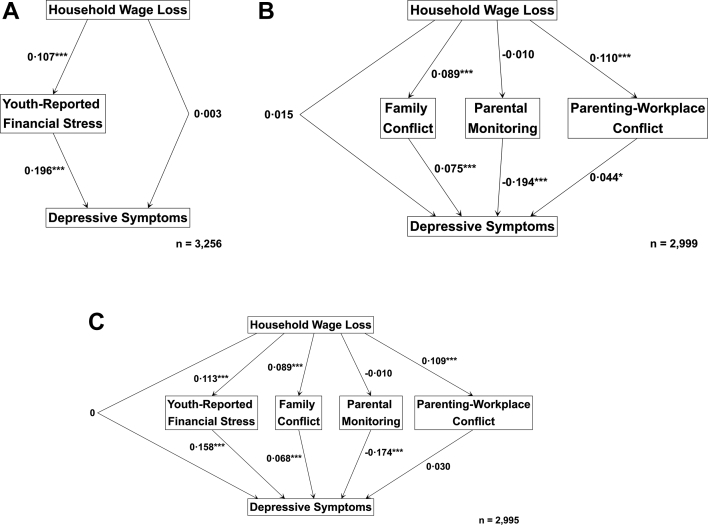
Financial strain was highly prevalent, especially among low-income participants, with >70% of the total sample reporting lost wages. Both wage loss and subjective financial stress were associated with depressive symptomatology over time (Estimate = 0.04, P = 0.014; Estimate = 0.17, P < 0.001; respectively). The association between financial stress and depressive symptomatology was robust to the addition of multiple environmental confounders (Estimate = 0.16, P < 0.001). Both family-level (family conflict) and individual-level (financial stress) factors mediated the relationship between wage loss and depressive symptomatology.
The financial effects of COVID-19 (and worldwide responses to it) have taken a significant toll on youth mental health. In families that lost wages, youth-reported financial stress and familial factors mediated the relationship between wage loss and mental health over time. Findings highlight financial stress as a key driver of youth mental health burden and identify familial factors as critical targets for intervention to mitigate mental health risks in periods of economic crises.
This study was supported by the National Institute of Mental Health [grant numbers K23MH120437 (RB), R01MH117014 (TMM)]; the Lifespan Brain Institute of Children's Hospital of Philadelphia and Penn Medicine, University of Pennsylvania.
新冠疫情及其相关应对措施在全球引发了一系列危机,包括经济衰退和全球心理健康危机。衰退对青少年心理健康的具体影响尚未得到充分研究。我们旨在探究与疫情相关的经济压力可能影响美国青少年多样化样本心理健康的机制。
我们分析了青少年大脑认知发展研究(ABCD研究®)的数据,这是一项针对美国青少年的大型纵向研究,在疫情之前和期间收集数据(N = 9720,平均年龄12.9岁,18.2%为黑人)。线性混合效应模型测试了经济压力(父母报告的家庭工资损失和青少年报告的经济压力)与随时间变化的抑郁症状之间的关联,并对包括疫情前社会经济地位和精神病理学以及与疫情相关的环境因素在内的多个混杂因素进行了协变量调整。纵向中介分析研究了从工资损失到青少年心理健康的潜在机制。
经济压力非常普遍,尤其是在低收入参与者中,超过70%的总样本报告有工资损失。随着时间的推移,工资损失和主观经济压力均与抑郁症状相关(估计值分别为0.04,P = 0.014;估计值为0.17,P < 0.001)。经济压力与抑郁症状之间的关联在加入多个环境混杂因素后仍然稳健(估计值为0.16,P < 0.001)。家庭层面(家庭冲突)和个人层面(经济压力)因素均介导了工资损失与抑郁症状之间的关系。
新冠疫情的经济影响(以及全球对此的应对措施)对青少年心理健康造成了重大损失。在工资受损的家庭中,青少年报告的经济压力和家庭因素随着时间的推移介导了工资损失与心理健康之间的关系。研究结果突出了经济压力是青少年心理健康负担的关键驱动因素,并确定家庭因素是在经济危机期间减轻心理健康风险的关键干预目标。
本研究得到了美国国立精神卫生研究所[资助编号K23MH120437(RB)、R01MH117014(TMM)];费城儿童医院和宾夕法尼亚大学佩雷尔曼医学院的寿命大脑研究所的支持。