Makar Piotr, Praça Gibson, Kawczyński Adam, Akyildiz Zeki, Yıldız Mehmet, Aquino Rodrigo, Clemente Filipe Manuel
Gdańsk University of Physical Education and Sport, Gdańsk, Poland.
Sports Department, Universidade Federal de Minas Gerais, Belo Horizonte, Brazil.
BMC Sports Sci Med Rehabil. 2022 Nov 24;14(1):199. doi: 10.1186/s13102-022-00592-1.
This study tested the effects of two training programs (one program based on extreme sided-games of 1v1 vs. one program based on the medium-sided game of 5v5) on the physical fitness adaptations of youth soccer players. In specific, it was analyzed the effects of the training programs on the 5-0-5 change-of-direction time (5-0-5 time), countermovement jump (CMJ), and final velocity in the 30-15 Intermittent Fitness test (VIFT).
This study followed a randomized parallel study design. Twenty male regional-level soccer players (age: 17.0 ± 0.3 years old) were randomly assigned to two groups: (1) the 1v1 format; and (2) the 5v5 format. The training intervention lasted four weeks. The week before (baseline) and the week after the intervention, the participants were assessed in the 5-0-5 change-of-direction test (measured using timing gates), CMJ (measured by photoelectric cells), and 30-15 Intermittent Fitness test. The training intervention consisted of 8 sessions (2 sessions per week). The 1v1 group performed four repetitions of 30 s in each session, while the 5v5 group performed four repetitions of 4 min.
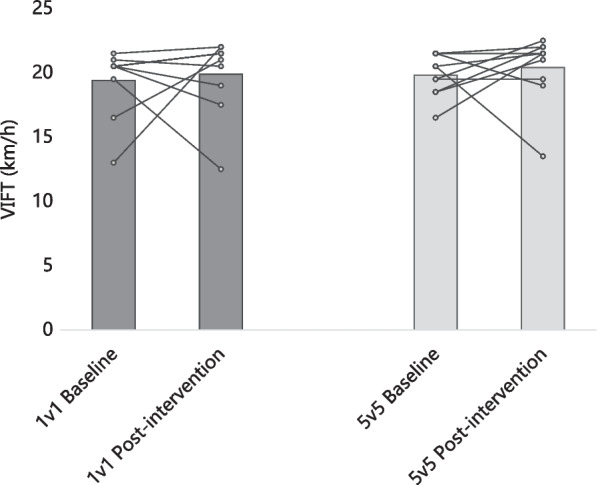
The 5-0-5 time changed - 4.82% (p = 0.004; d = 1.115) for the 1v1 group and - 4.26% (p = 0.004; d = 0.859) for the 5v5 group. CMJ changes occurred both in the 1v1 and 5v5 group and amounted to 1.7% (p = 0.003; d = 0.509) and 1.2% (p = 0.263; d = 0.155) respectively. VIFT changed 2.6% (p = 0.718; d = 0.178) for the 1v1 group and 3.0% (p = 0.593; d = 0.274) for the 5v5 group. The 1v1 group reported significantly lower post-intervention 5-0-5 time than the 5v5 group (- 4.3%; p = 0.048; d = 0.954), although no significant differences in CMJ (3.2%; p = 0.147; d = 0.678) and VIFT (2.5%; p = 0.697; d = 0.177) were revealed.
The extreme-sided games meaningfully beneficiated the vertical jump height and change-of-direction performance of youth soccer players. The extreme-sided games seem more beneficial than medium-sided games for improving these physical abilities while showing that four weeks were enough to impact the players significantly.
本研究测试了两种训练方案(一种基于1对1的极限边路比赛,另一种基于5对5的中等边路比赛)对青少年足球运动员体能适应的影响。具体而言,分析了训练方案对5-0-5变向时间(5-0-5时间)、反向纵跳(CMJ)以及30-15间歇体能测试中的最终速度(VIFT)的影响。
本研究采用随机平行研究设计。20名男性地区级足球运动员(年龄:17.0±0.3岁)被随机分为两组:(1)1对1形式组;(2)5对5形式组。训练干预持续四周。在干预前一周(基线)和干预后一周,对参与者进行5-0-5变向测试(使用计时门测量)、CMJ(通过光电细胞测量)和30-15间歇体能测试。训练干预包括8节训练课(每周2节)。1对1组每组进行4次30秒的重复训练,而5对5组每组进行4次4分钟的重复训练。
1对1组的5-0-5时间变化了-4.82%(p=0.004;d=1.115),5对5组变化了-4.26%(p=0.004;d=0.859)。1对1组和5对5组的CMJ均有变化,分别为1.7%(p=0.003;d=0.509)和1.2%(p=0.263;d=0.155)。1对1组的VIFT变化了2.6%(p=0.718;d=0.178),5对5组变化了3.0%(p=0.593;d=0.274)。1对1组干预后的5-0-5时间显著低于5对5组(-4.3%;p=0.048;d=0.954),尽管在CMJ(3.2%;p=0.147;d=0.678)和VIFT(2.5%;p=0.697;d=0.177)方面未发现显著差异。
极限边路比赛对青少年足球运动员的垂直跳跃高度和变向能力有显著益处。极限边路比赛在提高这些体能方面似乎比中等边路比赛更有益,同时表明四周的训练足以对运动员产生显著影响。