Department of Engineering and Architecture, University of Trieste, 34127 Trieste, Italy.
Department of Chemical and Pharmaceutical Sciences and INSTM Trieste Research Unit, University of Trieste, 34127 Trieste, Italy.
ACS Nano. 2022 Dec 27;16(12):20902-20914. doi: 10.1021/acsnano.2c08467. Epub 2022 Dec 2.
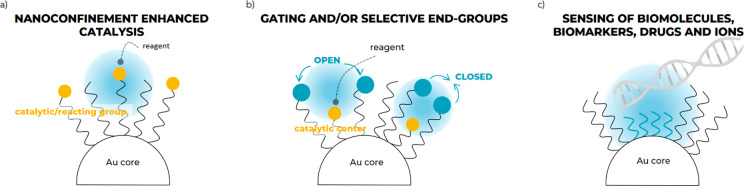
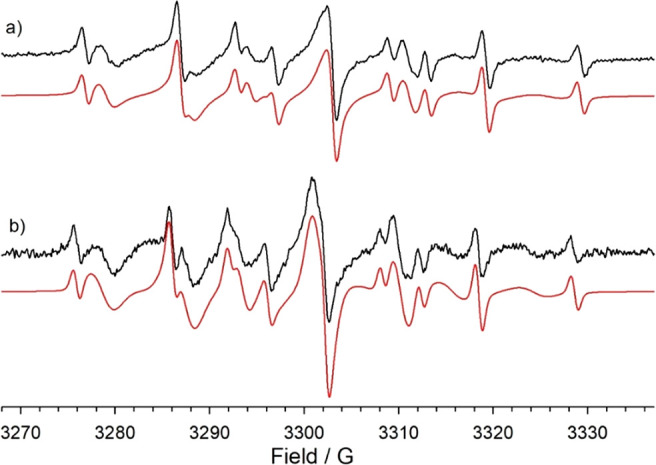
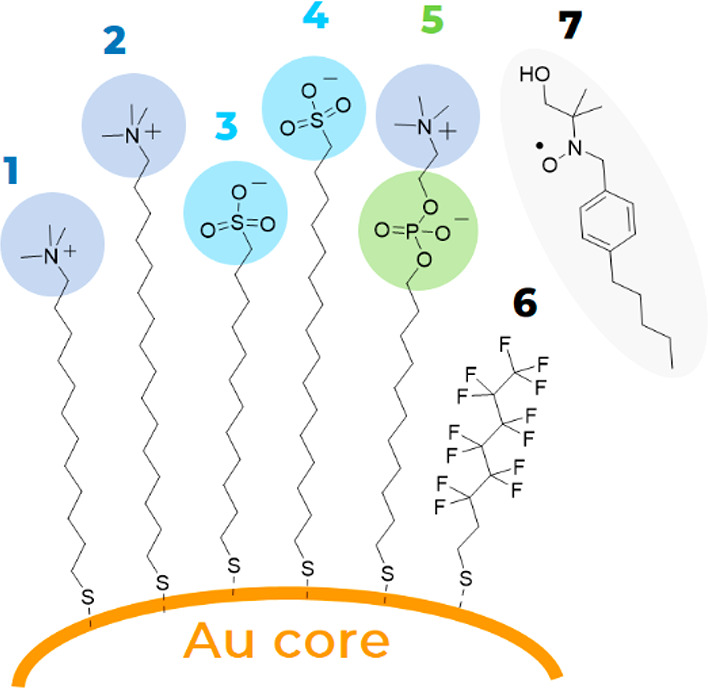
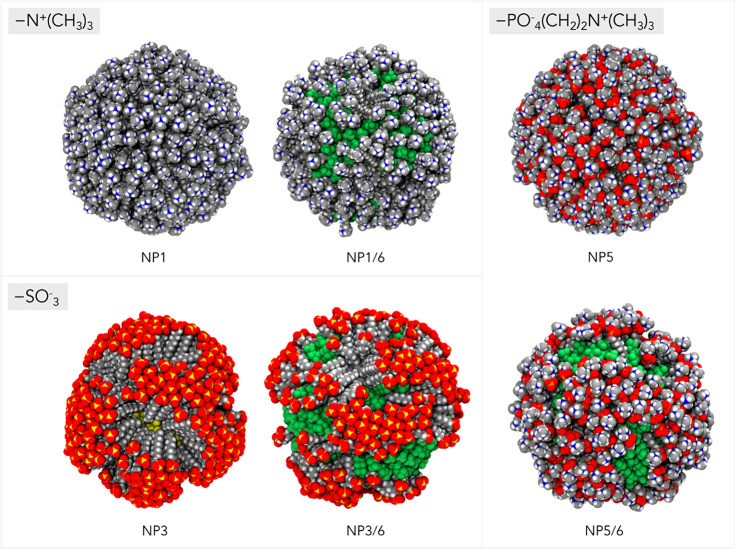
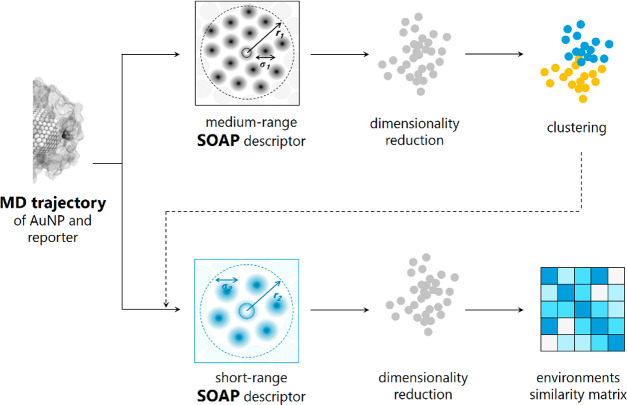
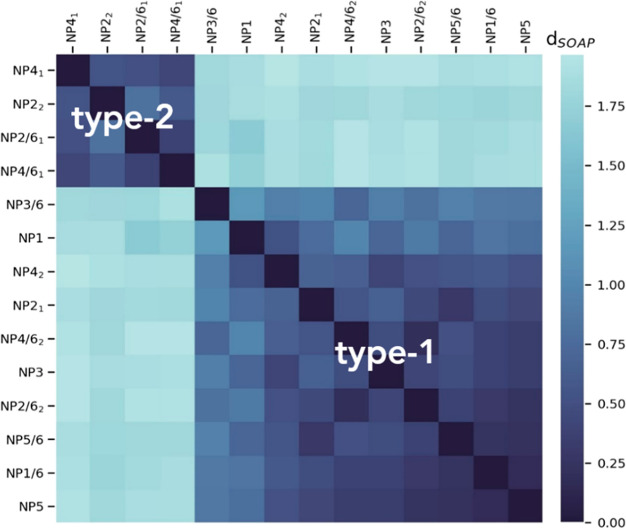
Organic-inorganic (O-I) nanomaterials are versatile platforms for an incredible high number of applications, ranging from heterogeneous catalysis to molecular sensing, cell targeting, imaging, and cancer diagnosis and therapy, just to name a few. Much of their potential stems from the unique control of organic environments around inorganic sites within a single O-I nanomaterial, which allows for new properties that were inaccessible using purely organic or inorganic materials. Structural and mechanistic characterization plays a key role in understanding and rationally designing such hybrid nanoconstructs. Here, we introduce a general methodology to identify and classify local (supra)molecular environments in an archetypal class of O-I nanomaterials, i.e., self-assembled monolayer-protected gold nanoparticles (SAM-AuNPs). By using an atomistic machine-learning guided workflow based on the Smooth Overlap of Atomic Positions (SOAP) descriptor, we analyze a collection of chemically different SAM-AuNPs and detect and compare local environments in a way that is agnostic and automated, i.e., with no need of information and minimal user intervention. In addition, the computational results coupled with experimental electron spin resonance measurements prove that is possible to have more than one local environment inside SAMs, being the thickness of the organic shell and solvation primary factors in the determining number and nature of multiple coexisting environments. These indications are extended to complex mixed hydrophilic-hydrophobic SAMs. This work demonstrates that it is possible to spot and compare local molecular environments in SAM-AuNPs exploiting atomistic machine-learning approaches, establishes ground rules to control them, and holds the potential for the rational design of O-I nanomaterials instructed from data.
有机-无机(O-I)纳米材料是多功能平台,可应用于从多相催化到分子传感、细胞靶向、成像以及癌症诊断和治疗等众多领域。它们的大部分潜力源于在单个 O-I 纳米材料中对无机位点周围有机环境的独特控制,这使得使用纯有机或无机材料无法获得新的性质。结构和机理表征在理解和合理设计这种混合纳米结构中起着关键作用。在这里,我们介绍了一种通用方法,用于识别和分类典型的 O-I 纳米材料类别,即自组装单分子层保护的金纳米粒子(SAM-AuNPs)中的局部(超)分子环境。通过使用基于原子位置平滑重叠(SOAP)描述符的原子级机器学习引导工作流程,我们分析了一系列化学性质不同的 SAM-AuNPs,并以一种无信息且自动化的方式(即无需信息和最小用户干预)检测和比较局部环境。此外,计算结果结合电子自旋共振实验测量证明,SAM 中可以存在多个局部环境,有机壳的厚度和溶剂化是决定多个共存环境的数量和性质的主要因素。这些迹象扩展到复杂的混合亲水-亲脂性 SAM。这项工作表明,通过原子级机器学习方法可以识别和比较 SAM-AuNPs 中的局部分子环境,为控制这些环境奠定了基础,并为基于数据的 O-I 纳米材料的合理设计提供了潜力。