Pecina Adam, Rosa-Gastaldo Daniele, Riccardi Laura, Franco-Ulloa Sebastian, Milan Emil, Scrimin Paolo, Mancin Fabrizio, De Vivo Marco
Laboratory of Molecular Modeling and Drug Discovery, Istituto Italiano di Tecnologia, Via Morego 30, 16163 Genoa, Italy.
Dipartimento di Scienze Chimiche, Università di Padova, Via Marzolo 1, 35131 Padova, Italy.
ACS Catal. 2021 Jul 16;11(14):8736-8748. doi: 10.1021/acscatal.1c01215. Epub 2021 Jul 2.
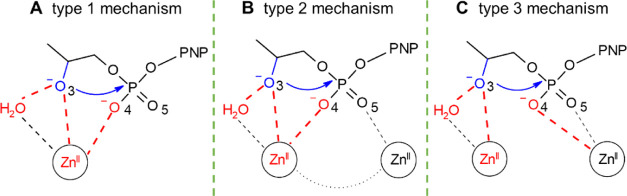
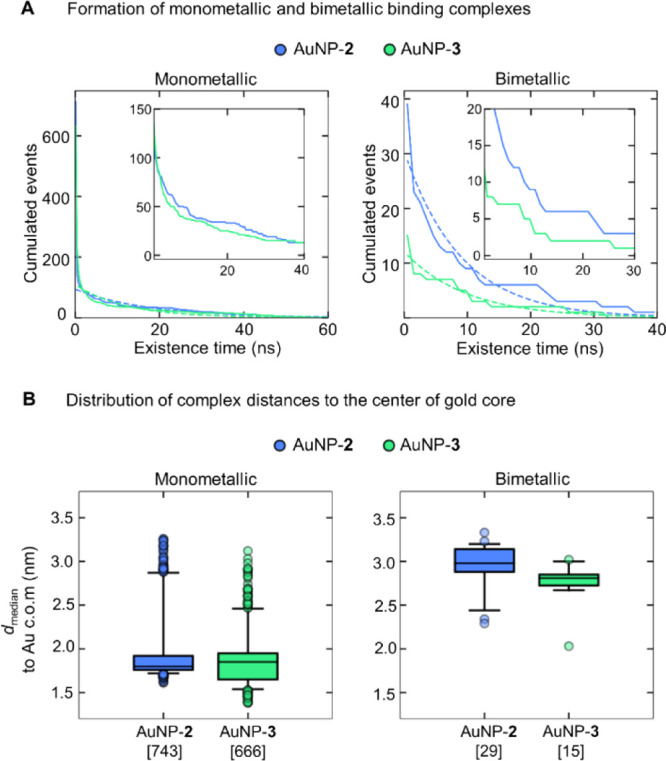
Recent studies have shown that gold nanoparticles (AuNPs) functionalized with Zn(II) complexes can cleave phosphate esters and nucleic acids. Remarkably, such synthetic nanonucleases appear to catalyze metal (Zn)-aided hydrolytic reactions of nucleic acids similar to metallonuclease enzymes. To clarify the reaction mechanism of these nanocatalysts, here we have comparatively analyzed two nanonucleases with a >10-fold difference in the catalytic efficiency for the hydrolysis of the 2-hydroxypropyl-4-nitrophenylphosphate (HPNP, a typical RNA model substrate). We have used microsecond-long atomistic simulations, integrated with NMR experiments, to investigate the structure and dynamics of the outer coating monolayer of these nanoparticles, either alone or in complex with HPNP, in solution. We show that the most efficient one is characterized by coating ligands that promote a well-organized monolayer structure, with the formation of solvated bimetallic catalytic sites. Importantly, we have found that these nanoparticles can mimic two-metal-ion enzymes for nucleic acid processing, with Zn ions that promote HPNP binding at the reaction center. Thus, the two-metal-ion-aided hydrolytic strategy of such nanonucleases helps in explaining their catalytic efficiency for substrate hydrolysis, in accordance with the experimental evidence. These mechanistic insights reinforce the parallelism between such functionalized AuNPs and proteins toward the rational design of more efficient catalysts.
最近的研究表明,用锌(II)配合物功能化的金纳米颗粒(AuNPs)可以切割磷酸酯和核酸。值得注意的是,这种合成纳米核酸酶似乎能催化类似于金属核酸酶的核酸金属(锌)辅助水解反应。为了阐明这些纳米催化剂的反应机制,我们在此对两种纳米核酸酶进行了比较分析,它们对2-羟丙基-4-硝基苯基磷酸酯(HPNP,一种典型的RNA模型底物)水解的催化效率相差10倍以上。我们使用了长达微秒级的原子模拟,并结合核磁共振实验,来研究这些纳米颗粒的外层包覆单层在溶液中单独或与HPNP形成复合物时的结构和动力学。我们表明,效率最高的纳米颗粒的特征在于其包覆配体促进了有序的单层结构,并形成了溶剂化的双金属催化位点。重要的是,我们发现这些纳米颗粒可以模拟用于核酸加工的双金属离子酶,锌离子促进HPNP在反应中心的结合。因此,这种纳米核酸酶的双金属离子辅助水解策略有助于根据实验证据解释其对底物水解的催化效率。这些机制上的见解加强了这种功能化AuNPs与蛋白质在合理设计更高效催化剂方面的相似性。