Wang Shengyou, Shao Chunfu, Zhang Jie, Zheng Yan, Meng Meng
School of Traffic Management, People's Public Security University of China, Beijing, 10038 China.
Key Laboratory of Transport Industry of Big Data Application Technologies for Comprehensive Transport, Beijing Jiaotong University, Beijing, 10044 China.
Urban Inform. 2022;1(1):16. doi: 10.1007/s44212-022-00015-z. Epub 2022 Dec 1.
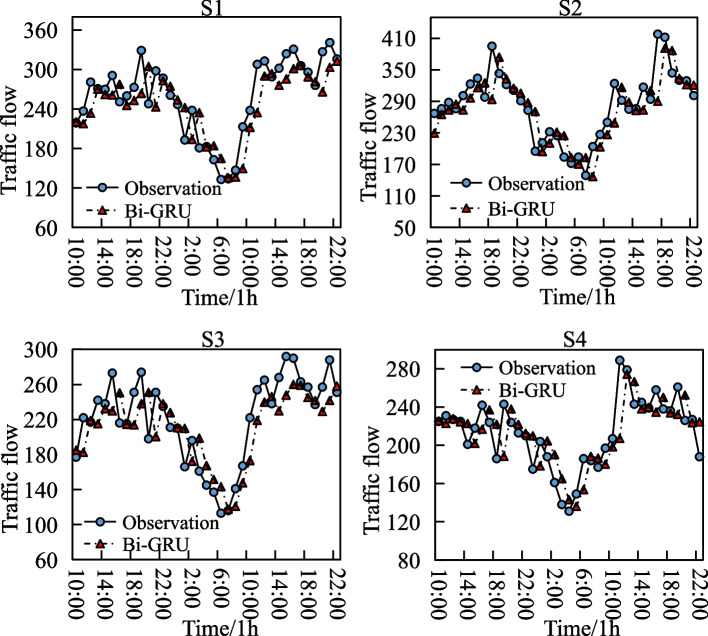
Traffic flow prediction plays an important role in intelligent transportation systems. To accurately capture the complex non-linear temporal characteristics of traffic flow, this paper adopts a Bi-directional Gated Recurrent Unit (Bi-GRU) model in traffic flow prediction. Compared to Gated Recurrent Unit (GRU), which can memorize information from the previous sequence, this model can memorize the traffic flow information in both previous and subsequent sequence. To demonstrate the model's performance, a set of real case data at 1-hour intervals from 5 working days was used, wherein the dataset was separated into training and validation. To improve data quality, an augmented dickey-fuller unit root test and differential processing were performed before model training. Four benchmark models were used, including the Autoregressive Integrated Moving Average (ARIMA), Long Short-Term Memory (LSTM), Bidirectional Long Short-Term Memory (Bi-LSTM), and GRU. The prediction results show the superior performance of Bi-GRU. The Root Mean Square Error (RMSE), Mean Absolute Percentage Error (MAPE), and Mean Absolute Error (MAE) of the Bi-GRU model are 30.38, 9.88%, and 23.35, respectively. The prediction accuracy of LSTM, Bi-LSTM, GRU, and Bi-GRU, which belong to deep learning methods, is significantly higher than that of the traditional ARIMA model. The MAPE difference of Bi-GRU and GRU is 0.48% which is a small prediction error value. The results show that the prediction accuracy of the peak period is higher than that of the low peak. The Bi-GRU model has a certain lag on traffic flow prediction.
交通流预测在智能交通系统中起着重要作用。为了准确捕捉交通流复杂的非线性时间特征,本文在交通流预测中采用了双向门控循环单元(Bi-GRU)模型。与能够记忆前序序列信息的门控循环单元(GRU)相比,该模型能够记忆前序和后续序列中的交通流信息。为了验证模型的性能,使用了一组来自5个工作日、间隔为1小时的实际案例数据,其中数据集被分为训练集和验证集。为了提高数据质量,在模型训练前进行了增强迪基-富勒单位根检验和差分处理。使用了四个基准模型,包括自回归积分移动平均(ARIMA)、长短期记忆(LSTM)、双向长短期记忆(Bi-LSTM)和GRU。预测结果显示了Bi-GRU的优越性能。Bi-GRU模型的均方根误差(RMSE)、平均绝对百分比误差(MAPE)和平均绝对误差(MAE)分别为30.38、9.88%和23.35。属于深度学习方法的LSTM、Bi-LSTM、GRU和Bi-GRU的预测准确率明显高于传统的ARIMA模型。Bi-GRU和GRU的MAPE差值为0.48%,这是一个较小的预测误差值。结果表明,高峰期的预测准确率高于低峰期。Bi-GRU模型在交通流预测上存在一定的滞后性。