Institute of Environmental Medicine, Integrative Toxicology, Karolinska Institutet, SE-171 77 Stockholm, Sweden.
Center for Occupational and Environmental Medicine, Region Stockholm, SE-113 65 Stockholm, Sweden.
Int J Environ Res Public Health. 2022 Nov 23;19(23):15542. doi: 10.3390/ijerph192315542.
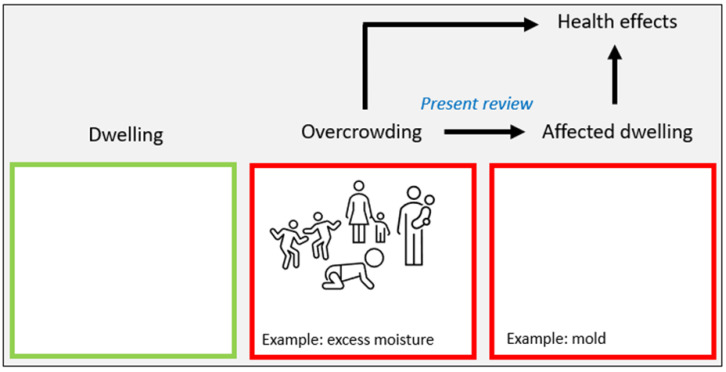
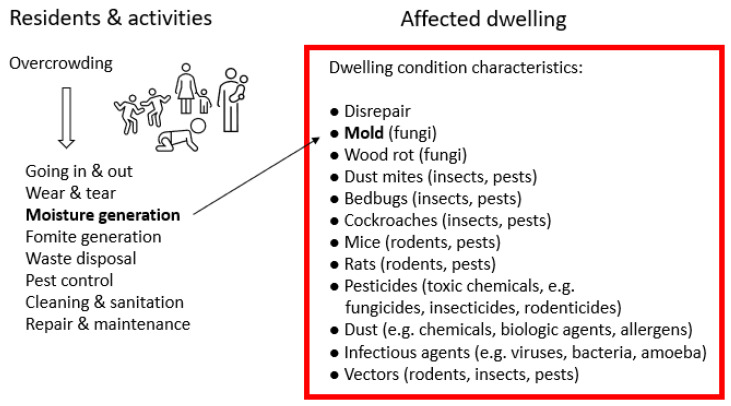
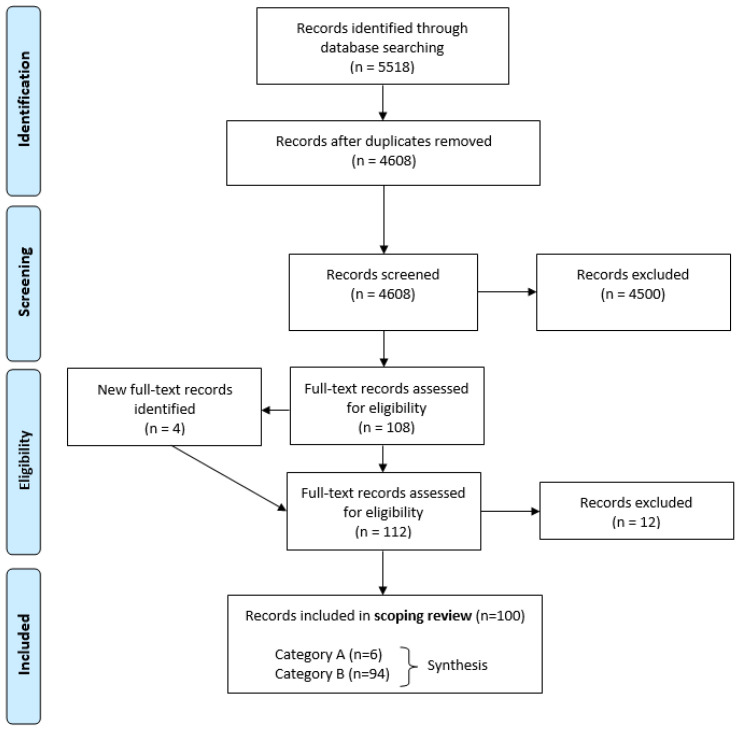
Crowding in dwellings is an important public health issue. We hypothesize that overcrowding may cause indirect health effects by adversely affecting the dwelling itself, for example, by increasing dampness leading to mold. We therefore performed a systematic search and a scoping review on overcrowding leading to dwelling condition characteristics of relevance for health. A literature search was performed using the PubMed and Scopus databases up to 5 March 2021. The search yielded 100 records with relevant information. We found that overcrowding is defined in numerous ways and often address "socially deprived" populations. Six studies report associations of overcrowding with at least one dwelling condition characteristic, namely lead, cadmium, microorganism distribution, dust mite and cockroach allergens in dust, cockroach infestation, peeling paint, and mold. One of the studies reports associations between several characteristics, e.g., association of mold with cleanliness and rodent infestation, and points out the common use of pesticides. Additional characteristics were extracted from the remaining 94 records, without data on statistical associations with overcrowding. Our review suggests that multiple potentially hazardous dwelling condition characteristics often coincide in overcrowded dwellings. The epidemiological attribution of health effects to any characteristic is therefore difficult. Causal relationships are even more difficult to establish, as overcrowding is also associated with a range of social and other circumstances that may affect health. The complexity should be considered by scientists and practitioners dealing with overcrowding in dwellings.
居住拥挤是一个重要的公共卫生问题。我们假设,居住拥挤可能通过对居住环境产生不利影响(例如,增加潮湿程度导致霉菌滋生)而间接对健康造成影响。因此,我们针对居住拥挤导致与健康相关的居住条件特征进行了系统检索和范围综述。使用 PubMed 和 Scopus 数据库进行了文献检索,截至 2021 年 3 月 5 日。该检索共获得 100 条包含相关信息的记录。我们发现,居住拥挤的定义方式众多,且通常针对“社会贫困”人群。有 6 项研究报告了居住拥挤与至少一种居住条件特征之间的关联,即铅、镉、微生物分布、尘螨和蟑螂过敏原在灰尘中的分布、蟑螂滋生、剥落的油漆和霉菌。其中一项研究报告了几种特征之间的关联,例如,霉菌与清洁度和鼠类滋生有关,并且指出了杀虫剂的普遍使用。从其余 94 条记录中提取了其他特征,但没有关于与居住拥挤相关的统计关联的数据。我们的综述表明,居住拥挤的住宅中通常存在多种潜在危险的居住条件特征。因此,很难将健康影响归因于任何特征。由于居住拥挤还与一系列可能影响健康的社会和其他情况有关,因此建立因果关系更加困难。科学家和从事住宅拥挤问题的从业人员应考虑到这种复杂性。