Wang Xi, Baidoo Edward E K, Kakumanu Ramu, Xie Silvia, Mukhopadhyay Aindrila, Lee Taek Soon
Joint BioEnergy Institute (JBEI), 5885 Hollis St., Emeryville, CA, 94608, USA.
Biological Systems & Engineering Division, Lawrence Berkeley National Laboratory, Berkeley, CA, 94720, USA.
Biotechnol Biofuels Bioprod. 2022 Dec 12;15(1):137. doi: 10.1186/s13068-022-02235-6.
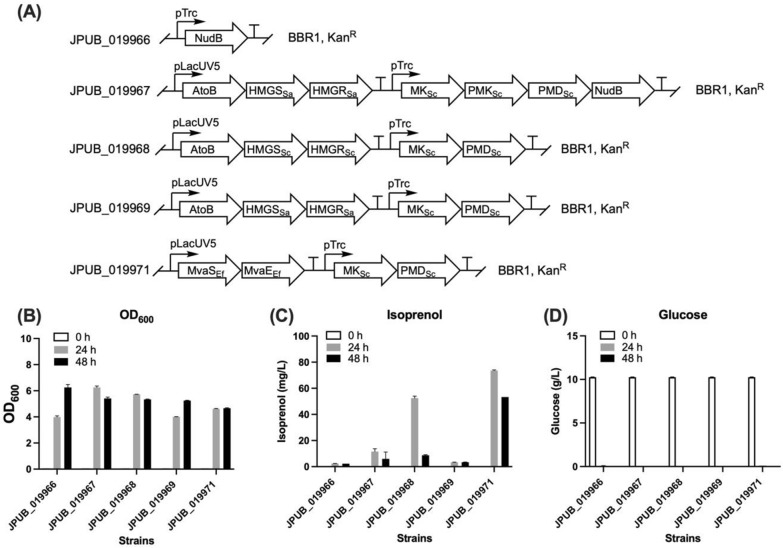
With the increasing need for microbial bioproduction to replace petrochemicals, it is critical to develop a new industrial microbial workhorse that improves the conversion of lignocellulosic carbon to biofuels and bioproducts in an economically feasible manner. Pseudomonas putida KT2440 is a promising microbial host due to its capability to grow on a broad range of carbon sources and its high tolerance to xenobiotics. In this study, we engineered P. putida KT2440 to produce isoprenoids, a vast category of compounds that provide routes to many petrochemical replacements. A heterologous mevalonate (MVA) pathway was engineered to produce potential biofuels isoprenol (C) and epi-isozizaene (C) for the first time in P. putida. We compared the difference between three different isoprenoid pathways in P. putida on isoprenol production and achieved 104 mg/L of isoprenol production in a batch flask experiment through optimization of the strain. As P. putida can natively consume isoprenol, we investigated how to prevent this self-consumption. We discovered that supplementing L-glutamate in the medium can effectively prevent isoprenol consumption in P. putida and metabolomics analysis showed an insufficient energy availability and an imbalanced redox status during isoprenol degradation. We also showed that the engineered P. putida strain can produce isoprenol using aromatic substrates such as p-coumarate as the sole carbon source, and this result demonstrates that P. putida is a valuable microbial chassis for isoprenoids to achieve sustainable biofuel production from lignocellulosic biomass.
随着微生物生物生产替代石化产品的需求不断增加,开发一种新型工业微生物主力菌株至关重要,该菌株能够以经济可行的方式提高木质纤维素碳向生物燃料和生物产品的转化效率。恶臭假单胞菌KT2440是一种有前景的微生物宿主,因为它能够利用多种碳源生长,并且对异生物质具有高耐受性。在本研究中,我们对恶臭假单胞菌KT2440进行了工程改造,以生产类异戊二烯,这是一类广泛的化合物,为许多石化替代品提供了途径。我们首次在恶臭假单胞菌中构建了一条异源甲羟戊酸(MVA)途径,用于生产潜在的生物燃料异戊醇(C)和表异紫穗槐烯(C)。我们比较了恶臭假单胞菌中三种不同类异戊二烯途径在异戊醇生产方面的差异,并通过菌株优化在分批摇瓶实验中实现了104 mg/L的异戊醇产量。由于恶臭假单胞菌能够天然消耗异戊醇,我们研究了如何防止这种自我消耗。我们发现,在培养基中添加L-谷氨酸可以有效防止恶臭假单胞菌消耗异戊醇,代谢组学分析表明,在异戊醇降解过程中能量供应不足且氧化还原状态失衡。我们还表明,工程改造后的恶臭假单胞菌菌株可以使用对香豆酸等芳香族底物作为唯一碳源生产异戊醇,这一结果表明恶臭假单胞菌是用于类异戊二烯生产的有价值的微生物底盘,能够从木质纤维素生物质中实现可持续生物燃料生产。