
利用CT图像的二阶导数纹理和机器学习预测乳腺癌患者治疗前的化疗反应。
Prediction of chemotherapy response in breast cancer patients at pre-treatment using second derivative texture of CT images and machine learning.
作者信息
Moghadas-Dastjerdi Hadi, Rahman Shan-E-Tallat Hira, Sannachi Lakshmanan, Wright Frances C, Gandhi Sonal, Trudeau Maureen E, Sadeghi-Naini Ali, Czarnota Gregory J
机构信息
Department of Medical Biophysics, University of Toronto, Toronto, ON, Canada; Physical Sciences Platform, Sunnybrook Research Institute, Sunnybrook Health Sciences Center, Toronto, ON, Canada; Department of Radiation Oncology, Odette Cancer Center, Sunnybrook Health Sciences Center, Toronto, ON, Canada; Department of Radiation Oncology, University of Toronto, Toronto, ON, Canada.
Physical Sciences Platform, Sunnybrook Research Institute, Sunnybrook Health Sciences Center, Toronto, ON, Canada; Faculty of Engineering, University of Waterloo, Waterloo, ON, Canada.
出版信息
Transl Oncol. 2021 Oct;14(10):101183. doi: 10.1016/j.tranon.2021.101183. Epub 2021 Jul 19.
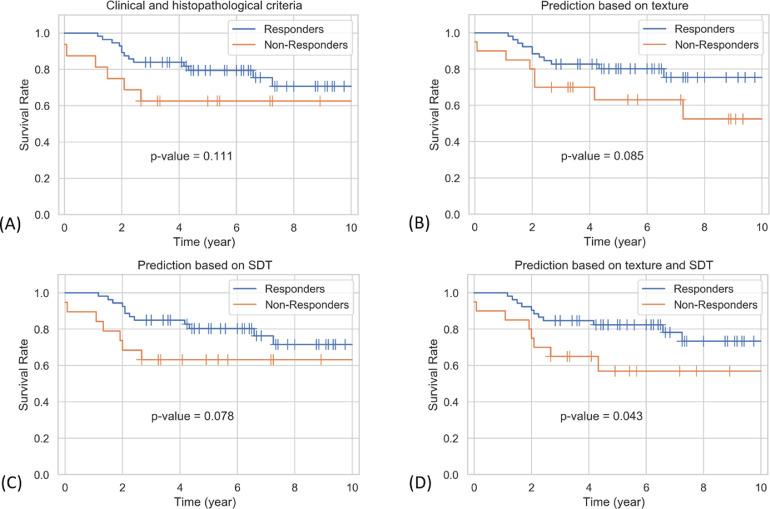
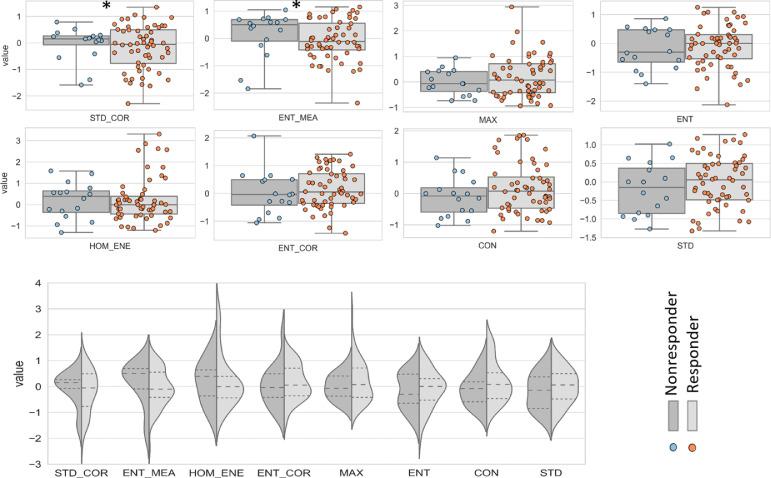
Although neoadjuvant chemotherapy (NAC) is a crucial component of treatment for locally advanced breast cancer (LABC), only about 70% of patients respond to it. Effective adjustment of NAC for individual patients can significantly improve survival rates of those resistant to standard regimens. Thus, the early prediction of NAC outcome is of great importance in facilitating a personalized paradigm for breast cancer therapeutics. In this study, quantitative computed tomography (qCT) parametric imaging in conjunction with machine learning techniques were investigated to predict LABC tumor response to NAC. Textural and second derivative textural (SDT) features of CT images of 72 patients diagnosed with LABC were analysed before the initiation of NAC to quantify intra-tumor heterogeneity. These quantitative features were processed through a correlation-based feature reduction followed by a sequential feature selection with a bootstrap 0.632+ area under the receiver operating characteristic (ROC) curve (AUC) criterion. The best feature subset consisted of a combination of one textural and three SDT features. Using these features, an AdaBoost decision tree could predict the patient response with a cross-validated AUC accuracy, sensitivity and specificity of 0.88, 85%, 88% and 75%, respectively. This study demonstrates, for the first time, that a combination of textural and SDT features of CT images can be used to predict breast cancer response NAC prior to the start of treatment which can potentially facilitate early therapy adjustments.
尽管新辅助化疗(NAC)是局部晚期乳腺癌(LABC)治疗的关键组成部分,但只有约70%的患者对其有反应。针对个体患者有效调整NAC可显著提高对标准方案耐药患者的生存率。因此,NAC疗效的早期预测对于推动乳腺癌治疗的个性化模式至关重要。在本研究中,研究了定量计算机断层扫描(qCT)参数成像与机器学习技术相结合来预测LABC肿瘤对NAC的反应。在开始NAC之前,分析了72例诊断为LABC患者的CT图像的纹理和二阶导数纹理(SDT)特征,以量化肿瘤内异质性。这些定量特征通过基于相关性的特征约简进行处理,随后采用基于0.632+自助法的接收者操作特征(ROC)曲线下面积(AUC)标准进行顺序特征选择。最佳特征子集由一个纹理特征和三个SDT特征组合而成。使用这些特征,AdaBoost决策树可以预测患者反应,交叉验证的AUC准确率、敏感性和特异性分别为0.88、85%、88%和75%。本研究首次证明,CT图像的纹理和SDT特征组合可用于在治疗开始前预测乳腺癌对NAC的反应,这可能有助于早期治疗调整。


 Zotero 插件