Shahid Momina, Rehman Kanwal, Akash Muhammad Sajid Hamid, Suhail Shaleem, Kamal Shagufta, Imran Muhammad, Assiri Mohammed A
Department of Pharmaceutical Chemistry, Government College University, Faisalabad 38000, Pakistan.
Department of Pharmacy, The Women University, Multan 60000, Pakistan.
Metabolites. 2022 Dec 19;12(12):1291. doi: 10.3390/metabo12121291.
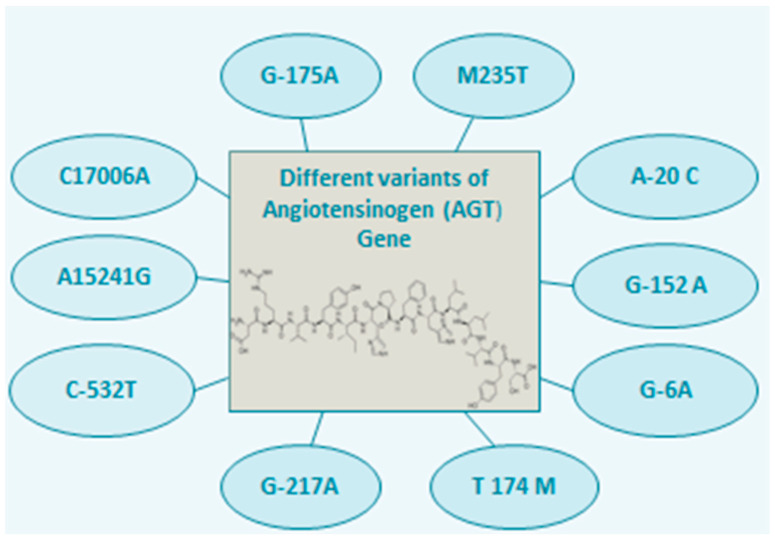
Angiotensinogen (AGT) is one of the most significant enzymes of the renin-angiotensin-aldosterone system (RAAS) which is involved in the regulation and maintenance of blood pressure. AGT is involved in the production of angiotensin I which is then converted into angiotensin II that leads to renal homeostasis. However, various genetic polymorphisms in AGT have been discovered in recent times which have shown an association with various diseases. Genetic polymorphism increases the level of circulating AGT in blood which exaggerates the effects produced by AGT. The associated diseases occur due to various effects produced by increased AGT levels. Several cardiovascular diseases including myocardial infarction, coronary heart disease, heart failure, hypertrophy, etc. are associated with AGT polymorphism. Other diseases such as depression, obesity, diabetic nephropathy, pre-eclampsia, and liver injury are also associated with some variants of AGT gene. The most common variants of AGT polymorphism are M235T and T174M. The two variants are associated with many diseases. Some other variants such as G-217A, A-6G, A-20C and G-152A, are also present but they are not as significant as that of M235T and T174M variants. These variants increase the level of circulating AGT and are associated with prevalence of different diseases. These diseases occur through various pathological pathways, but the initial reason remains the same, i.e., increased level of AGT in the blood. In this article, we have majorly focused on how genetic polymorphism of different variants of AGT gene is associated with the prevalence of different diseases.
血管紧张素原(AGT)是肾素-血管紧张素-醛固酮系统(RAAS)中最重要的酶之一,该系统参与血压的调节和维持。AGT参与血管紧张素I的产生,血管紧张素I随后转化为血管紧张素II,从而导致肾脏内环境稳定。然而,近年来已发现AGT存在多种基因多态性,这些多态性与多种疾病有关。基因多态性会增加血液中循环AGT的水平,从而放大AGT产生的效应。相关疾病是由AGT水平升高产生的各种效应引起的。包括心肌梗死、冠心病、心力衰竭、肥大等在内的几种心血管疾病都与AGT多态性有关。其他疾病,如抑郁症、肥胖症、糖尿病肾病、先兆子痫和肝损伤也与AGT基因的某些变体有关。AGT多态性最常见的变体是M235T和T174M。这两种变体与许多疾病有关。还存在一些其他变体,如G-217A、A-6G、A-20C和G-152A,但它们不如M235T和T174M变体那么显著。这些变体增加了循环AGT的水平,并与不同疾病的患病率有关。这些疾病通过各种病理途径发生,但最初的原因是相同的,即血液中AGT水平升高。在本文中,我们主要关注AGT基因不同变体的基因多态性如何与不同疾病的患病率相关。