Smith Kristen S, Morris Molly M, Morrow Casey D, Novak Josh R, Roberts Michael D, Frugé Andrew Dandridge
Department of Nutrition, Dietetics, and Hospitality Management, Auburn University, Auburn, AL 36849, USA.
College of Science and Mathematics, Auburn University, Auburn, AL 36849, USA.
Microorganisms. 2022 Nov 26;10(12):2344. doi: 10.3390/microorganisms10122344.
The gut microbiome contributes to numerous physiological processes in humans, and diet and exercise are known to alter both microbial composition and mood. We sought to explore the effect of a 10-week resistance training (RT) regimen with or without peanut protein supplementation (PPS) in untrained young adults on fecal microbiota and mood disturbance (MD).
Participants were randomized into PPS (n = 25) and control (CTL [no supplement]; n = 24) groups and engaged in supervised, full-body RT twice a week. Measures included body composition, fecal microbe relative abundance, alpha- and beta-diversity from 16 s rRNA gene sequencing with QIIME2 processing, dietary intake at baseline and following the 10-week intervention, and post-intervention MD via the profile of mood states (POMS) questionnaire. Independent samples -tests were used to determine differences between PPS and CTL groups. Paired samples -tests investigated differences within groups.
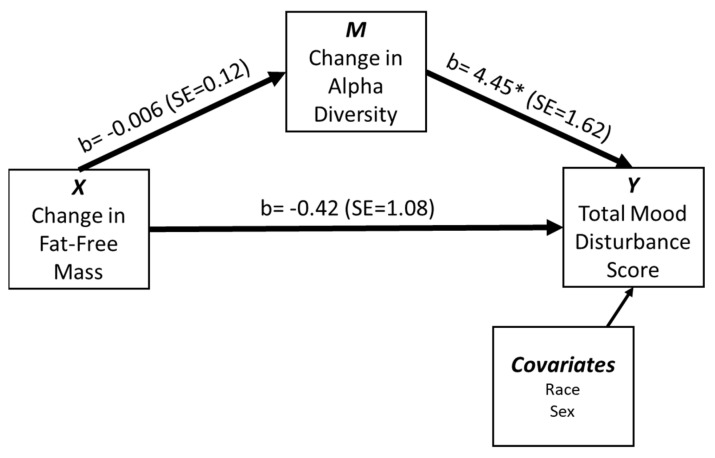
Our sample was mostly female (69.4%), white (87.8%), normal weight (body mass index 24.6 ± 4.2 kg/m), and 21 ± 2.0 years old. Shannon index significantly increased from baseline in all participants ( 0.040), with no between-group differences or pre-post beta-diversity dissimilarities. Changes in abundance were associated with the positive POMS subscales, Vigor and self-esteem-related-affect (SERA) (rho = -0.451, 0.04; rho = -0.487, 0.025, respectively). Whole tree phylogeny changes were negatively correlated with SERA and Vigor (rho = -0.475, 0.046; rho = -0.582, 0.011, respectively) as well as change in bodyfat percentage (rho = -0.608, 0.007). Mediation analysis results indicate changes in PD Whole Tree Phylogeny was not a significant mediator of the relationship between change in fat-free mass and total MD.
Mood state subscales are associated with changes in microbial taxa and body composition. PD Whole Tree Phylogeny increased following the 10-week RT regimen; further research is warranted to explore how RT-induced changes in microbial diversity are related to changes in body composition and mood disturbance.
肠道微生物群对人类的众多生理过程有影响,已知饮食和运动可改变微生物组成及情绪。我们试图探究在未经训练的年轻成年人中,进行为期10周的抗阻训练(RT)方案(有或无花生蛋白补充剂(PPS))对粪便微生物群和情绪障碍(MD)的影响。
参与者被随机分为PPS组(n = 25)和对照组(CTL[无补充剂];n = 24),每周进行两次有监督的全身RT。测量指标包括身体成分、粪便微生物相对丰度、通过QIIME2处理的16s rRNA基因测序得出的α和β多样性、基线时及10周干预后的饮食摄入量,以及通过情绪状态剖面图(POMS)问卷评估的干预后MD。使用独立样本t检验来确定PPS组和CTL组之间的差异。配对样本t检验研究组内差异。
我们的样本大多为女性(69.4%)、白人(87.8%)、体重正常(体重指数24.6±4.2kg/m²),年龄为21±2.0岁。所有参与者的香农指数从基线显著增加(P < 0.040),组间无差异,且前后β多样性无差异。丰度变化与POMS积极子量表、活力和自尊相关情感(SERA)相关(rho分别为 -0.451,P < 0.04;rho为 -0.487,P < 0.025)。全树系统发育变化与SERA和活力呈负相关(rho分别为 -0.475,P < 0.046;rho为 -0.582,P < 0.011),以及与体脂百分比变化呈负相关(rho为 -0.608,P < 0.007)。中介分析结果表明,PD全树系统发育变化不是无脂肪量变化与总MD之间关系的显著中介因素。
情绪状态子量表与微生物分类群和身体成分的变化相关。在为期10周的RT方案后,PD全树系统发育增加;有必要进一步研究以探索RT引起的微生物多样性变化如何与身体成分和情绪障碍的变化相关。