Department of Physiology, Radboud University Medical Center, Radboud Institute for Health Sciences, Nijmegen, the Netherlands.
Laboratory of Microbiology, Wageningen University, Wageningen, the Netherlands.
Obesity (Silver Spring). 2021 Oct;29(10):1615-1624. doi: 10.1002/oby.23252. Epub 2021 Aug 31.
Obesity is associated with impaired gut microbiota diversity, which has been linked to the development of type 2 diabetes. This study aims to examine the effects of an 8-week aerobic exercise intervention on insulin sensitivity, visceral adiposity, and gut microbiota diversity and composition in participants with obesity.
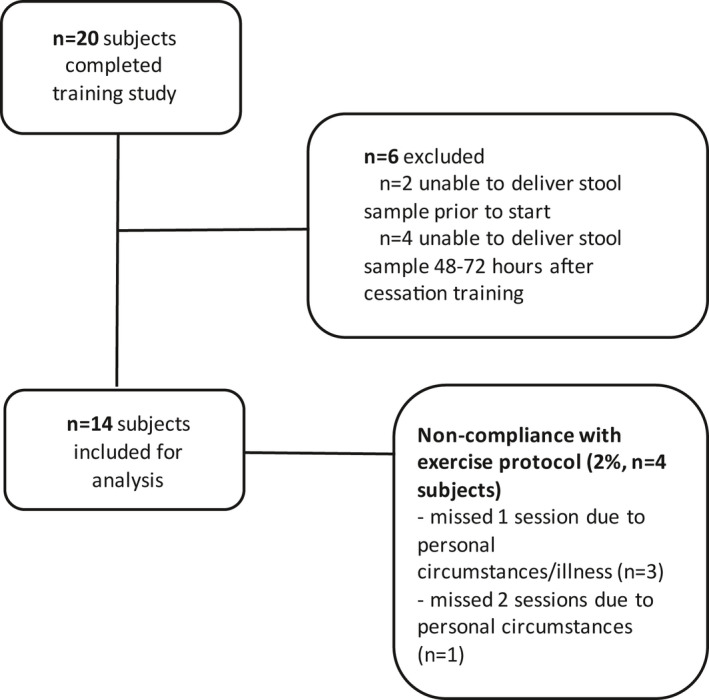
Fourteen participants (mean [SD], age 51 [11] years; BMI 34.9 [4.9] kg/m ) performed an 8-week exercise intervention (2 to 4 times/week on 65% to 85% of heart rate reserve). Insulin sensitivity (hyperinsulemic euglycemic clamp), cardiorespiratory fitness (maximal oxygen uptake), visceral adiposity (dual-energy X-ray absorptiometry scan) and gut microbiota composition (16S rRNA gene sequencing) were measured before and after the intervention.
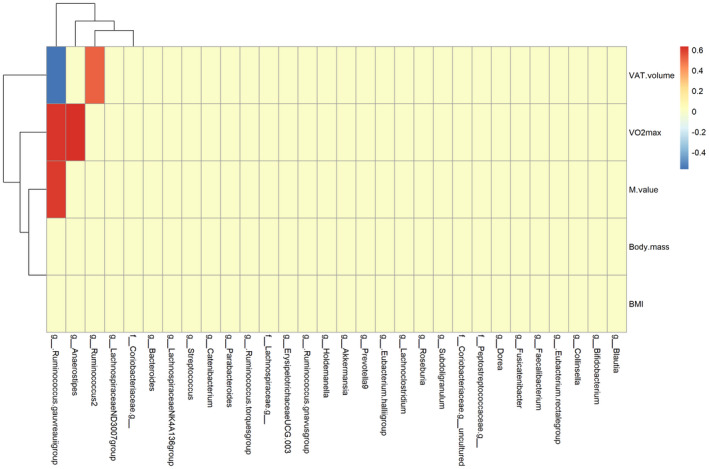
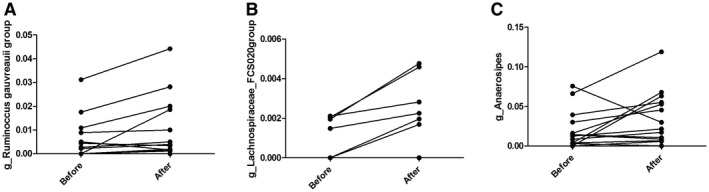
Insulin sensitivity showed a significant increase (pre: 3.8 [1.9] mg/min/kg; post: 4.5 [1.7] mg/min/kg; p = 0.007) after training, whereas visceral adiposity decreased (pre: 959 [361] cm ; post: 897 [364] cm ; p = 0.02). No change in gut microbiota α- or β-diversity was found. At the genus level, the abundance of Ruminococcus gauvreauii (p = 0.02); Lachnospiraceae FCS020 group (p = 0.04), and Anaerostipes (p = 0.04) significantly increased after exercise training. Significant positive correlations were present for M-value (R. gauvreauii) and VO max (R. gauvreauii and Anaerostipes).
Eight-week exercise training in humans with obesity leads to marked improvements in insulin sensitivity and body composition and is accompanied by modest changes in 3 gut microbiome genera, all belonging to the Firmicutes phylum.
肥胖与肠道微生物多样性受损有关,而肠道微生物多样性已与 2 型糖尿病的发生相关联。本研究旨在探究 8 周有氧运动干预对肥胖患者胰岛素敏感性、内脏脂肪和肠道微生物多样性及组成的影响。
14 名参与者(平均[标准差]年龄 51[11]岁;BMI 34.9[4.9]kg/m²)进行了 8 周的运动干预(每周 2 至 4 次,运动强度为心率储备的 65%至 85%)。干预前后测量了胰岛素敏感性(高胰岛素正葡萄糖钳夹)、心肺功能(最大摄氧量)、内脏脂肪(双能 X 射线吸收法扫描)和肠道微生物组成(16S rRNA 基因测序)。
胰岛素敏感性在训练后显著增加(干预前:3.8[1.9]mg/min/kg;干预后:4.5[1.7]mg/min/kg;p=0.007),而内脏脂肪减少(干预前:959[361]cm;干预后:897[364]cm;p=0.02)。肠道微生物 α-或β多样性没有变化。在属水平上,Ruminococcus gauvreauii(p=0.02)、Lachnospiraceae FCS020 组(p=0.04)和 Anaerostipes(p=0.04)的丰度在运动训练后显著增加。M 值(R. gauvreauii)和 VO max(R. gauvreauii 和 Anaerostipes)之间存在显著的正相关。
肥胖人群进行 8 周的运动训练可显著改善胰岛素敏感性和身体成分,同时肠道微生物群落的 3 个属(均属于厚壁菌门)发生适度变化。