Francine Piubeli
Department of Microbiology and Parasitology, Faculty of Pharmacy, University of Seville, 41012 Seville, Spain.
Microorganisms. 2022 Nov 29;10(12):2362. doi: 10.3390/microorganisms10122362.
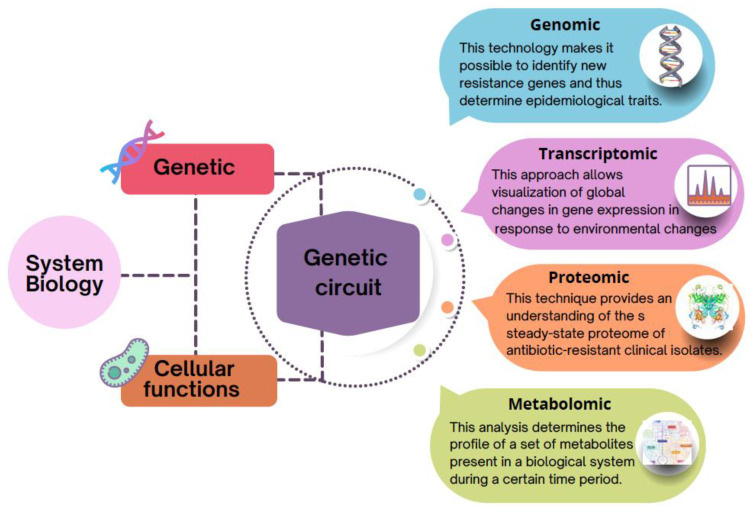
Over the past few decades, antimicrobial resistance (AMR) has emerged as an important threat to public health, resulting from the global propagation of multidrug-resistant strains of various bacterial species. Knowledge of the intrinsic factors leading to this resistance is necessary to overcome these new strains. This has contributed to the increased use of omics technologies and their extrapolation to the system level. Understanding the mechanisms involved in antimicrobial resistance acquired by microorganisms at the system level is essential to obtain answers and explore options to combat this resistance. Therefore, the use of robust whole-genome sequencing approaches and other omics techniques such as transcriptomics, proteomics, and metabolomics provide fundamental insights into the physiology of antimicrobial resistance. To improve the efficiency of data obtained through omics approaches, and thus gain a predictive understanding of bacterial responses to antibiotics, the integration of mathematical models with genome-scale metabolic models (GEMs) is essential. In this context, here we outline recent efforts that have demonstrated that the use of omics technology and systems biology, as quantitative and robust hypothesis-generating frameworks, can improve the understanding of antibiotic resistance, and it is hoped that this emerging field can provide support for these new efforts.
在过去几十年中,由于各种细菌的多重耐药菌株在全球传播,抗菌药物耐药性(AMR)已成为对公共卫生的一项重大威胁。了解导致这种耐药性的内在因素对于战胜这些新菌株至关重要。这促使组学技术的使用增加,并将其外推到系统层面。在系统层面理解微生物获得抗菌药物耐药性所涉及的机制对于找到答案和探索对抗这种耐药性的方法至关重要。因此,使用强大的全基因组测序方法以及其他组学技术,如转录组学、蛋白质组学和代谢组学,能为抗菌药物耐药性的生理学提供基本见解。为了提高通过组学方法获得的数据的效率,从而对细菌对抗生素的反应有预测性的理解,将数学模型与基因组规模代谢模型(GEMs)整合至关重要。在此背景下,我们在此概述近期的一些努力,这些努力表明,将组学技术和系统生物学作为定量且强大的假设生成框架加以运用,能够增进对抗生素耐药性的理解,希望这个新兴领域能为这些新的努力提供支持。