Department of Physics, University of Alberta, Edmonton, AB, T6G-2E1, Canada.
Department of Biological Sciences, University of Alberta, Edmonton, AB, T6G-2E9, Canada.
NPJ Syst Biol Appl. 2023 Sep 7;9(1):40. doi: 10.1038/s41540-023-00304-6.
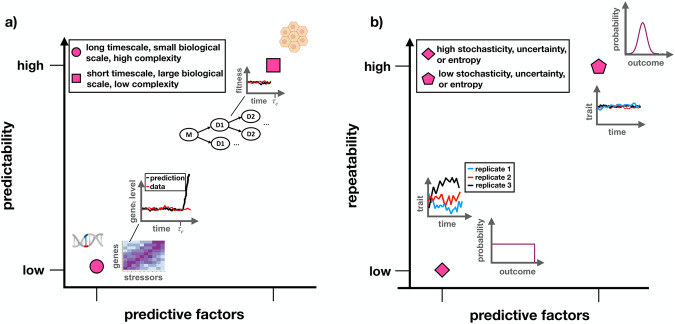
Predicting evolution is a fundamental problem in biology with practical implications for treating antimicrobial resistance, which is a complex system-level phenomenon. In this perspective article, we explore the limits of predicting antimicrobial resistance evolution, quantitatively define the predictability and repeatability of microevolutionary processes, and speculate on how these quantities vary across temporal, biological, and complexity scales. The opportunities and challenges for predicting antimicrobial resistance in the context of systems biology are also discussed. Based on recent research, we conclude that the evolution of antimicrobial resistance can be predicted using a systems biology approach integrating quantitative models with multiscale data from microbial evolution experiments.
预测进化是生物学中的一个基本问题,对于治疗抗菌药物耐药性具有实际意义,而后者是一种复杂的系统层面现象。在这篇观点文章中,我们探讨了预测抗菌药物耐药性进化的局限性,定量定义了微观进化过程的可预测性和可重复性,并推测了这些数量在时间、生物学和复杂性尺度上的变化。我们还讨论了在系统生物学背景下预测抗菌药物耐药性的机遇和挑战。基于最近的研究,我们得出结论,使用系统生物学方法可以预测抗菌药物耐药性的进化,该方法将定量模型与微生物进化实验的多尺度数据相结合。