Mihanfar Ainaz, Yousefi Bahman, Azizzadeh Bita, Majidinia Maryam
Solid Tumor Research Center, Cellular and Molecular Medicine Institute, Urmia University of Medical Sciences, Urmia, Iran.
Immunology Research Center, Tabriz University of Medical Sciences, Tabriz, Iran.
Cancer Cell Int. 2022 Dec 29;22(1):420. doi: 10.1186/s12935-022-02825-2.
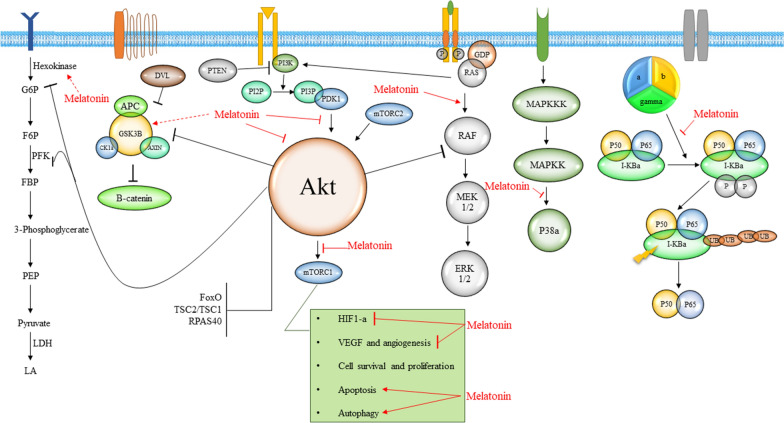
Melatonin is a neuro-hormone with conserved roles in evolution. Initially synthetized as an antioxidant molecule, it has gained prominence as a key molecule in the regulation of the circadian rhythm. Melatonin exerts its effect by binding to cytoplasmic and intra-nuclear receptors, and is able to regulate the expression of key mediators of different signaling pathways. This ability has led scholars to investigate the role of melatonin in reversing the process of carcinogenesis, a process in which many signaling pathways are involved, and regulating these pathways may be of clinical significance. In this review, the role of melatonin in regulating multiple signaling pathways with important roles in cancer progression is discussed, and evidence regarding the beneficence of targeting malignancies with this approach is presented.
褪黑素是一种在进化过程中具有保守作用的神经激素。它最初作为一种抗氧化分子合成,后来作为昼夜节律调节中的关键分子而备受关注。褪黑素通过与细胞质和细胞核内的受体结合发挥作用,能够调节不同信号通路关键介质的表达。这种能力促使学者们研究褪黑素在逆转致癌过程中的作用,致癌过程涉及许多信号通路,调节这些通路可能具有临床意义。在这篇综述中,讨论了褪黑素在调节对癌症进展具有重要作用的多种信号通路中的作用,并介绍了以这种方法靶向恶性肿瘤有益性的证据。