Luo Jeffrey, Darai Anjani, Pongkulapa Thanapat, Conley Brian, Yang Letao, Han Inbo, Lee Ki-Bum
Department of Chemistry and Chemical Biology, Rutgers, The State University of New Jersey, Piscataway, NJ, 08854, USA.
Department of Neurosurgery, CHA University School of Medicine, CHA Bundang Medical Center, 59 Yaptap-ro, Bundang-gu, Seongnam-si, Gyeonggi-do, 13496, Republic of Korea.
Bioact Mater. 2022 Dec 12;23:551-562. doi: 10.1016/j.bioactmat.2022.11.017. eCollection 2023 May.
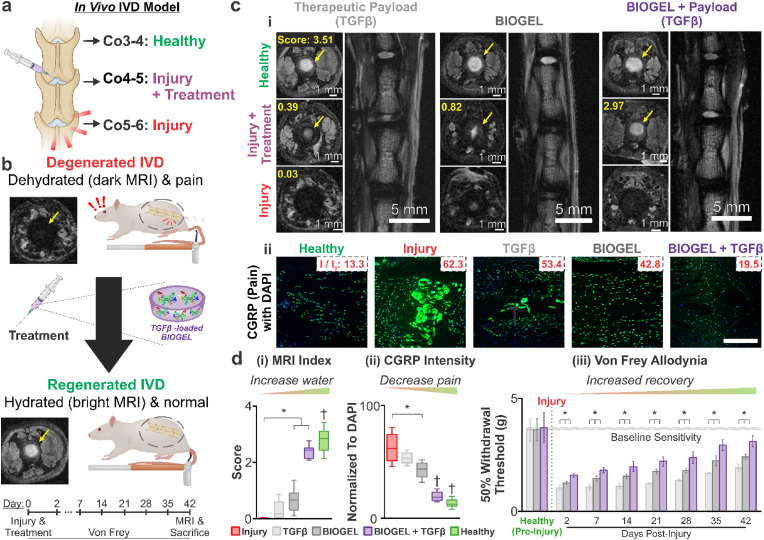
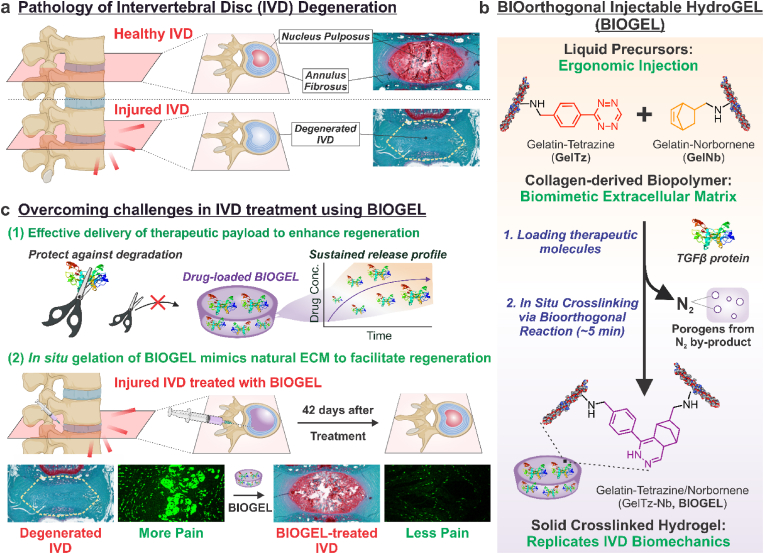
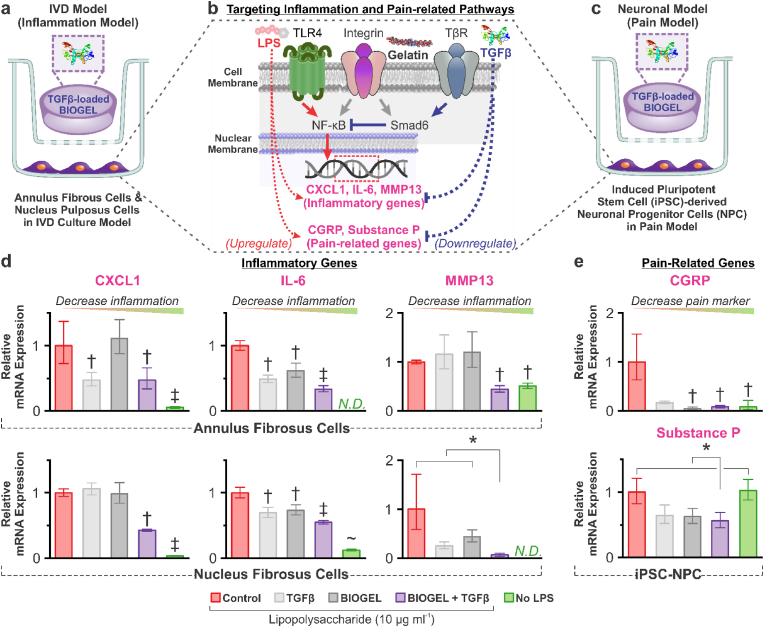
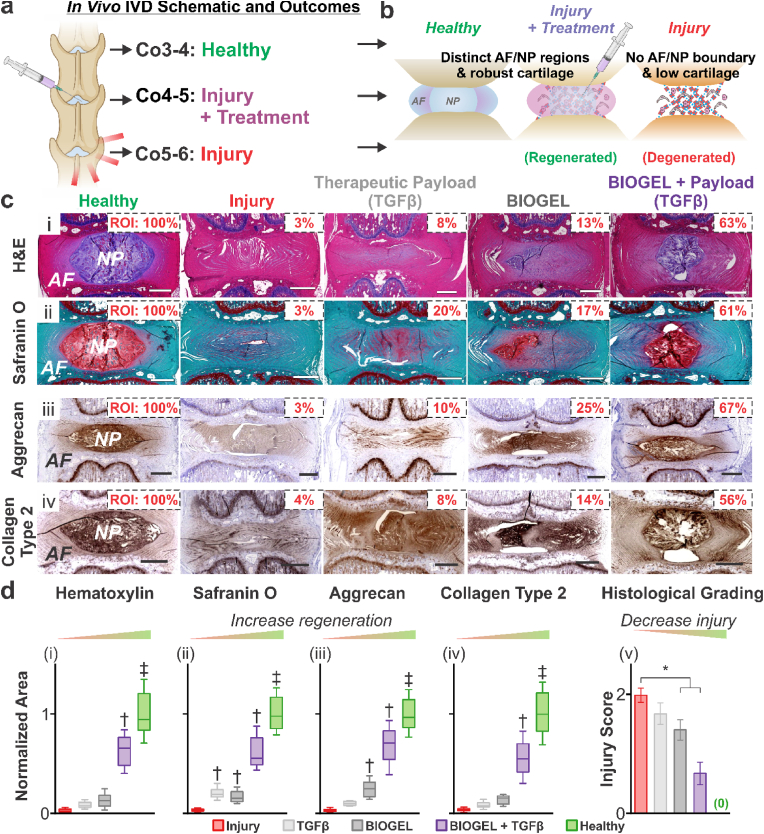
Intervertebral disc (IVD) degeneration is a leading cause of back pain and precursor to more severe conditions, including disc herniation and spinal stenosis. While traditional growth factor therapies (e.g., TGFβ) are effective at transiently reversing degenerated disc by stimulation of matrix synthesis, it is increasingly accepted that bioscaffolds are required for sustained, complete IVD regeneration. Current scaffolds (e.g., metal/polymer composites, non-mammalian biopolymers) can be improved in one or more IVD regeneration demands: biodegradability, noninvasive injection, recapitulated healthy IVD biomechanics, predictable crosslinking, and matrix repair induction. To meet these demands, tetrazine-norbornene bioorthogonal ligation was combined with gelatin to create an injectable orthogonal hydro (BIOGEL). The liquid hydrogel precursors remain free-flowing across a wide range of temperatures and crosslink into a robust hydrogel after 5-10 min, allowing a human operator to easily inject the therapeutic constructs into degenerated IVD. Moreover, BIOGEL encapsulation of TGFβ potentiated histological repair (e.g., tissue architecture and matrix synthesis) and functional recovery (e.g., high water retention by promoting the matrix synthesis and reduced pain) in an rat IVD degeneration/nucleotomy model. This BIOGEL procedure readily integrates into existing nucleotomy procedures, indicating that clinical adoption should proceed with minimal difficulty. Since bioorthogonal crosslinking is essentially non-reactive towards biomolecules, our developed material platform can be extended to other payloads and degenerative injuries.
椎间盘(IVD)退变是背痛的主要原因,也是包括椎间盘突出和椎管狭窄等更严重疾病的先兆。虽然传统的生长因子疗法(如转化生长因子β)通过刺激基质合成能有效短暂逆转退变的椎间盘,但人们越来越认识到,持续、完全的IVD再生需要生物支架。目前的支架(如金属/聚合物复合材料、非哺乳动物生物聚合物)在IVD再生的一个或多个需求方面可以改进:生物可降解性、无创注射、重现健康IVD生物力学、可预测交联以及诱导基质修复。为满足这些需求,将四嗪-降冰片烯生物正交连接与明胶相结合,制备出一种可注射的正交水凝胶(BIOGEL)。液态水凝胶前体在很宽的温度范围内保持自由流动,5-10分钟后交联成坚固的水凝胶,使操作人员能够轻松地将治疗性构建体注入退变的IVD中。此外,在大鼠IVD退变/髓核摘除模型中,BIOGEL包裹的转化生长因子β增强了组织学修复(如组织结构和基质合成)和功能恢复(如通过促进基质合成保持高含水量并减轻疼痛)。这种BIOGEL方法很容易融入现有的髓核摘除手术中,表明临床应用应该不会有太大困难。由于生物正交交联对生物分子基本无反应,我们开发的材料平台可以扩展到其他有效载荷和退行性损伤。