Sazali Mohd Fazeli, Rahim Syed Sharizman Syed Abdul, Mohammad Ahmad Hazim, Kadir Fairrul, Payus Alvin Oliver, Avoi Richard, Jeffree Mohammad Saffree, Omar Azizan, Ibrahim Mohd Yusof, Atil Azman, Tuah Nooralisa Mohd, Dapari Rahmat, Lansing Meryl Grace, Rahim Ahmad Asyraf Abdul, Azhar Zahir Izuan
Department of Public Health Medicine, Faculty of Medicine and Health Sciences, Universiti Malaysia Sabah, Kota Kinabalu.
Department of Emergency Medicine, Faculty of Medicine and Health Sciences, Universiti Malaysia Sabah, Kota Kinabalu, Malaysia.
Tuberc Respir Dis (Seoul). 2023 Apr;86(2):82-93. doi: 10.4046/trd.2022.0148. Epub 2022 Dec 23.
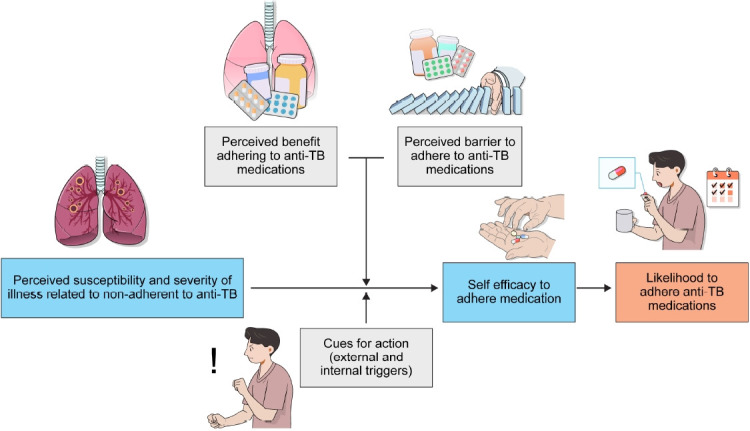
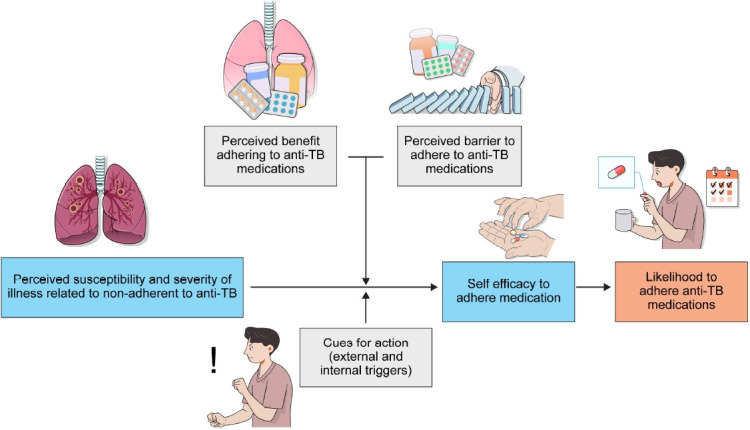
Tuberculosis (TB) is a significant public health concern. Globally, TB is among the top 10 and the leading cause of death due to a single infectious agent. Providing standard anti-TB therapy for at least 6 months is recommended as one of the crucial strategies to control the TB epidemic. However, the long duration of TB treatment raised the issue of non-adherence. Non-adherence to TB therapy could negatively affect clinical and public health outcomes. Thus, directly observed therapy (DOT) has been introduced as a standard strategy to improve anti-TB medication adherence. Nonetheless, the DOT approach has been criticized due to inconvenience, stigma, reduced economic productivity, and reduced quality of life, which ultimately could complicate adherence issues. Apart from that, its effectiveness in improving anti-TB adherence is debatable. Therefore, digital technology could be an essential tool to enhance the implementation of DOT. Incorporating the health belief model (HBM) into digital technology can further increase its effectiveness in changing behavior and improving medication adherence. This article aimed to review the latest evidence regarding TB medication non-adherence, its associated factors, DOT's efficacy and its alternatives, and the use of digital technology and HBM in improving medication adherence. This paper used the narrative review methodology to analyze related articles to address the study objectives. Conventional DOT has several disadvantages in TB management. Integrating HBM in digital technology development is potentially effective in improving medication adherence. Digital technology provides an opportunity to improve medication adherence to overcome various issues related to DOT implementation.
结核病(TB)是一个重大的公共卫生问题。在全球范围内,结核病位列十大死因之中,并且是单一传染源导致死亡的主要原因。推荐提供至少6个月的标准抗结核治疗作为控制结核病流行的关键策略之一。然而,结核病治疗的长期疗程引发了不依从性问题。不依从抗结核治疗会对临床和公共卫生结果产生负面影响。因此,直接观察治疗(DOT)已作为一种提高抗结核药物依从性的标准策略被引入。尽管如此,DOT方法因不便、耻辱感、经济生产力下降和生活质量降低而受到批评,这些最终可能使依从性问题复杂化。除此之外,其在提高抗结核依从性方面的有效性也存在争议。因此,数字技术可能是加强DOT实施的重要工具。将健康信念模型(HBM)纳入数字技术可以进一步提高其在改变行为和提高药物依从性方面的有效性。本文旨在综述关于结核病药物不依从性、其相关因素、DOT的疗效及其替代方法,以及数字技术和HBM在提高药物依从性方面的应用的最新证据。本文采用叙述性综述方法分析相关文章以实现研究目标。传统的DOT在结核病管理中有几个缺点。将HBM整合到数字技术开发中可能有效地提高药物依从性。数字技术为提高药物依从性提供了一个机会,以克服与DOT实施相关的各种问题。