From the Djavad Mowafaghian Centre for Brain Health (S.S., J.C., J.G., C.L.W.), Department of Pathology and Laboratory Medicine (S.S, J,C, J.G.,C.L.W.) Division of Neurology, Department of Medicine (N.F.), Division of Neurosurgery (S.P., T.A., N.D.), Michael Smith Laboratories (M.A.S.), and School of Biomedical Engineering (C.L.W.), University of British Columbia, Vancouver, British Columbia; Praxis Spinal Cord Institute (N.F.), and Vancouver Spine Research Program (L.B., L.R., A.T.), Vancouver General Hospital, Blusson Spinal Cord Center, Vancouver, British Columbia; International Collaboration on Repair Discoveries (ICORD) (K.D., F.S., J.S., M.F.D., C.L.W., B.K.K.) and Vancouver Spine Surgery Institute, Department of Orthopaedics (J.S., R.C.-M., C.G.F., M.F.D., B.K.K.), University of British Columbia, Blusson Spinal Cord Center, Vancouver, British Columbia; Division of Orthopaedics (C.S.B.), Schulich School of Medicine, University of Western Ontario, London, Canada; Department of Neurosurgery (S.D.), University of California San Francisco; Department of Surgery (J-M., M-T.), Hôpital du Sacré-Coeur de Montréal, Quebec; Department of Surgery (J.-M., M.-T.), Chu Sainte-Justine, University of Montreal, Quebec; Division of Neurosurgery (J.R.W.), University of Toronto, St. Michael's Hospital, Ontario; and Division of Neurosurgery (S.C.), Halifax Infirmary, Dalhousie University, Nova Scotia, Canada.
Neurology. 2023 Mar 21;100(12):e1221-e1233. doi: 10.1212/WNL.0000000000206744. Epub 2023 Jan 4.
Traumatic spinal cord injury (SCI) is highly heterogeneous, and tools to better delineate pathophysiology and recovery are needed. Our objective was to profile the response of 2 biomarkers, neurofilament light (NF-L) and glial fibrillary acidic protein (GFAP), in the serum and CSF of patients with acute SCI to evaluate their ability to objectively characterize injury severity and predict neurologic recovery.
Blood and CSF samples were obtained from prospectively enrolled patients with acute SCI through days 1-4 postinjury, and the concentration of NF-L and GFAP was quantified using Simoa technology. Neurologic assessments defined the ASIA Impairment Scale (AIS) grade and motor score (MS) at presentation and 6 months postinjury.
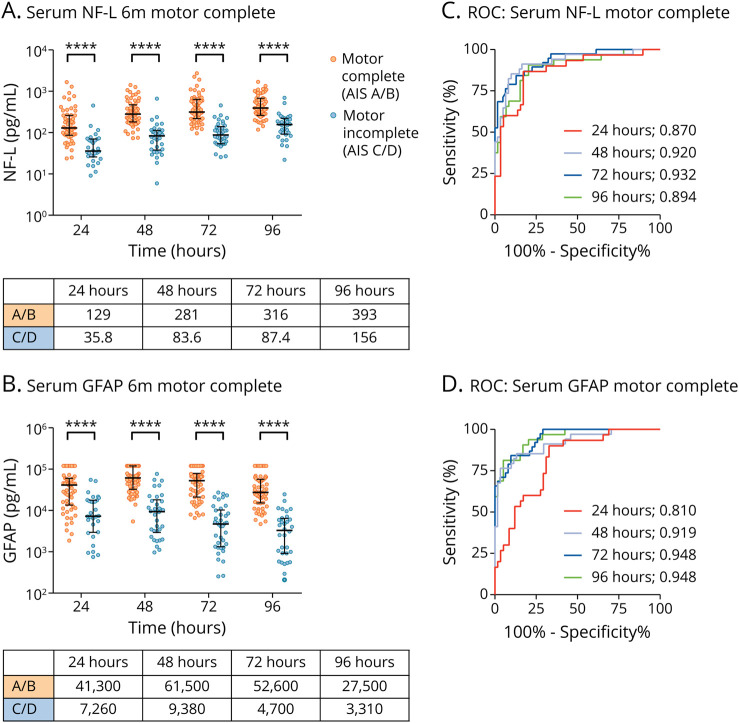
One hundred eighteen patients with acute SCI (78 AIS A, 20 AIS B, and 20 AIS C) were enrolled, with 113 (96%) completing 6-month follow-up. NF-L and GFAP levels were strongly associated between paired serum and CSF specimens, were both increased with injury severity, and distinguished among baseline AIS grades. Serum NF-L and GFAP were significantly ( = 0.02 to <0.0001) higher in AIS A patients who did not improve at 6 months, predicting AIS grade conversion with a sensitivity and specificity (95% CI) of 76% (61, 87) and 77% (55, 92) using NF-L and 72% (57, 84) and 77% (55, 92) using GFAP at 72 hours, respectively. Independent of clinical baseline assessment, a serum NF-L threshold of 170 pg/mL at 72 hours predicted those patients who would be classified as motor complete (AIS A/B) compared with motor incomplete (AIS C/D) at 6 months with a sensitivity of 87% (76, 94) and specificity of 84% (69, 94); a serum GFAP threshold of 13,180 pg/mL at 72 hours yielded a sensitivity of 90% (80, 96) and specificity of 84% (69, 94).
The potential for NF-L and GFAP to classify injury severity and predict outcome after acute SCI will be useful for patient stratification and prognostication in clinical trials and inform communication of prognosis.
This study provides Class I evidence that higher serum NF-L and GFAP are associated with worse neurological outcome after acute SCI.
Registered on ClinicalTrials.gov: NCT00135278 (March 2006) and NCT01279811 (January 2012).
外伤性脊髓损伤(SCI)高度异质,需要更好地描绘其病理生理学和恢复的工具。我们的目的是分析 2 种生物标志物神经丝轻链(NF-L)和胶质纤维酸性蛋白(GFAP)在急性 SCI 患者血清和脑脊液中的反应,以评估其客观描述损伤严重程度和预测神经恢复的能力。
前瞻性纳入急性 SCI 患者,在损伤后第 1-4 天采集血样和脑脊液样本,并使用 Simoa 技术定量 NF-L 和 GFAP 的浓度。神经学评估在就诊时和损伤后 6 个月定义 ASIA 损伤量表(AIS)分级和运动评分(MS)。
共纳入 118 例急性 SCI 患者(78 例 AIS A、20 例 AIS B 和 20 例 AIS C),其中 113 例(96%)完成了 6 个月随访。NF-L 和 GFAP 水平在配对的血清和脑脊液标本之间具有很强的相关性,均随损伤严重程度而增加,并在基线 AIS 分级之间有所区分。在 6 个月时未改善的 AIS A 患者中,血清 NF-L 和 GFAP 显著升高(=0.02 至<0.0001),预测 AIS 分级转换的敏感性和特异性(95%CI)分别为 76%(61,87)和 77%(55,92),NF-L 在 72 小时时为 72%(57,84)和 77%(55,92),GFAP 在 72 小时时为 72%(57,84)和 77%(55,92)。独立于临床基线评估,NF-L 在 72 小时时的血清阈值为 170 pg/mL 可预测患者在 6 个月时被归类为运动完全(AIS A/B)与运动不完全(AIS C/D),敏感性为 87%(76,94),特异性为 84%(69,94);GFAP 在 72 小时时的血清阈值为 13,180 pg/mL 时,敏感性为 90%(80,96),特异性为 84%(69,94)。
NF-L 和 GFAP 具有分类损伤严重程度和预测急性 SCI 后结局的潜力,将有助于临床试验中的患者分层和预后预测,并为预后沟通提供信息。
本研究提供了 I 级证据,表明较高的血清 NF-L 和 GFAP 与急性 SCI 后的不良神经结局相关。
在 ClinicalTrials.gov 注册:NCT00135278(2006 年 3 月)和 NCT01279811(2012 年 1 月)。