Park Jeong Bae, Sharman James E, Li Yan, Munakata Masanori, Shirai Kohji, Chen Chen-Huan, Jae Sae Young, Tomiyama Hirofumi, Kosuge Hisanori, Bruno Rosa Maria, Spronck Bart, Kario Kazuomi, Lee Hae Young, Cheng Hao-Min, Wang Jiguang, Budoff Matthew, Townsend Raymond, Avolio Alberto P
JB Lab and Clinic, And Department of Precision Medicine and Biostatistics, Yonsei University, Wonju College of Medicine, Seoul, Republic of Korea.
Menzies Institute for Medical Research, University of Tasmania, Hobart, Tasmania, Australia.
Pulse (Basel). 2022 Nov 22;10(1-4):1-18. doi: 10.1159/000528208. eCollection 2022 Dec.
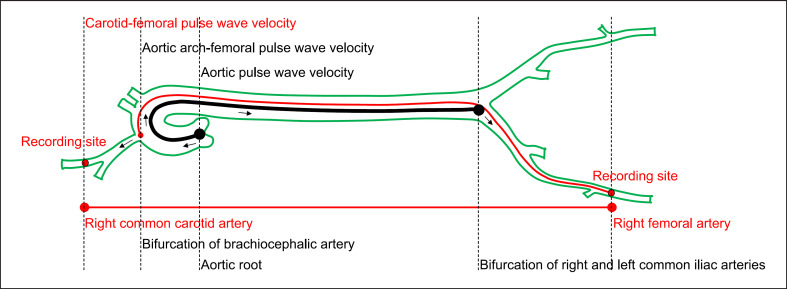
Arterial stiffness is a progressive aging process that predicts cardiovascular disease. Pulse wave velocity (PWV) has emerged as a noninvasive, valid, and reliable measure of arterial stiffness and an independent risk predictor for adverse outcomes. However, up to now, PWV measurement has mostly been used as a tool for risk prediction and has not been widely used in clinical practice. This consensus paper aims to discuss multiple PWV measurements currently available in Asia and to provide evidence-based assessment together with recommendations on the clinical use of PWV. For the methodology, PWV measurement including the central elastic artery is essential and measurements including both the central elastic and peripheral muscular arteries, such as brachial-ankle PWV and cardio-ankle vascular index, can be a good alternative. As Asian populations are rapidly aging, timely detection and intervention of "early vascular aging" in terms of abnormally high PWV values are recommended. More evidence is needed to determine if a PWV-guided therapeutic approach will be beneficial to the prevention of cardiovascular diseases beyond current strategies. Large-scale randomized controlled intervention studies are needed to guide clinicians.
动脉僵硬度是一种预测心血管疾病的渐进性衰老过程。脉搏波速度(PWV)已成为一种无创、有效且可靠的动脉僵硬度测量指标,以及不良结局的独立风险预测因子。然而,截至目前,PWV测量大多被用作风险预测工具,尚未在临床实践中广泛应用。本共识文件旨在讨论目前亚洲可用的多种PWV测量方法,并提供基于证据的评估以及关于PWV临床应用的建议。在方法学方面,包括中心弹性动脉的PWV测量至关重要,而包括中心弹性动脉和外周肌性动脉的测量,如臂踝PWV和心踝血管指数,可能是一个不错的选择。由于亚洲人群正在迅速老龄化,建议根据PWV值异常升高及时检测和干预“早期血管衰老”。需要更多证据来确定PWV指导的治疗方法是否会比当前策略更有利于预防心血管疾病。需要大规模随机对照干预研究来指导临床医生。