Bruno Rosa Maria, Pépin Jean Louis, Empana Jean Philippe, Yang Rui Yi, Vercamer Vincent, Jouhaud Paul, Escourrou Pierre, Boutouyrie Pierre
Université Paris Cité, Inserm, PARCC, F-75015 Paris, France.
Pharmacology Unit, AP-HP, Hôpital Européen Georges Pompidou, F-75015 Paris, France.
Eur Heart J Digit Health. 2022 Oct 3;3(3):362-372. doi: 10.1093/ehjdh/ztac027. eCollection 2022 Sep.
To investigate the impact of coronavirus disease 2019 lockdown on trajectories of arterial pulse-wave velocity in a large population of users of connected smart scales that provide reliable measurements of pulse-wave velocity.
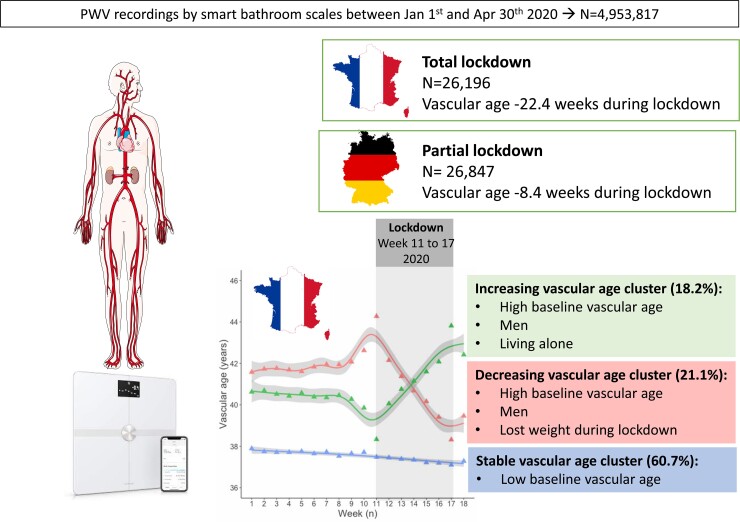
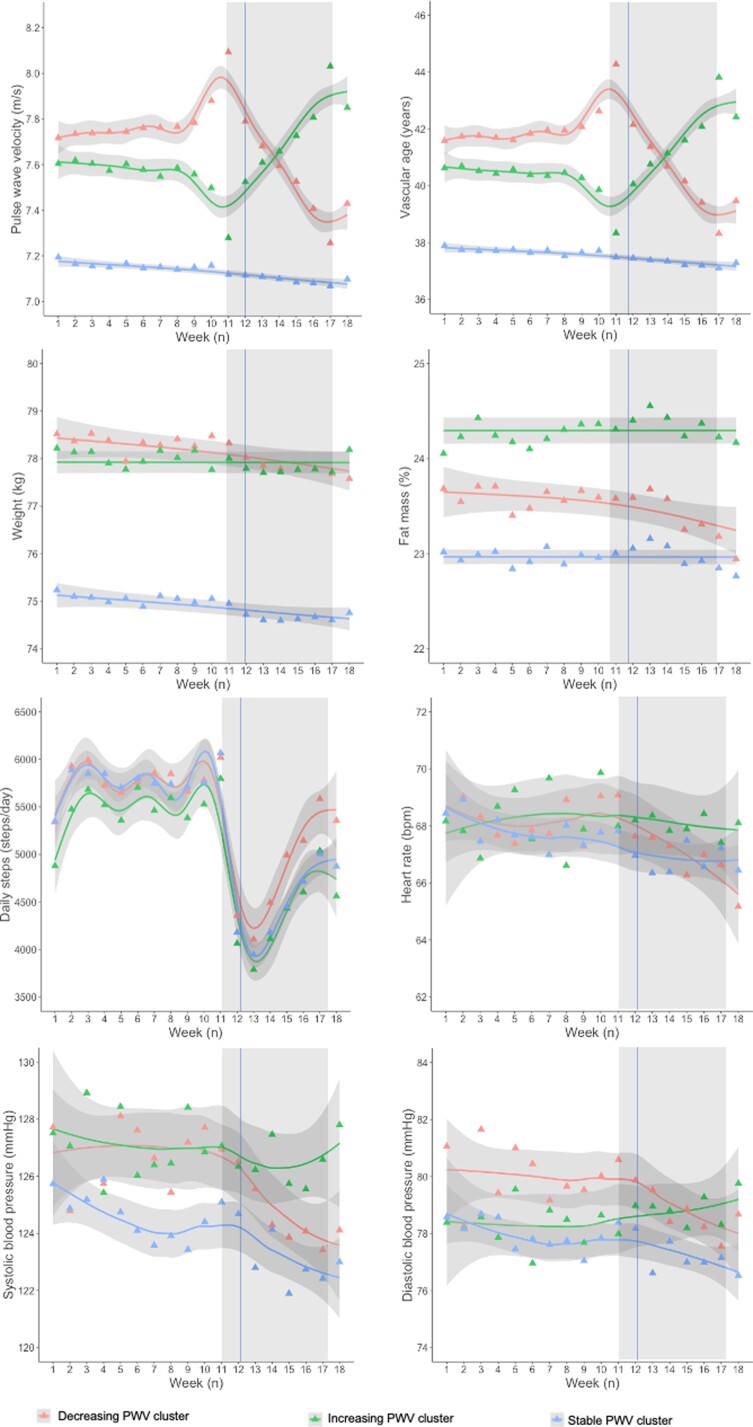
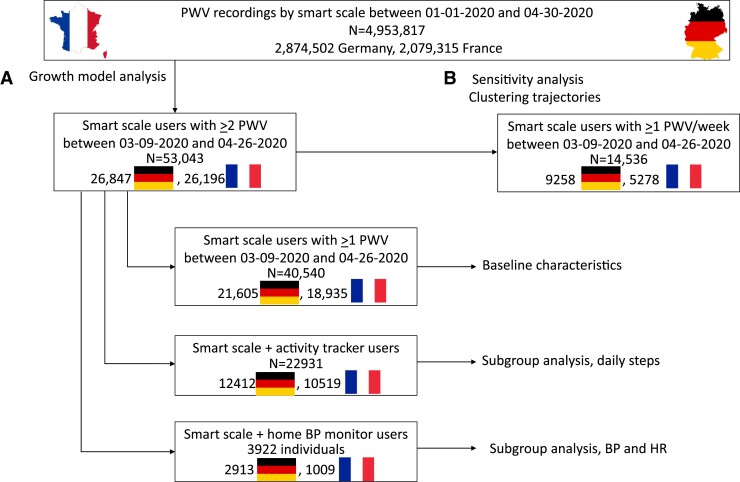
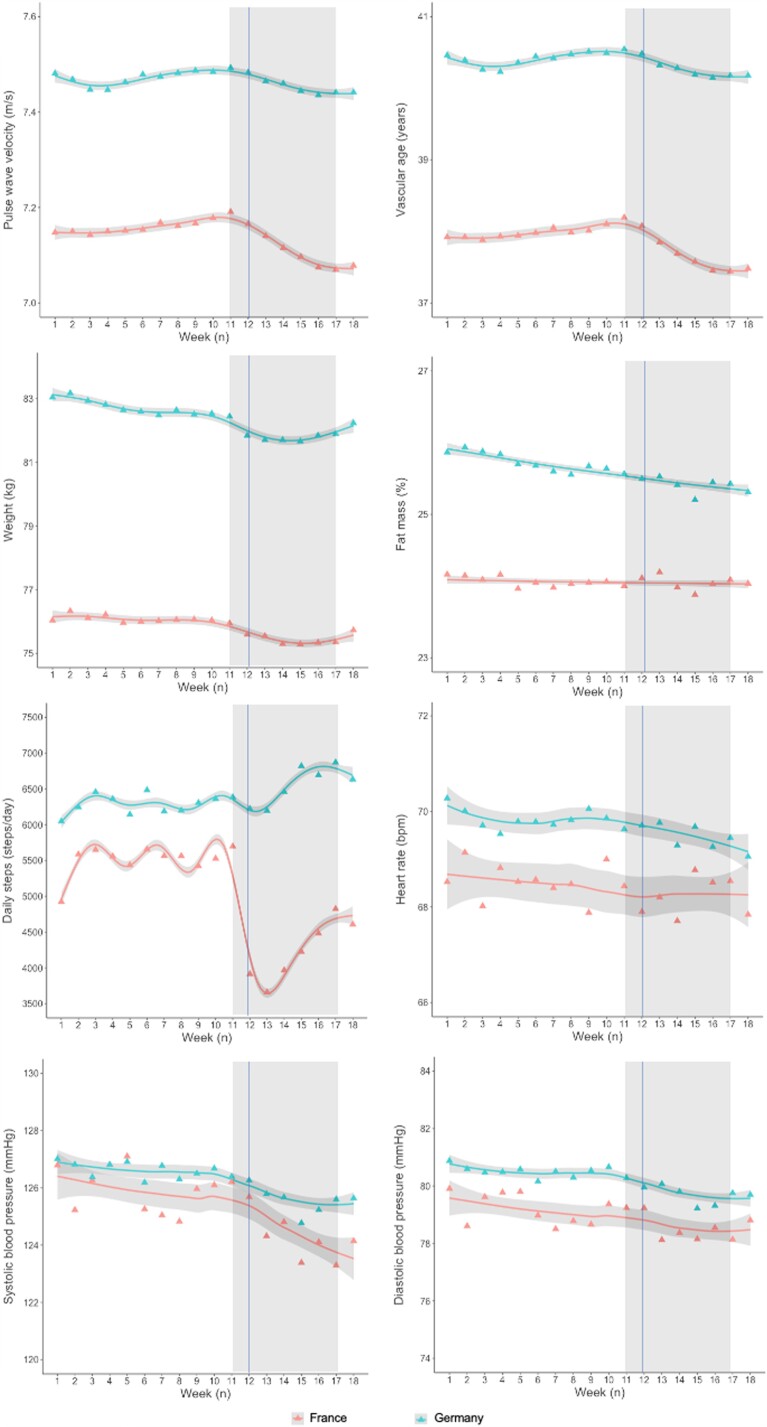
Pulse-wave velocity recordings obtained by Withings Heart Health & Body Composition Wi-Fi Smart Scale users before and during lockdown were analysed. We compared two demonstrative countries: France, where strict lockdown rules were enforced ( = 26 196) and Germany, where lockdown was partial ( = 26 847). Subgroup analysis was conducted in users of activity trackers and home blood pressure monitors. Linear growth curve modelling and trajectory clustering analyses were performed. During lockdown, a significant reduction in vascular stiffness, weight, blood pressure, and physical activity was observed in the overall population. Pulse-wave velocity reduction was greater in France than in Germany, corresponding to 5.2 month reduction in vascular age. In the French population, three clusters of stiffness trajectories were identified: decreasing (21.1%), stable (60.6%), and increasing pulse-wave velocity clusters (18.2%). Decreasing and increasing clusters both had higher pulse-wave velocity and vascular age before lockdown compared with the stable cluster. Only the decreasing cluster showed a significant weight reduction (-400 g), whereas living alone was associated with increasing pulse-wave velocity cluster. No clusters were identified in the German population.
During total lockdown in France, a reduction in pulse-wave velocity in a significant proportion of French users of connected smart bathroom scales occurred. The impact on long-term cardiovascular health remains to be established.
在大量使用可提供可靠脉搏波速度测量值的联网智能秤的用户群体中,研究2019年冠状病毒病封锁措施对动脉脉搏波速度轨迹的影响。
分析了Withings心脏健康与身体成分Wi-Fi智能秤用户在封锁前和封锁期间获得的脉搏波速度记录。我们比较了两个具有代表性的国家:实施严格封锁规定的法国(n = 26196)和实施部分封锁的德国(n = 26847)。对活动追踪器和家用血压监测仪的用户进行了亚组分析。进行了线性生长曲线建模和轨迹聚类分析。在封锁期间,总体人群中血管硬度、体重、血压和身体活动均显著降低。法国的脉搏波速度降低幅度大于德国,相当于血管年龄降低了5.2个月。在法国人群中,确定了三组硬度轨迹:降低组(21.1%)、稳定组(60.6%)和脉搏波速度增加组(18.2%)。与稳定组相比,降低组和增加组在封锁前的脉搏波速度和血管年龄均更高。只有降低组的体重显著减轻(-400 g),而独居与脉搏波速度增加组相关。德国人群中未发现聚类。
在法国全面封锁期间,很大一部分使用联网智能浴室秤的法国用户的脉搏波速度有所降低。对长期心血管健康的影响仍有待确定。