Lancet Glob Health. 2023 Feb;11(2):e229-e243. doi: 10.1016/S2214-109X(22)00497-1.
Understanding health trends and estimating the burden of disease at the national and subnational levels helps policy makers track progress and identify disparities in overall health performance. The Global Burden of Diseases, Injuries, and Risk Factors Study (GBD) 2019 provides comprehensive estimates for Pakistan. Comparison of health indicators since 1990 provides valuable insights about Pakistan's ability to strengthen its health-care system, reduce inequalities, improve female and child health outcomes, achieve universal health coverage, and meet the UN Sustainable Development Goals. We present estimates of the burden of disease, injuries, and risk factors for Pakistan provinces and territories from 1990 to 2019 based on GBD 2019 to improve health and health outcomes in the country.
We used methods and data inputs from GBD 2019 to estimate socio-demographic index, total fertility rate, cause-specific deaths, years of life lost, years lived with disability, disability-adjusted life-years, healthy life expectancy, and risk factors for 286 causes of death and 369 causes of non-fatal health loss in Pakistan and its four provinces and three territories from 1990 to 2019. To generate estimates for Pakistan at the national and subnational levels, we used 68 location-years of data to estimate Pakistan-specific demographic indicators, 316 location-years of data for Pakistan-specific causes of death, 579 location-years of data for Pakistan-specific non-fatal outcomes, 296 location-years of data for Pakistan-specific risk factors, and 3089 location-years of data for Pakistan-specific covariates.
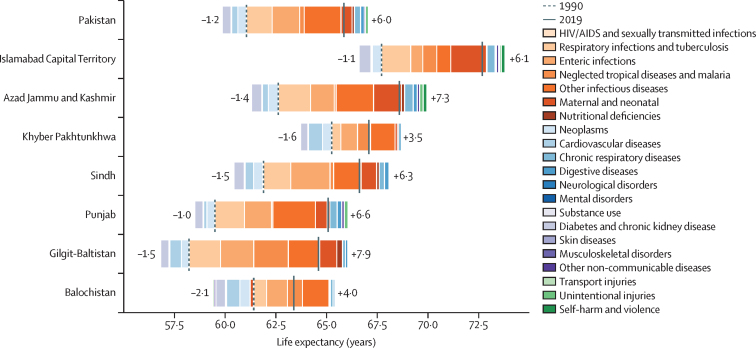
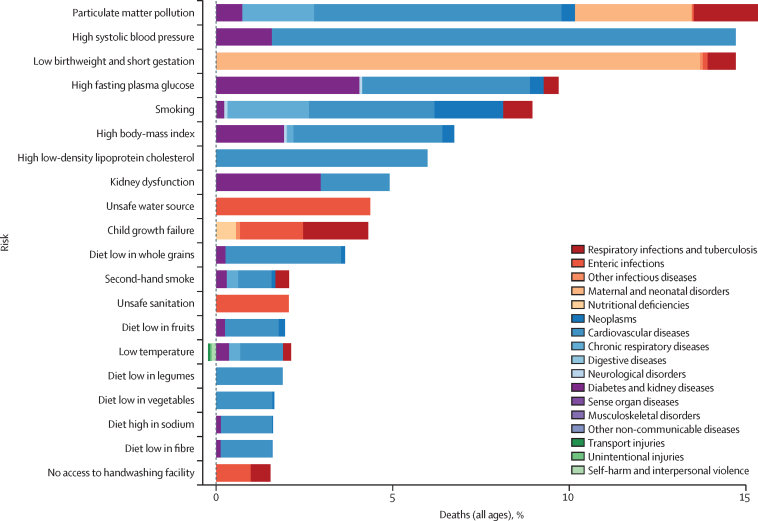
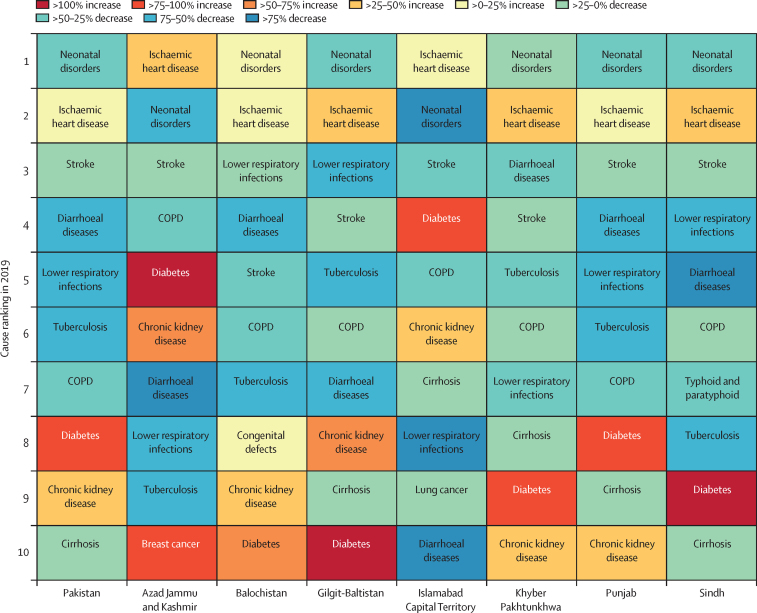
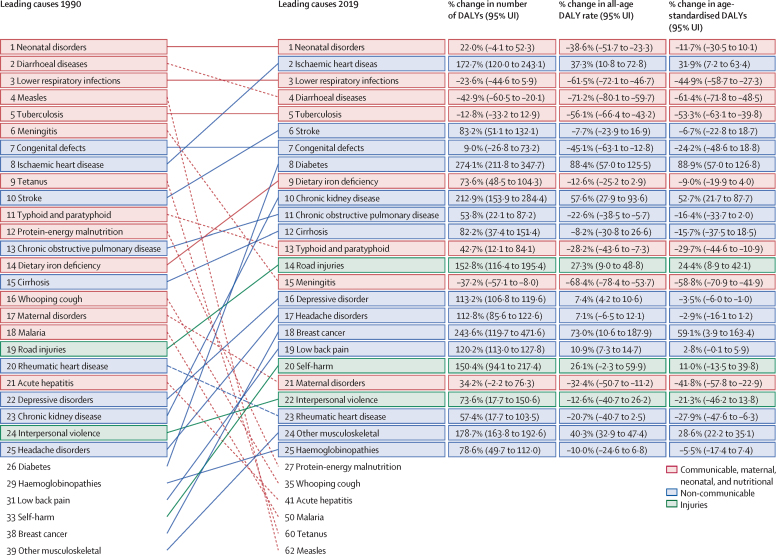
Life expectancy for both sexes in Pakistan increased nationally from 61·1 (95% uncertainty interval [UI] 60·0-62·1) years in 1990 to 65·9 (63·8-67·8) years in 2019; however, these gains were not uniform across the provinces and federal territories. Pakistan saw a narrowing of the difference in healthy life expectancy between the sexes from 1990 to 2019, as health gains for women occurred at faster rates than for men. For women, life expectancy increased by 8·2% (95% UI 6·3-13·8) between 1990 and 2019, whereas the male life expectancy increased by 7·6% (3·5-11·8). Neonatal disorders, followed by ischaemic heart disease, stroke, diarrhoeal diseases, and lower respiratory infections were the leading causes of all-age premature mortality in 2019. Child and maternal malnutrition, air pollution, high systolic blood pressure, dietary risks, and tobacco consumption were the leading all-age risk factors for death and disability-adjusted life-years at the national level in 2019. Five non-communicable diseases-ischaemic heart disease, stroke, congenital defects, cirrhosis, and chronic kidney disease-were among the ten leading causes of years of life lost in Pakistan. Burden varied by socio-demographic index. Notably, Balochistan and Khyber Pakhtunkhwa had the lowest observed gains in life expectancy. Dietary iron deficiency was the leading cause of years lived with disability for both men and women in 1990 and 2019. Low birthweight and short gestation and particulate matter pollution were the leading contributors to overall disease burden in both 1990 and 2019 despite moderate improvements, with a 23·5% (95% UI 3·8-39·2) and 27·6% (14·3-38·6) reduction in age-standardised attributable DALY rates during the study period.
Our study shows that progress has been made on reducing Pakistan's disease burden since 1990, but geographical, age, and sex disparities persist. Equitable investment in the health system, as well as the prioritisation of high-impact policy interventions and programmes, are needed to save lives and improve health outcomes. Pakistan is facing several domestic and foreign challenges-the Taliban's return to power in Afghanistan, political turmoil, catastrophic flooding, the COVID-19 pandemic-that will shape the trajectory of the country's health and development. Pakistan must address the burden of infectious disease and curb rising rates of non-communicable diseases. Prioritising these three areas will enhance Pakistan's ability to achieve universal health coverage, meet its Sustainable Development Goals, and improve the overall health outcomes.
Bill & Melinda Gates Foundation.
For the Urdu translation of the abstract see Supplementary Materials section.
了解健康趋势和评估国家及次国家层面的疾病负担有助于决策者跟踪进展并识别整体健康绩效的差异。《全球疾病、伤害和风险因素研究(GBD)2019》为巴基斯坦提供了全面的估计值。自 1990 年以来健康指标的比较提供了有关巴基斯坦加强其医疗保健系统、减少不平等、改善女性和儿童健康结果、实现全民健康覆盖和实现联合国可持续发展目标能力的宝贵见解。我们根据 GBD 2019 提供了 1990 年至 2019 年巴基斯坦各省和地区疾病、伤害和风险因素负担的估计值,以改善该国的健康和健康结果。
我们使用了 GBD 2019 的方法和数据输入来估计巴基斯坦 286 种死亡原因和 369 种非致命性健康损失原因的社会人口指数、总生育率、特定原因死亡率、生命损失年数、失能生命年数、残疾调整生命年数、健康预期寿命以及风险因素,时间跨度为 1990 年至 2019 年。为了在国家和次国家层面生成估计值,我们使用了 68 个位置年的数据来估计巴基斯坦特定的人口统计指标、316 个位置年的数据来估计巴基斯坦特定的死亡原因、579 个位置年的数据来估计巴基斯坦特定的非致命性结果、296 个位置年的数据来估计巴基斯坦特定的风险因素以及 3089 个位置年的数据来估计巴基斯坦特定的协变量。
巴基斯坦的男女预期寿命均有所增加,从 1990 年的 61.1 岁(95%置信区间 [95%UI] 60.0-62.1)增加到 2019 年的 65.9 岁;然而,这些收益在各省和联邦领土之间并不均衡。巴基斯坦在 1990 年至 2019 年间,男女之间健康预期寿命的差距有所缩小,因为女性的健康收益增长速度快于男性。对于女性,1990 年至 2019 年期间,女性的预期寿命增加了 8.2%(95%UI 6.3-13.8),而男性的预期寿命增加了 7.6%(3.5-11.8)。新生儿疾病、缺血性心脏病、中风、腹泻病和下呼吸道感染是 2019 年所有年龄段早逝的主要原因。儿童和孕产妇营养不良、空气污染、高血压、饮食风险和烟草消费是 2019 年国家层面死亡和残疾调整生命年的主要全因风险因素。五种非传染性疾病——缺血性心脏病、中风、先天性缺陷、肝硬化和慢性肾脏病——是 2019 年巴基斯坦寿命损失年数最多的 10 大原因之一。负担因社会人口指数而异。值得注意的是,俾路支省和开伯尔-普赫图赫瓦省的预期寿命增长幅度最小。1990 年和 2019 年,铁缺乏性贫血是男女失能生命年数的主要原因。尽管有所改善,但低出生体重和早产以及颗粒物污染仍是 1990 年和 2019 年总疾病负担的主要因素,在此期间,年龄标准化归因残疾调整生命年(DALY)率降低了 23.5%(95%UI 3.8-39.2)和 27.6%(14.3-38.6)。
我们的研究表明,自 1990 年以来,巴基斯坦的疾病负担有所减轻,但在地理、年龄和性别方面仍存在差距。需要在卫生系统中进行公平投资,并优先考虑高影响力的政策干预措施和方案,以拯救生命和改善健康结果。巴基斯坦正面临着一些国内和国外的挑战——阿富汗塔利班的重新掌权、政治动荡、灾难性的洪水、COVID-19 大流行——这些都将影响该国的健康和发展轨迹。巴基斯坦必须应对传染病负担,并遏制非传染性疾病发病率的上升。优先考虑这三个领域将增强巴基斯坦实现全民健康覆盖、实现可持续发展目标和改善整体健康结果的能力。
比尔及梅琳达·盖茨基金会。
本文为《全球疾病、伤害和风险因素研究(GBD)2019》巴基斯坦分报告,原文于 2023 年 6 月 29 日发表于《柳叶刀》(Lancet)杂志。