Eller Susan, Rudolph Jenny, Barwick Stephanie, Janssens Sarah, Bajaj Komal
Immersive Learning and Learning Spaces, Center for Immersive and Simulation-Based Learning, School of Medicine, Stanford University, 291 Campus Drive, Stanford, CA, LK311B, USA.
Surgery, Health Professions Education, Center for Medical Simulation, Harvard Medical School, Massachusetts General Hospital-Institute for Health Professions, Boston, MA, USA.
Adv Simul (Lond). 2023 Jan 21;8(1):3. doi: 10.1186/s41077-023-00243-6.
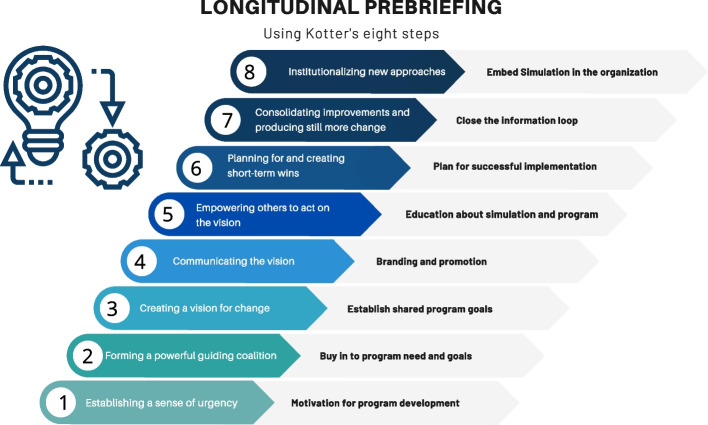
In situ simulation (ISS) programs deliver patient safety benefits to healthcare systems, however, face many challenges in both implementation and sustainability. Prebriefing is conducted immediately prior to a simulation activity to enhance engagement with the learning activity, but is not sufficient to embed and sustain an ISS program. Longer-term and broader change leadership is required to engage colleagues, secure time and resources, and sustain an in situ simulation program. No framework currently exists to describe this process for ISS programs. This manuscript presents a framework derived from the analysis of three successful ISS program implementations across different hospital systems. We describe eight change leadership steps adapted from Kotter's change management theory, used to sustainably implement the ISS programs analyzed. These steps include the following: (1) identifying goals of key stakeholders, (2) engaging a multi-professional team, (3) creating a shared vision, (4) communicating the vision effectively, (5) energizing participants and enabling program participation, (6) identifying and celebrating early success, (7) closing the loop on early program successes, and (8) embedding simulation in organizational culture and operations. We describe this process as a "longitudinal prebrief," a framework which provides a step-by-step guide to engage colleagues and sustain successful implementation of ISS.
情景模拟(ISS)项目为医疗系统带来了患者安全效益,然而,在实施和可持续性方面面临诸多挑战。预演在模拟活动即将开始前立即进行,以增强对学习活动的参与度,但不足以嵌入并维持一个ISS项目。需要更长期、更广泛的变革领导力来促使同事参与、确保时间和资源,并维持情景模拟项目。目前尚无框架来描述ISS项目的这一过程。本文介绍了一个通过对不同医院系统中三个成功的ISS项目实施情况进行分析而得出的框架。我们描述了从科特变革管理理论改编而来的八个变革领导步骤,用于可持续地实施所分析的ISS项目。这些步骤包括:(1)确定关键利益相关者的目标;(2)吸引多专业团队参与;(3)创建共同愿景;(4)有效传达愿景;(5)激励参与者并促进项目参与;(6)识别并庆祝早期成功;(7)巩固早期项目成功;(8)将模拟融入组织文化和运营。我们将这一过程描述为“纵向预演”,这是一个为促使同事参与并维持ISS的成功实施提供逐步指导的框架。