
发作间期脑电图的癫痫发作灶检测:一项综述
Epileptic seizure focus detection from interictal electroencephalogram: a survey.
作者信息
Islam Md Rabiul, Zhao Xuyang, Miao Yao, Sugano Hidenori, Tanaka Toshihisa
机构信息
Institute of Global Innovation Research, Tokyo University of Agriculture and Technology, Tokyo, Japan.
Center for Precision Medicine, The University of Texas Health, San Antonio, USA.
出版信息
Cogn Neurodyn. 2023 Feb;17(1):1-23. doi: 10.1007/s11571-022-09816-z. Epub 2022 May 18.
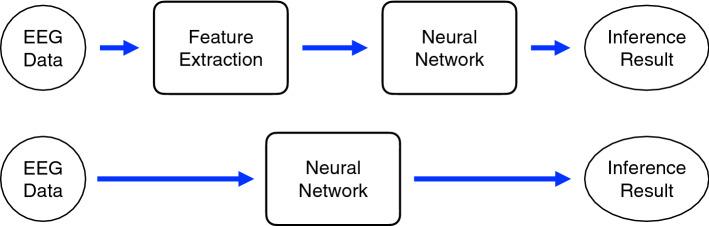
Electroencephalogram (EEG) is one of most effective clinical diagnosis modalities for the localization of epileptic focus. Most current AI solutions use this modality to analyze the EEG signals in an automated manner to identify the epileptic seizure focus. To develop AI system for identifying the epileptic focus, there are many recently-published AI solutions based on biomarkers or statistic features that utilize interictal EEGs. In this review, we survey these solutions and find that they can be divided into three main categories: (i) those that use of biomarkers in EEG signals, including high-frequency oscillation, phase-amplitude coupling, and interictal epileptiform discharges, (ii) others that utilize feature-extraction methods, and (iii) solutions based upon neural networks (an end-to-end approach). We provide a detailed description of seizure focus with clinical diagnosis methods, a summary of the public datasets that seek to reduce the research gap in epilepsy, recent novel performance evaluation criteria used to evaluate the AI systems, and guidelines on when and how to use them. This review also suggests a number of future research challenges that must be overcome in order to design more efficient computer-aided solutions to epilepsy focus detection.
脑电图(EEG)是用于癫痫病灶定位的最有效的临床诊断方法之一。目前大多数人工智能解决方案都使用这种方法以自动化方式分析脑电图信号,以识别癫痫发作病灶。为了开发用于识别癫痫病灶的人工智能系统,最近有许多基于生物标志物或统计特征的人工智能解决方案利用发作间期脑电图发表。在这篇综述中,我们对这些解决方案进行了调查,发现它们可以分为三大类:(i)那些使用脑电图信号中的生物标志物的方法,包括高频振荡、相位-振幅耦合和发作间期癫痫样放电;(ii)其他利用特征提取方法的方法;(iii)基于神经网络的解决方案(端到端方法)。我们详细描述了癫痫病灶及临床诊断方法,总结了旨在缩小癫痫研究差距的公共数据集,用于评估人工智能系统的最新新颖性能评估标准,以及关于何时以及如何使用它们的指南。这篇综述还提出了一些未来的研究挑战,为了设计出更有效的计算机辅助癫痫病灶检测解决方案,必须克服这些挑战。



 Zotero 插件