de Pater B S, Klinkhamer M P, Amesz P A, de Kam R J, Memelink J, Hoge J H, Schilperoort R A
Molbas Research Group, Department of Plant Molecular Biology, Leiden University, The Netherlands.
Nucleic Acids Res. 1987 Oct 26;15(20):8267-81. doi: 10.1093/nar/15.20.8267.
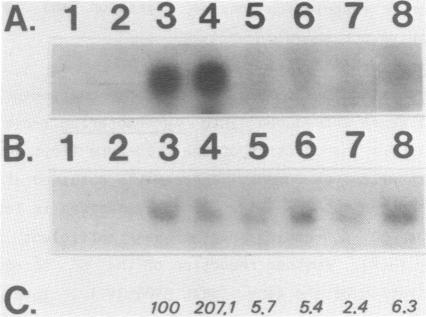
Within the 5' and 3' non-coding regions of the T-cyt gene from the octopine T-DNA of Agrobacterium tumefaciens sequences required for expression of this gene in plant cells were identified by deletion mutagenesis. The results show that 184 bp of the 5' non-coding region and 270 bp of the 3' non-coding region are sufficient for wild-type expression. Within the 5' non-coding region two essential expression signals were identified: (1.) an activator element located between -185 and -129 with respect to the ATG start codon and (2.) one out of two TATA boxes. Deletions of the activator element or the two TATA boxes resulted in nonfunctional genes. Deletion of the upstream TATA box and both putative CAAT boxes did not significantly affect expression. Within the 3' non-coding region, the polyadenylation box most distal to the stop codon was not essential for expression, but sequences more upstream, including a second polyadenylation box were found to be required for wild-type expression.
通过缺失诱变,在根癌土壤杆菌章鱼碱型T-DNA的T-cyt基因的5'和3'非编码区内,鉴定出了该基因在植物细胞中表达所需的序列。结果表明,5'非编码区的184bp和3'非编码区的270bp足以实现野生型表达。在5'非编码区内,鉴定出了两个必需的表达信号:(1)相对于ATG起始密码子,位于-185至-129之间的一个激活元件;(2)两个TATA框中的一个。激活元件或两个TATA框的缺失导致基因无功能。上游TATA框和两个假定的CAAT框的缺失对表达没有显著影响。在3'非编码区内,终止密码子最远端的多聚腺苷酸化框对表达不是必需的,但发现更上游的序列,包括第二个多聚腺苷酸化框,是野生型表达所必需的。