Oishi Shigehiro, Cha Youngjae, Komiya Asuka, Ono Hiroshi
Department of Psychology, University of Chicago, Chicago, IL 60637, USA.
Department of Psychology, University of Virginia, Charlottesville, VA 22904-4132, USA.
PNAS Nexus. 2022 Oct 8;1(5):pgac224. doi: 10.1093/pnasnexus/pgac224. eCollection 2022 Nov.
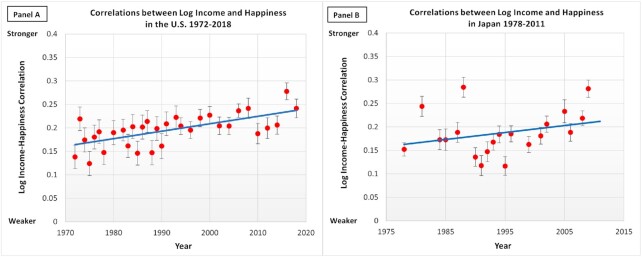
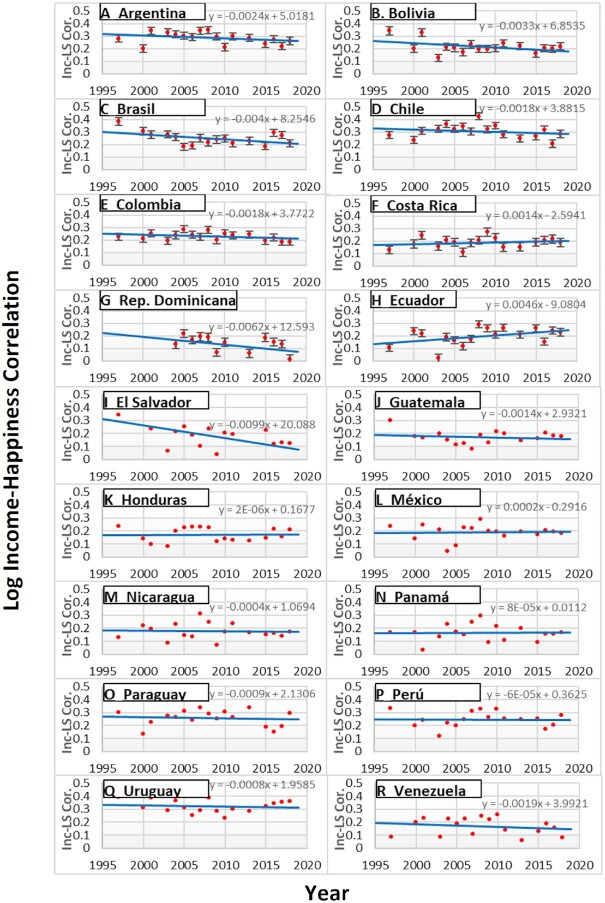
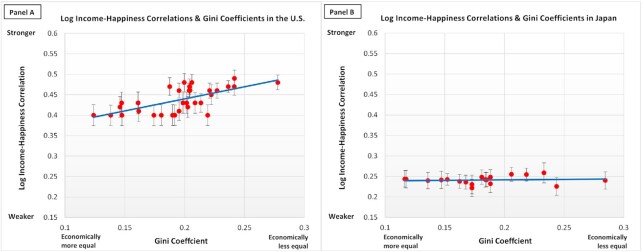
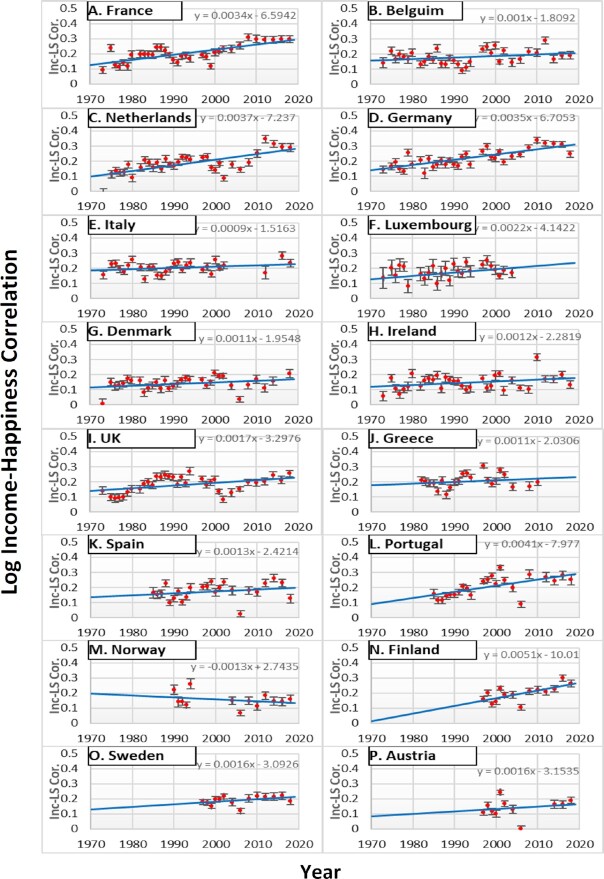
Has the income-happiness correlation changed over time? If so, what predicts such changes? We tested these questions in diverse economic, political, and cultural contexts. Drawing on nationally representative data, we found that the income-happiness correlation has increased in the USA since 1972, as GDP per capita and income inequality increased (Study 1). Study 2 examined an income-life satisfaction correlation in nationally representative surveys between 1978 and 2011 in Japan. Unlike in the USA, there was no clear increase in the income-life satisfaction correlation over time. We next examined the income-life satisfaction correlations in 16 European countries and found that on average the income-life satisfaction correlation has increased since 1970, and it was particularly high in years of high GDP per capita and high-income inequality (Study 3). Finally, we found that among Latin American countries, the income-life satisfaction correlation has, on average, decreased since 1997, as income inequality has decreased (Study 4). Over the last 5 decades, the income-happiness correlation has increased, not decreased, in the USA and several European countries. The income-happiness correlation tends to get higher when both GDP per capita and income inequality are high, whereas it tends to get lower when GDP per capita and/or income inequality are low. These findings suggest the importance of accounting for income inequality as well as national wealth in understanding the role of money in happiness.
收入与幸福的关联随时间发生变化了吗?如果是,是什么因素导致了这些变化?我们在不同的经济、政治和文化背景下对这些问题进行了研究。利用具有全国代表性的数据,我们发现自1972年以来,随着人均国内生产总值(GDP)和收入不平等程度的增加,美国的收入与幸福的关联度有所上升(研究1)。研究2考察了1978年至2011年日本全国代表性调查中的收入与生活满意度的关联。与美国不同,随着时间的推移,收入与生活满意度的关联并没有明显增加。接下来,我们研究了16个欧洲国家的收入与生活满意度的关联,发现自1970年以来,平均而言,收入与生活满意度的关联度有所上升,在人均GDP高和收入不平等程度高的年份尤其明显(研究3)。最后,我们发现,自1997年以来,在拉丁美洲国家中,随着收入不平等程度的下降,收入与生活满意度的关联度平均有所下降(研究4)。在过去的50年里,美国和几个欧洲国家的收入与幸福的关联度上升了,而非下降。当人均GDP和收入不平等程度都很高时,收入与幸福的关联度往往更高;而当人均GDP和/或收入不平等程度较低时,收入与幸福的关联度往往更低。这些发现表明,在理解金钱在幸福中的作用时,考虑收入不平等以及国家财富具有重要意义。