Attia Zachi I, Lerman Gilad, Friedman Paul A
Department of Cardiovascular Medicine, Mayo Clinic, 200 First St SW, Rochester, MN 55905, USA.
Bioinformatics and Computational Biology Program, University of Minnesota, Minneapolis, MN 55455, USA.
Eur Heart J Digit Health. 2021 Jul 17;2(3):446-455. doi: 10.1093/ehjdh/ztab060. eCollection 2021 Sep.
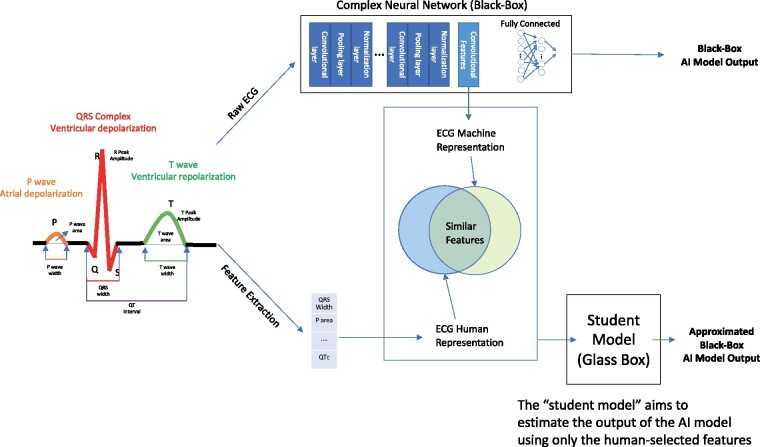
We sought to investigate whether artificial intelligence (AI) and specifically deep neural networks (NNs) for electrocardiogram (ECG) signal analysis can be explained using human-selected features. We also sought to quantify such explainability and test if the AI model learns features that are similar to a human expert.
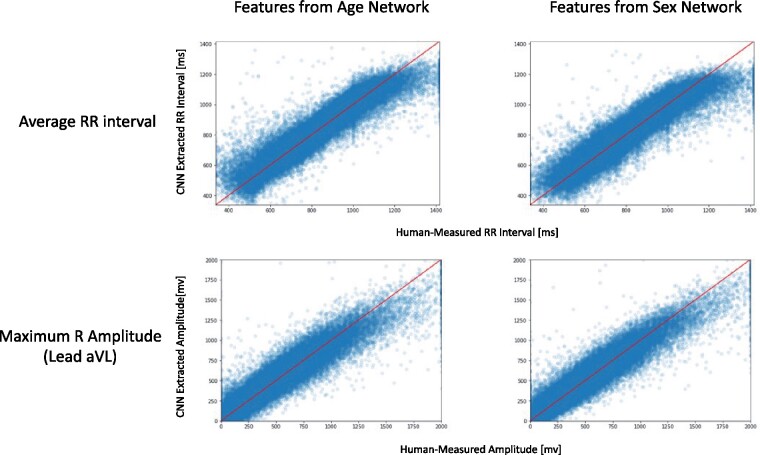
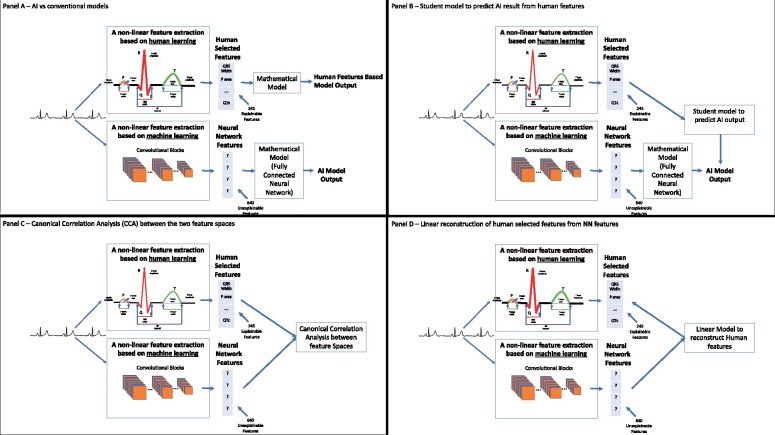
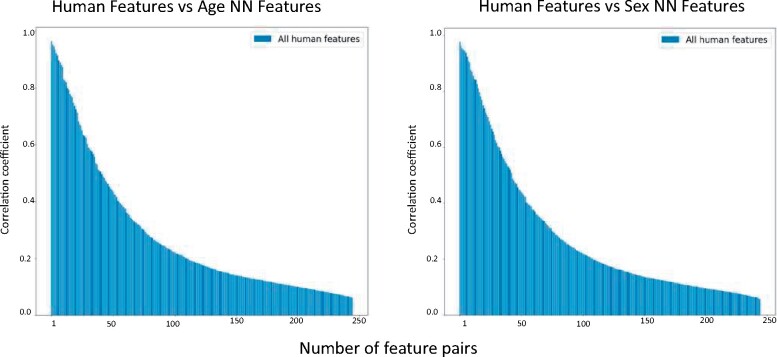
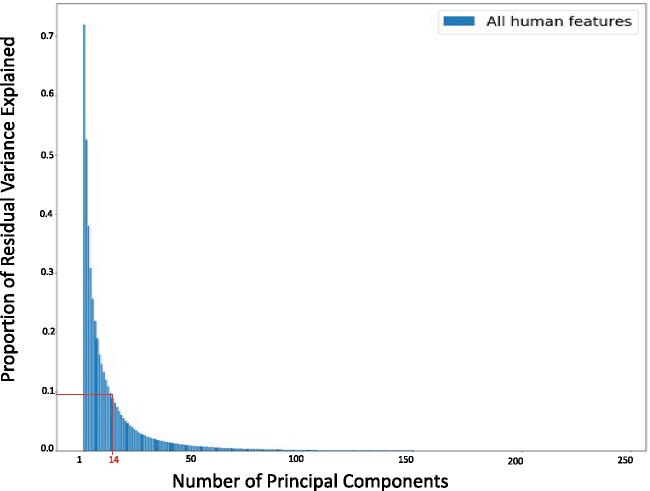
We used a set of 100 000 ECGs that were annotated by human explainable features. We applied both linear and non-linear models to predict published ECG AI models output for the detection of patients' age and sex. We further used canonical correlation analysis to quantify the amount of shared information between the NN features and human-selected features. We reconstructed single human-selected ECG features from the unexplained NN features using a simple linear model. We noticed a strong correlation between the simple models and the AI output ( of 0.49-0.57 for the linear models and of 0.69-0.70 for the non-linear models). We found that the correlation of the human explainable features with either 13 of the strongest age AI features or 15 of the strongest sex AI features was above 0.85 (for comparison, the first 14 principal components explain 90% of the human feature variance). We linearly reconstructed single human-selected ECG features from the AI features with up to 0.86.
This work shows that NNs for ECG signals extract features in a similar manner to human experts and that they also generate additional novel features that help achieve superior performance.
我们试图研究用于心电图(ECG)信号分析的人工智能(AI),特别是深度神经网络(NN),是否可以通过人工选择的特征来解释。我们还试图量化这种可解释性,并测试AI模型是否学习到与人类专家相似的特征。
我们使用了一组由人工可解释特征标注的100000份心电图。我们应用线性和非线性模型来预测已发表的心电图AI模型用于检测患者年龄和性别的输出。我们进一步使用典型相关分析来量化NN特征与人工选择特征之间共享信息的数量。我们使用简单的线性模型从无法解释的NN特征中重建单个人工选择的心电图特征。我们注意到简单模型与AI输出之间存在很强的相关性(线性模型的R值为0.49 - 0.57,非线性模型的R值为0.69 - 0.70)。我们发现人工可解释特征与13个最强的年龄AI特征或15个最强的性别AI特征中的任何一个的相关性都高于0.85(作为比较,前14个主成分解释了人类特征方差的90%)。我们从AI特征中线性重建单个人工选择的心电图特征,R值高达0.86。
这项工作表明,用于心电图信号的NN以与人类专家相似的方式提取特征,并且它们还生成有助于实现卓越性能的额外新颖特征。