CAS Key Laboratory of Molecular Nanostructure and Nanotechnology, CAS Research/Education Center for Excellence in Molecular Sciences, Beijing National Laboratory for Molecular Sciences (BNLMS), Institute of Chemistry, Chinese Academy of Sciences (CAS), Beijing 100190, P. R. China.
Key Laboratory of Synthetic and Natural Functional Molecule of the Ministry of Education, College of Chemistry & Materials Science, Northwest University, Xi'an, Shaanxi 710127, P. R. China.
Sci Adv. 2023 Feb 3;9(5):eade5802. doi: 10.1126/sciadv.ade5802. Epub 2023 Feb 1.
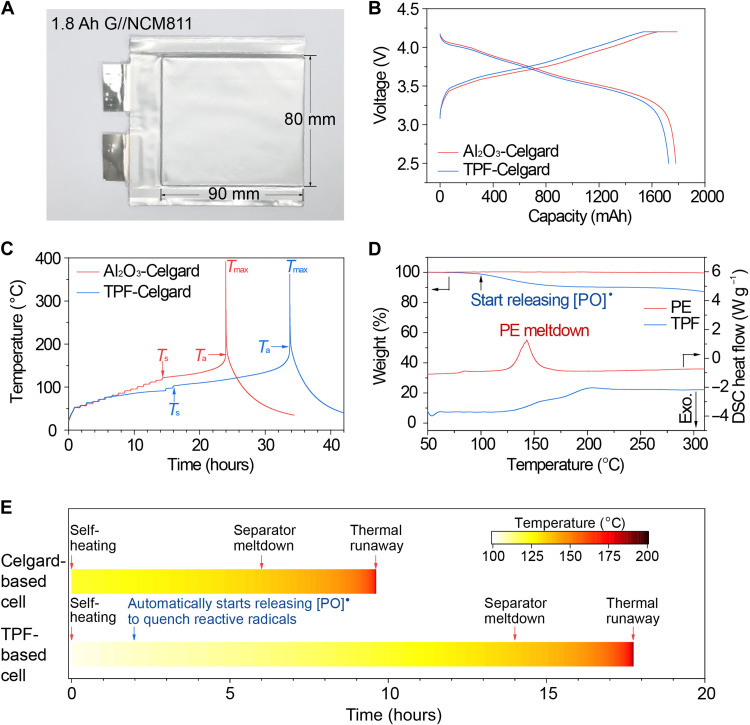
Safety concerns related to the abuse operation and thermal runaway are impeding the large-scale employment of high-energy-density rechargeable lithium batteries. Here, we report that by incorporating phosphorus-contained functional groups into a hydrocarbon-based polymer, a smart risk-responding polymer is prepared for effective mitigation of battery thermal runaway. At room temperature, the polymer is (electro)chemically compatible with electrodes, ensuring the stable battery operation. Upon thermal accumulation, the phosphorus-containing radicals spontaneously dissociate from the polymer skeleton and scavenge hydrogen and hydroxyl radicals to terminate the exothermic chain reaction, suppressing thermal generation at an early stage. With the smart risk-responding strategy, we demonstrate extending the time before thermal runaway for a 1.8-Ah Li-ion pouch cell by 100% (~9 hours) compared with common cells, creating a critical time window for safety management. The temperature-triggered automatic safety-responding strategy will improve high-energy-density battery tolerance against thermal abuse risk and pave the way to safer rechargeable batteries.
与滥用操作和热失控相关的安全问题阻碍了高能量密度可充电锂电池的大规模应用。在这里,我们报告说,通过在碳氢化合物基聚合物中引入含磷官能团,可以制备一种智能风险响应聚合物,以有效缓解电池热失控。在室温下,该聚合物与电极(电)化学兼容,确保电池稳定运行。在热积累时,含磷自由基会从聚合物骨架上自发解离,并清除氢和羟基自由基,从而终止放热链式反应,在早期抑制热的产生。通过这种智能风险响应策略,与普通电池相比,我们证明了 1.8-Ah 锂离子软包电池在热失控前的时间延长了 100%(~9 小时),为安全管理创造了一个关键的时间窗口。温度触发的自动安全响应策略将提高高能量密度电池对热滥用风险的容忍度,并为更安全的可充电电池铺平道路。