Zhang Yan, Ding Yuwei, Zhu Ning, Mi Mi, Lu Yier, Zheng Jia, Weng Shanshan, Yuan Ying
Department of Medical Oncology (Key Laboratory of Cancer Prevention and Intervention, China National Ministry of Education, Key Laboratory of Molecular Biology in Medical Sciences, Zhejiang Province, China), The Second Affiliated Hospital, Zhejiang University School of Medicine, Hangzhou, Zhejiang, China.
Zhejiang Provincial Clinical Research Center for CANCER, Hangzhou, Zhejiang, China.
Front Oncol. 2023 Jan 19;13:1032749. doi: 10.3389/fonc.2023.1032749. eCollection 2023.
The exponential growth of the cancer burden attributable to metabolic factors deserves global attention. We investigated the trends of cancer mortality attributable to metabolic factors in 204 countries and regions between 1990 and 2019.
We extracted data from the Global Burden of Disease Study (GBD) 2019 and assessed the mortality, age-standardized death rate (ASDR), and population attributable fractions (PAFs) of cancers attributable to metabolic factors. Average annual percentage changes (AAPCs) were calculated to assess the changes in the ASDR. The cancer mortality burden was evaluated according to geographic location, SDI quintiles, age, sex, and changes over time.
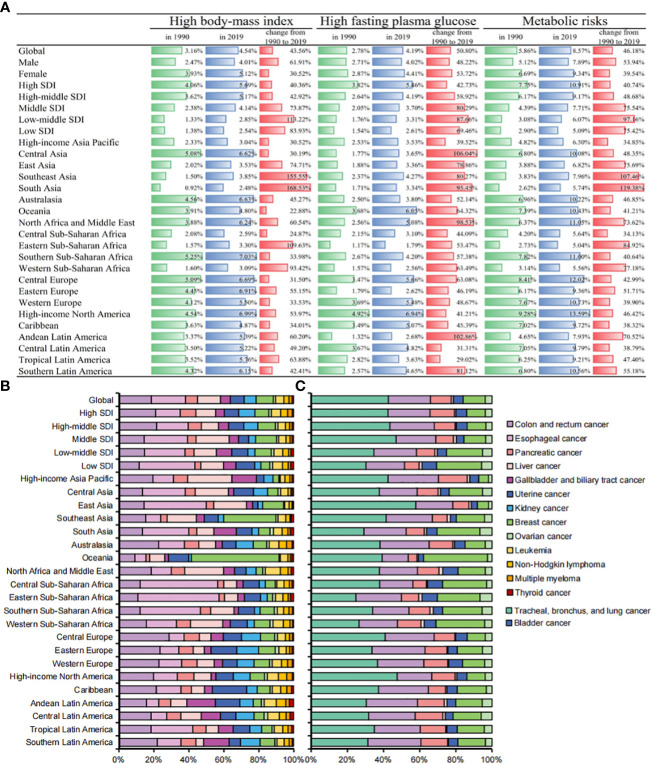
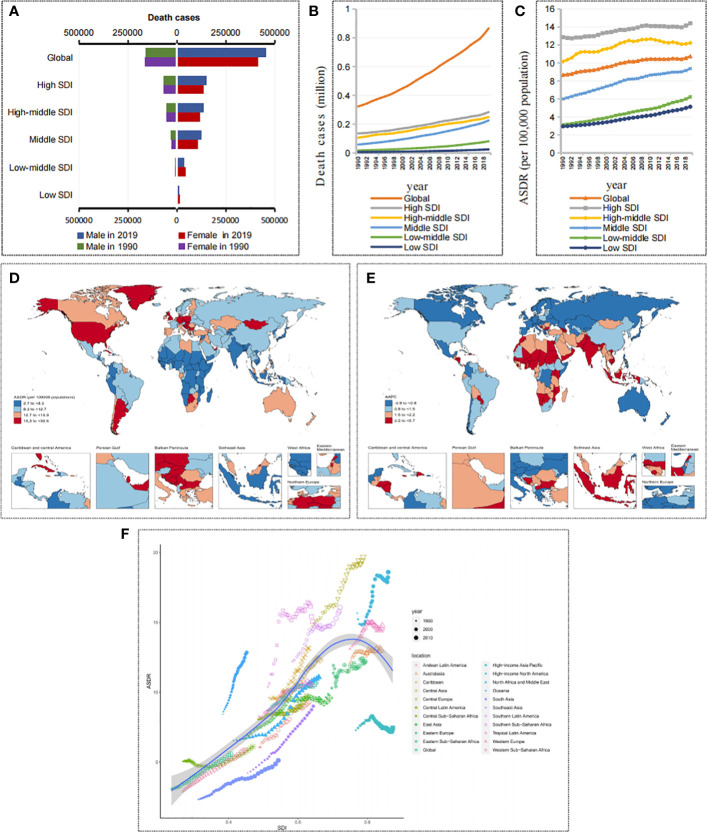
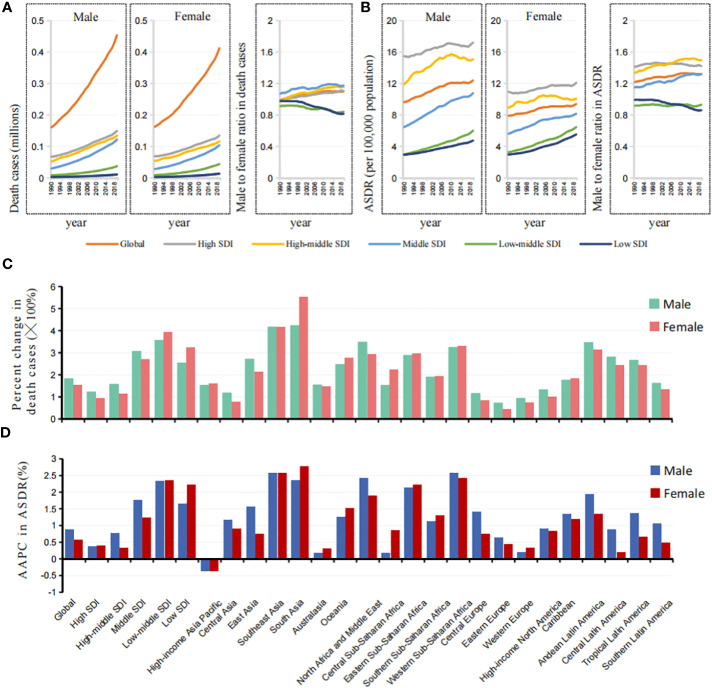
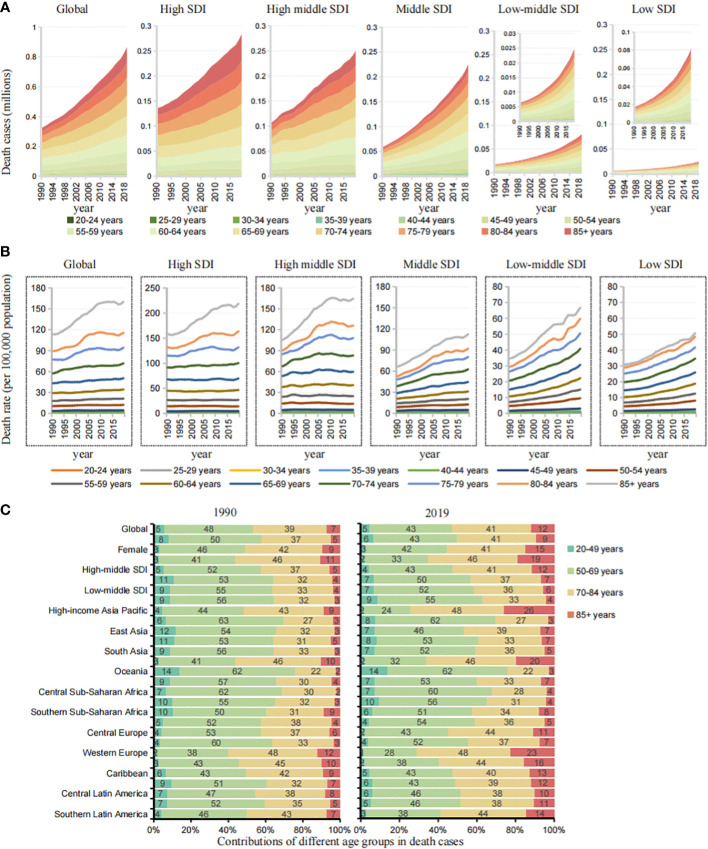
Cancer attributable to metabolic factors contributed 865,440 (95% UI, 447,970-140,590) deaths in 2019, a 167.45% increase over 1990. In the past 30 years, the increase in the number of deaths and ASDR in lower SDI regions have been significantly higher than in higher SDI regions (from high to low SDIs: the changes in death numbers were 108.72%, 135.7%, 288.26%, 375.34%, and 288.26%, and the AAPCs were 0.42%, 0.58%, 1.51%, 2.36%, and 1.96%). Equatorial Guinea (AAPC= 5.71%), Cabo Verde (AAPC=4.54%), and Lesotho (AAPC=4.42%) had the largest increase in ASDR. Large differences were observed in the ASDRs by sex across different SDIs, and the male-to-female ratios of ASDR were 1.42, 1.50, 1.32, 0.93, and 0.86 in 2019. The core population of death in higher SDI regions is the age group of 70 years and above, and the lower SDI regions are concentrated in the age group of 50-69 years. The proportion of premature deaths in lower SDI regions is significantly higher than that in higher SDI regions (from high to low SDIs: 2%, 4%, 7%, 7%, and 9%). Gastrointestinal cancers were the core burden, accounting for 50.11% of cancer deaths attributable to metabolic factors, among which the top three cancers were tracheal, bronchus, and lung cancer, followed by colon and rectum cancer and breast cancer.
The cancer mortality burden attributable to metabolic factors is shifting from higher SDI regions to lower SDI regions. Sex differences show regional heterogeneity, with men having a significantly higher burden than women in higher SDI regions but the opposite is observed in lower SDI regions. Lower SDI regions have a heavier premature death burden. Gastrointestinal cancers are the core of the burden of cancer attributable to metabolic factors.
代谢因素导致的癌症负担呈指数增长,值得全球关注。我们调查了1990年至2019年间204个国家和地区代谢因素所致癌症死亡率的趋势。
我们从《2019年全球疾病负担研究》(GBD)中提取数据,评估代谢因素所致癌症的死亡率、年龄标准化死亡率(ASDR)和人群归因分数(PAF)。计算平均年度百分比变化(AAPC)以评估ASDR的变化。根据地理位置、社会人口指数(SDI)五分位数、年龄、性别和随时间的变化评估癌症死亡负担。
2019年,代谢因素所致癌症导致865440例(95%不确定区间,447970 - 140590)死亡,比1990年增加了167.45%。在过去30年中,低SDI地区死亡人数和ASDR的增加显著高于高SDI地区(从高到低SDI:死亡人数变化分别为108.72%、135.7%、288.26%、375.34%和288.26%,AAPC分别为0.42%、0.58%、1.51%、2.36%和1.96%)。赤道几内亚(AAPC = 5.71%)、佛得角(AAPC = 4.54%)和莱索托(AAPC = 4.42%)的ASDR增幅最大。不同SDI水平下,男女的ASDR存在较大差异,2019年ASDR的男女比例分别为1.42、1.50、1.32、0.93和0.86。高SDI地区的核心死亡人群是70岁及以上年龄组,低SDI地区则集中在50 - 69岁年龄组。低SDI地区的过早死亡比例显著高于高SDI地区(从高到低SDI:2%、4%、7%、7%和9%)。胃肠道癌症是核心负担,占代谢因素所致癌症死亡的50.11%,其中前三大癌症是气管、支气管和肺癌,其次是结肠癌和直肠癌以及乳腺癌。
代谢因素所致癌症死亡负担正从高SDI地区向低SDI地区转移。性别差异呈现区域异质性,高SDI地区男性负担显著高于女性,而低SDI地区则相反。低SDI地区的过早死亡负担更重。胃肠道癌症是代谢因素所致癌症负担的核心。