Forsberg Elin M V, Riise Rebecca, Saellström Sara, Karlsson Joakim, Alsén Samuel, Bucher Valentina, Hemminki Akseli E, Olofsson Bagge Roger, Ny Lars, Nilsson Lisa M, Rönnberg Henrik, Nilsson Jonas A
Sahlgrenska Translational Melanoma Group, Sahlgrenska Center for Cancer Research, Departments of Surgery and Oncology, Institute of Clinical Sciences, University of Gothenburg, Sahlgrenska University Hospital, 40530 Gothenburg, Sweden.
Department of Clinical Sciences, Swedish University of Agricultural Sciences, 75007 Uppsala, Sweden.
Cancers (Basel). 2023 Jan 20;15(3):648. doi: 10.3390/cancers15030648.
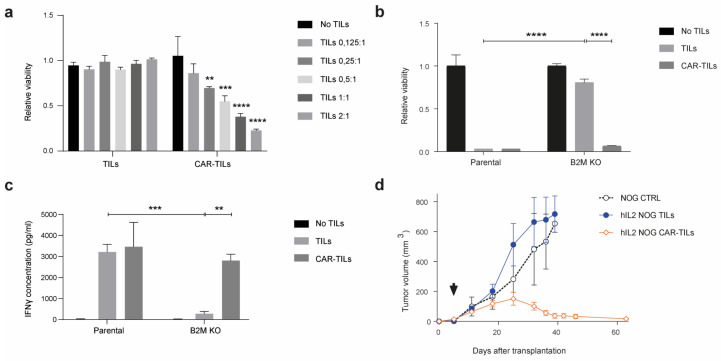
Patients with metastatic melanoma have a historically poor prognosis, but recent advances in treatment options, including targeted therapy and immunotherapy, have drastically improved the outcomes for some of these patients. However, not all patients respond to available treatments, and around 50% of patients with metastatic cutaneous melanoma and almost all patients with metastases of uveal melanoma die of their disease. Thus, there is a need for novel treatment strategies for patients with melanoma that do not benefit from the available therapies. Chimeric antigen receptor-expressing T (CAR-T) cells are largely unexplored in melanoma. Traditionally, CAR-T cells have been produced by transducing blood-derived T cells with a virus expressing CAR. However, tumor-infiltrating lymphocytes (TILs) can also be engineered to express CAR, and such CAR-TILs could be dual-targeting. To this end, tumor samples and autologous TILs from metastasized human uveal and cutaneous melanoma were expanded in vitro and transduced with a lentiviral vector encoding an anti-HER2 CAR construct. When infused into patient-derived xenograft (PDX) mouse models carrying autologous tumors, CAR-TILs were able to eradicate melanoma, even in the absence of antigen presentation by HLA. To advance this concept to the clinic and assess its safety in an immune-competent and human-patient-like setting, we treated four companion dogs with autologous anti-HER2 CAR-TILs. We found that these cells were tolerable and showed signs of anti-tumor activity. Taken together, CAR-TIL therapy is a promising avenue for broadening the tumor-targeting capacity of TILs in patients with checkpoint immunotherapy-resistant melanoma.
转移性黑色素瘤患者历来预后较差,但近年来治疗方案取得了进展,包括靶向治疗和免疫治疗,显著改善了部分此类患者的治疗效果。然而,并非所有患者都对现有治疗有反应,约50%的转移性皮肤黑色素瘤患者以及几乎所有葡萄膜黑色素瘤转移患者最终死于该疾病。因此,对于无法从现有疗法中获益的黑色素瘤患者,需要新的治疗策略。嵌合抗原受体表达T(CAR-T)细胞在黑色素瘤治疗中尚未得到充分探索。传统上,CAR-T细胞是通过用表达CAR的病毒转导血液来源的T细胞来产生的。然而,肿瘤浸润淋巴细胞(TILs)也可以被改造以表达CAR,并且这种CAR-TILs可以进行双靶点靶向。为此,我们从转移性人类葡萄膜和皮肤黑色素瘤中获取肿瘤样本和自体TILs,在体外进行扩增,并用编码抗HER2 CAR构建体的慢病毒载体进行转导。当将其注入携带自体肿瘤的患者来源异种移植(PDX)小鼠模型中时,CAR-TILs能够根除黑色素瘤,即使在没有HLA抗原呈递的情况下也是如此。为了将这一概念推进到临床并在具有免疫活性且类似人类患者的环境中评估其安全性,我们用自体抗HER2 CAR-TILs治疗了四只伴犬。我们发现这些细胞是可耐受的,并显示出抗肿瘤活性的迹象。综上所述,CAR-TIL疗法是拓宽检查点免疫治疗耐药黑色素瘤患者TILs肿瘤靶向能力的一个有前景的途径。